Amos 7 Bible Study
AMOS TIMELINE:
A commonly agreed date for the writing of the Book of Amos is between 760-750 B.C. The first verse of the book informs readers that Amos‘ book opens during the reigns of Uzziah in Judah and Jeroboam II in Israel, two years before the earthquake. The earthquake must have been a significant one because it was also mentioned by the prophet Zechariah in his writing (Zec 14:5) around 250 years later.
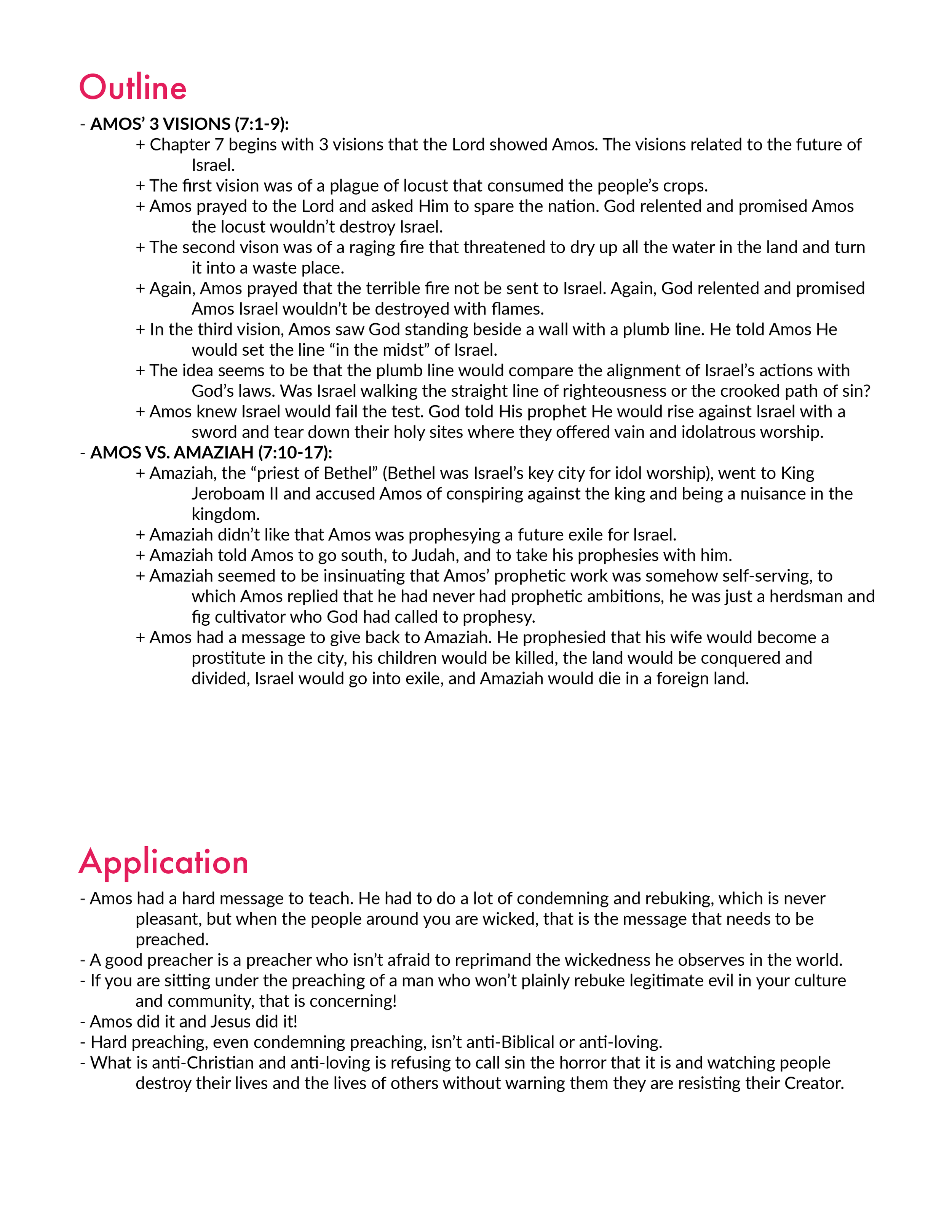
WHAT IS A PLUMB LINE?
A plumb line is a string, held by hand on one end and suspended with a weight attached to the other. Gravity pulls the weight down, straightening the string, and giving the user a perfect vertical reference line.

REVIEW OF PREVIOUS CHAPTERS:
Amos 1 – Amos is introduced and God condemned several of Israel’s neighboring nations, including Syria, Philistia, Edom, Tyre, and the Ammonites.
Amos 2 – God condemned Moab and the southern kingdom of Judah before turning His anger against Israel. They were guilty of trampling the poor, worshiping idols, and ignoring God’s law.
Amos 3 – Amos asked Israel a series of obvious questions and told them Israel’s destruction would be equally obvious as being the work of God. Israel was portrayed as a sheep devoured by a lion.
Amos 4 – God rebuked the women of Israel who crushed the needy to feed their appetite for sin and luxury. He listed His past efforts to discipline Israel, which they had ignored, and because they had ignored them, they were told to prepare to meet their God.
Amos 5 - Chapter 5 repeats many of the themes from previous chapters but does it in more poetic language. God wanted justice and righteousness to wash over Israel and purge the land of its wickedness.
Amos 6 – Amos rebuked those who were resting in their confidence of Israel’s safety. The evil rich wasted their days without fear of judgement. God told them they would be the first to be punished. Israel had turned justice into poison, righteousness into bitterness, and virtue into evil.
OUTLINE:
AMOS’ 3 VISIONS (7:1-9):
Chapter 7 begins with 3 visions that the Lord showed Amos. The visions related to the future of Israel.
The first vision was of a plague of locust that consumed the people’s crops.
Amos prayed to the Lord and asked Him to spare the nation. God relented and promised Amos the locust wouldn’t destroy Israel.
The second vison was of a raging fire that threatened to dry up all the water in the land and turn it into a waste place.
Again, Amos prayed that the terrible fire not be sent to Israel. Again, God relented and promised Amos Israel wouldn’t be destroyed with flames.
In the third vision, Amos saw God standing beside a wall with a plumb line. He told Amos He would set the line “in the midst” of Israel.
The idea seems to be that the plumb line would compare the alignment of Israel’s actions with God’s laws. Was Israel walking the straight line of righteousness or the crooked path of sin?
Amos knew Israel would fail the test. God told His prophet He would rise against Israel with a sword and tear down their holy sites where they offered vain and idolatrous worship.
AMOS VS. AMAZIAH (7:10-17):
Amaziah, the “priest of Bethel” (Bethel was Israel’s key city for idol worship), went to King Jeroboam II and accused Amos of conspiring against the king and being a nuisance in the kingdom.
Amaziah didn’t like that Amos was prophesying a future exile for Israel.
Amaziah told Amos to go south, to Judah, and to take his prophesies with him.
Amaziah seemed to be insinuating that Amos’ prophetic work was somehow self-serving, to which Amos replied that he had never had prophetic ambitions, he was just a herdsman and fig cultivator who God had called to prophesy.
Amos had a message to give back to Amaziah. He prophesied that his wife would become a prostitute in the city, his children would be killed, the land would be conquered and divided, Israel would go into exile, and Amaziah would die in a foreign land.
APPLICATION:
Amos had a hard message to teach. He had to do a lot of condemning and rebuking, which is never pleasant, but when the people around you are wicked, that is the message that needs to be preached.
A good preacher is a preacher who isn’t afraid to reprimand the wickedness he observes in the world.
If you are sitting under the preaching of a man who won’t plainly rebuke legitimate evil in your culture and community, that is concerning!
Amos did it and Jesus did it!
Hard preaching, even condemning preaching, isn’t anti-Biblical or anti-loving.
What is anti-Christian and anti-loving is refusing to call sin the horror that it is and watching people destroy their lives and the lives of others without warning them they are resisting their Creator.
