Daniel 1 Bible Study
TIMELINE:
The Book of Daniel opens in the 3rd year of the reign of King Jehoiakim, 606 BC. Daniel was a contemporary of Ezekiel in Babylon. Daniel was taken to Babylon about 14 years before Ezekiel was called by God to be a prophet (Ezekiel 1-2).
Daniel 1:21 informs us Daniel was in the palace of Babylon until the first year of King Cyrus (539 BC).
Below is a useful list of kings of Judah and dates for their reign:
Amon (642-640 BC)
Josiah (640-609 BC)
Jehoahaz (also known as Shallum, 609 BC)
Jehoiakim (initially known as Eliakim, 609-598 BC)
Jehoiachin (also known as Jeconiah or Coniah, 598-597 BC)
Zedekiah (His reign ended when Babylon destroyed Jerusalem, (597-586 BC)
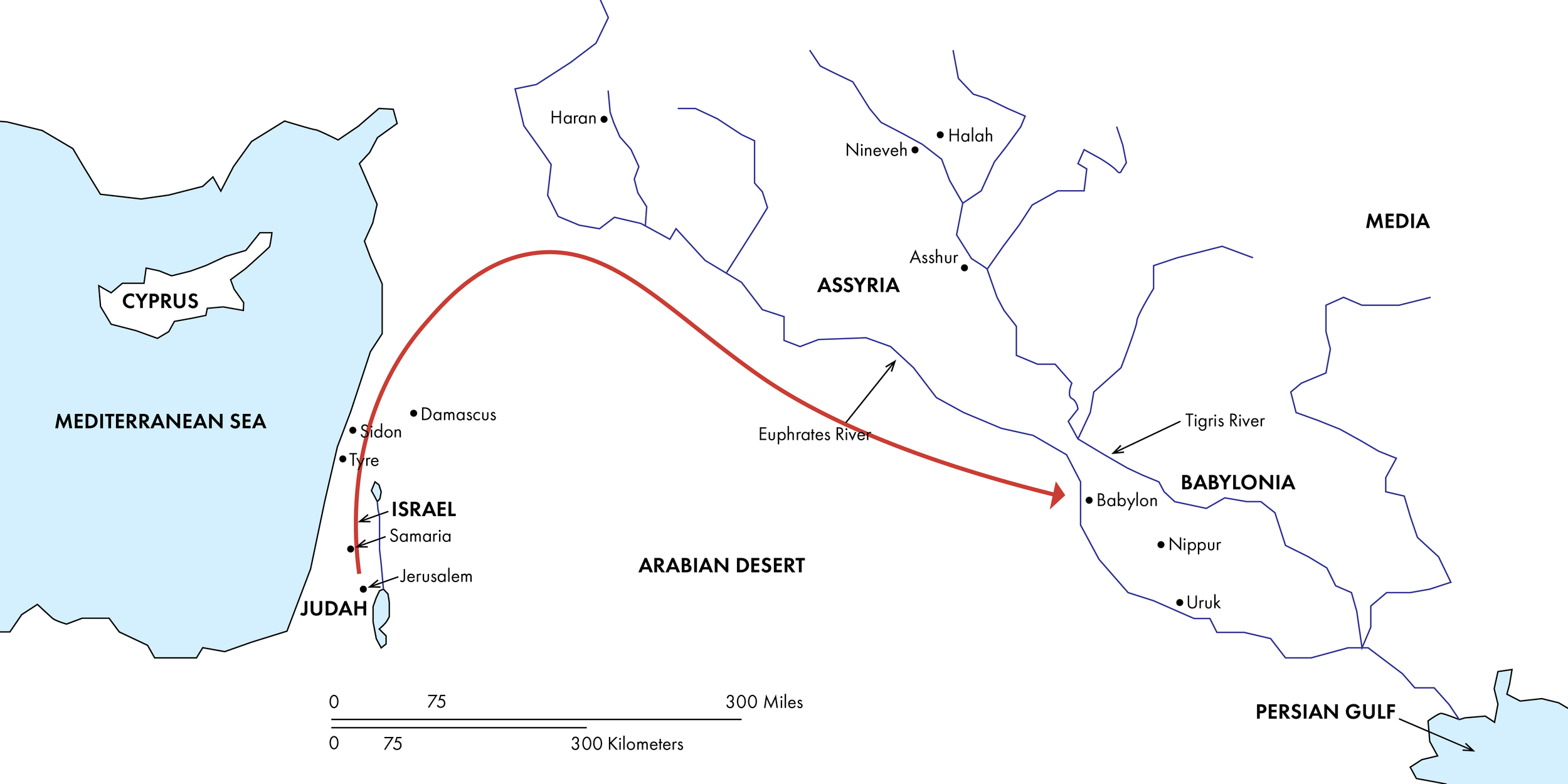
MAP:
OUTLINE:
DANIEL AND HIS FRIENDS TAKEN TO BABYLON (1:1-7):
In the 3rd year of King Jehoiakim of Judah, Nebuchanezzar, the king of Babylon, attacked the city of Jerusalem.
After his victory, Nebuchadnezzar returned to Babylon with many of the treasures that had been in the Temple of God and some of the accomplished youths of Judah.
“Then the king commanded Ashpenaz, his chief eunuch, to bring some of the people of Israel, both of the royal family and of the nobility, youths without blemish, of good appearance and skillful in all wisdom, endowed with knowledge, understanding learning, and competent to stand in the king's palace, and to teach them the literature and language of the Chaldeans” (1:3-4).
The young people were to be educated by the king’s servants for 3 years and then placed into the king’s service.
They were assigned a portion of food and wine from the king’s court.
Four of those young men are highlighted in the text, Daniel, Hananiah, Mishael, and Azariah.
They were each given Babylonians names, Belteshazzar, Shadrach, Meshach, and Abednego.
DANIEL’S REQUEST (1:8-16):
Although there were many in Judah who didn’t respect God’s commands, Daniel wasn’t one of them. He was determined to follow God even in a foreign land.
When offered the Babylonian food, he knew he couldn’t eat it if he wanted to keep the dietary laws God gave to Israel, so he resolved to ask the chief eunuch for an exemption.
God “gave Daniel favor and compassion in the sight of the chief of the eunuchs,” and when he asked to be given only vegetables and water, the chief eunuch agreed to let Daniel and his friends try it for 10 days.
At the end of 10 days, Daniel and his friends appeared healthier and more fit than all the other youths, so the eunuch agreed to exempt them permanently from the Babylonian food.
GOD BLESSES DANIEL AND HIS FRIENDS (1:17-21):
God blessed Daniel and his 3 friends.
At the end of their education, they were found more accomplished and capable than all the other young men.
God gave Daniel the ability to interpret dreams and visions (important in the upcoming chapters).
The 4 young men were given high positions and the “stood before the king” (1:19).
APPLICATION:
If anyone had a case to be bitter, it was Daniel.
He was one of the few people in Judah that kept God’s instructions and yet he was one of the first to get shipped off to Babylon.
He could have cried out to God and pointed to all the sinful rebels in Judah and told God how unfair it was that he was receiving this fate even though there were thousands in Judah who deserved it more than him.
But Daniel didn’t lash out at God. He seemed to know that his fate was more than a simple matter of God carelessly lumping him in with the “sinners group” and giving them all the same outcome. It took a lot of maturity to recognize that and not become bitter!
What we’ll find out is that God’s relocation of Daniel was for a great purpose. His move to Babylon would affect world history and bring the knowledge of God to some of the most powerful men on earth, which would impact their decisions and the direction of Judah and the ancient world.
When you feel like the fate you’re receiving belongs to someone else, when life doesn’t seem fair, consider that God may have a divine relocation or redirection written into the story of your life
God’s providential work with us on earth is a lot more complicated than simple cause and effect (do good = get the outcome you want, do bad = don’t get the outcome you want). It takes maturity to see that, and it takes significant maturing to live through circumstances that you don’t enjoy and that are contrary to the life you envisioned and to submit humbly to the story God wants to write with your life.
Daniel wasn’t simple in His understanding of God, and we shouldn’t be either. One of the reasons to study the Old Testament is because it presents us with hundreds of stories of how God worked in vastly different scenarios.
It keeps us from oversimplifying God and from having our faith fall apart when God’s decisions aren’t surface level predictable.
