Ezekiel 16 - Bible Study, Explanation, and Application
Ezekiel 16 Bible Study
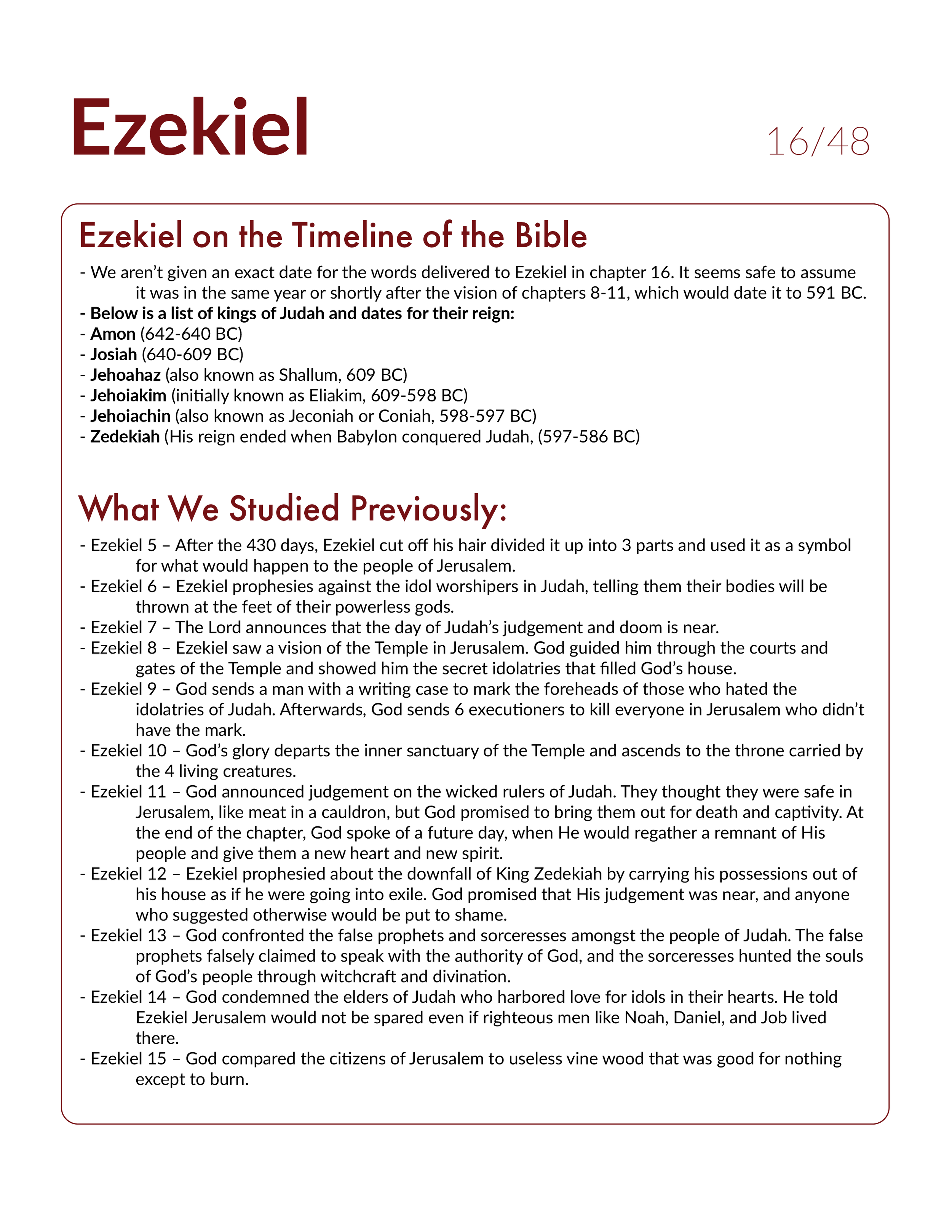
TIMELINE:
We aren’t given an exact date for the revelation given to Ezekiel in chapter 16. It seems safe to assume it was in the same year or shortly after the vision of chapters 8-11, which would date it to 591 BC.
Below is a list of kings of Judah and dates for their reign:
Amon (642-640 BC)
Josiah (640-609 BC)
Jehoahaz (also known as Shallum, 609 BC)
Jehoiakim (initially known as Eliakim, 609-598 BC)
Jehoiachin (also known as Jeconiah or Coniah, 598-597 BC)
Zedekiah (His reign ended when Babylon conquered Judah, (597-586 BC)
WHAT WE STUDIED PREVIOUSLY
Ezekiel 1 – Ezekiel had a vision of 4 living creatures, 4 wheels, and God’s throne.
Ezekiel 2 – God commissioned Ezekiel to be a prophet to his rebellious countrymen.
Ezekiel 3 – The end of the heavenly vision. Ezekiel ate a scroll of God’s words, and God called him to be a watchman over the people of Judah.
Ezekiel 4 – Ezekiel prophesies with an object lesson in the street by laying on his side for 430 days, eating rations of bread, and creating a siege scene with a brick that represents Jerusalem.
Ezekiel 5 – After the 430 days, Ezekiel cut off his hair divided it up into 3 parts and used it as a symbol for what would happen to the people of Jerusalem.
Ezekiel 6 – Ezekiel prophesies against the idol worshipers in Judah, telling them their bodies will be thrown at the feet of their powerless gods.
Ezekiel 7 – God spoke to Ezekiel about the day of His judgement. The end was near for the citizens of Jerusalem, and their doom was on the horizon.
Ezekiel 8 – Ezekiel saw a vision of the Temple in Jerusalem. God guided him through the courts and gates of the Temple and showed him the secret idolatries that filled God’s house.
Ezekiel 9 – God sends a man with a writing case to mark the foreheads of those who hated the idolatries of Judah. Afterwards, God sends 6 executioners to kill everyone in Jerusalem who didn’t have the mark.
Ezekiel 10 – God’s glory departed the inner sanctuary of the Temple and ascended to His throne carried by the 4 living creatures.
Ezekiel 11 – God announced judgement on the wicked rulers of Judah. They thought they were safe in Jerusalem, like meat in a cauldron, but God promised to bring them out for death and captivity. At the end of the chapter, God spoke of a future day, when He would regather a remnant of His people and give them a new heart and new spirit.
Ezekiel 12 – Ezekiel prophesied about the downfall of King Zedekiah by carrying his possessions out of his house as if he were going into exile. God promised that His judgement was near, and anyone who suggested otherwise would be put to shame.
Ezekiel 13 – God confronted the false prophets and sorceresses amongst the people of Judah. The false prophets falsely claimed to speak with the authority of God, and the sorceresses hunted the souls of God’s people through witchcraft and divination.
Ezekiel 14 – God condemned the elders of Judah who harbored love for idols in their hearts. He told Ezekiel Jerusalem would not be spared even if righteous men like Noah, Daniel, and Job lived there.
Ezekiel 15 – God compared the citizens of Jerusalem to useless vine wood that was good for nothing except to burn.
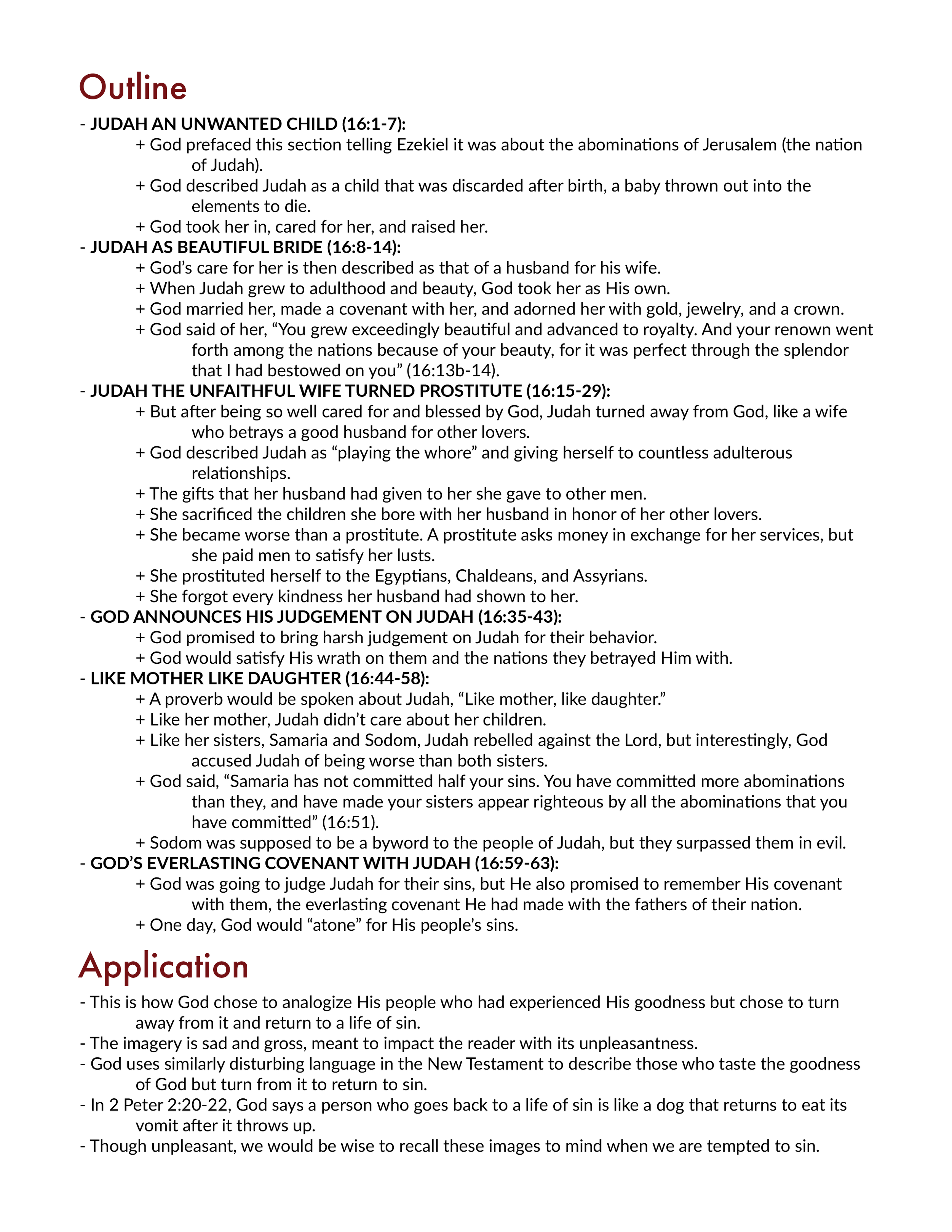
OUTLINE:
JUDAH AN UNWANTED CHILD (16:1-7):
God prefaced this section telling Ezekiel it was about the abominations of Jerusalem (the nation of Judah).
God described Judah as a child that was discarded after birth, a baby thrown out into the elements to die.
God took her in, cared for her, and raised her.
JUDAH A BEAUTIFUL BRIDE (16:8-14):
God’s care for her is then described as that of a husband for his wife.
When Judah grew to adulthood and beauty, God took her as His own.
God married her, made a covenant with her, and adorned her with gold, jewelry, and a crown.
God said of her, “You grew exceedingly beautiful and advanced to royalty. And your renown went forth among the nations because of your beauty, for it was perfect through the splendor that I had bestowed on you” (16:13b-14).
JUDAH THE UNFAITHFUL WIFE TURNED PROSTITUTE (16:15-29):
But after being so well cared for and blessed by God, Judah turned away from God, like a wife who betrays a good husband for other lovers.
God described Judah as “playing the whore” and giving herself to countless adulterous relationships.
The gifts that her husband had given to her she gave to other men.
She sacrificed the children she bore with her husband in honor of her other lovers.
She became worse than a prostitute. A prostitute asks money in exchange for her services, but she paid men to satisfy her lusts.
She prostituted herself to the Egyptians, Chaldeans, and Assyrians.
She forgot every kindness her husband had shown to her.
GOD ANNOUNCES HIS JUDGEMENT ON JUDAH (16:35-43):
God promised to bring harsh judgement on Judah for their behavior.
God would satisfy His wrath on them and the nations they betrayed Him with.
LIKE MOTHER LIKE DAUGHTER (16:44-58):
A proverb would be spoken about Judah, “Like mother, like daughter.”
Like her mother, Judah didn’t care about her children.
Like her sisters, Samaria and Sodom, Judah rebelled against the Lord, but interestingly, God accused Judah of being worse than both sisters.
God said, “Samaria has not committed half your sins. You have committed more abominations than they, and have made your sisters appear righteous by all the abominations that you have committed” (16:51).
Sodom was supposed to be a byword to the people of Judah, but they surpassed them in evil.
GOD’S EVERLASTING COVENANT WITH JUDAH (16:59-63):
God was going to judge Judah for their sins, but He also promised to remember His covenant with them, the everlasting covenant He had made with the fathers of their nation.
One day, God would “atone” for His people’s sins.
APPLICATION:
This is how God chose to analogize His people who had experienced His goodness but chose to turn away from it and return to a life of sin.
The imagery is sad and gross, meant to impact the reader with its unpleasantness.
God uses similarly disturbing language in the New Testament to describe those who taste the goodness of God but turn from it to return to sin.
In 2 Peter 2:20-22, God says a person who goes back to a life of sin is like a dog that returns to eat its vomit after it throws up.
Though unpleasant, we would be wise to recall these images to mind when we are tempted to sin.
