Ezekiel 18 - Bible Study, Explanation, and Application
Ezekiel 18 Bible Study
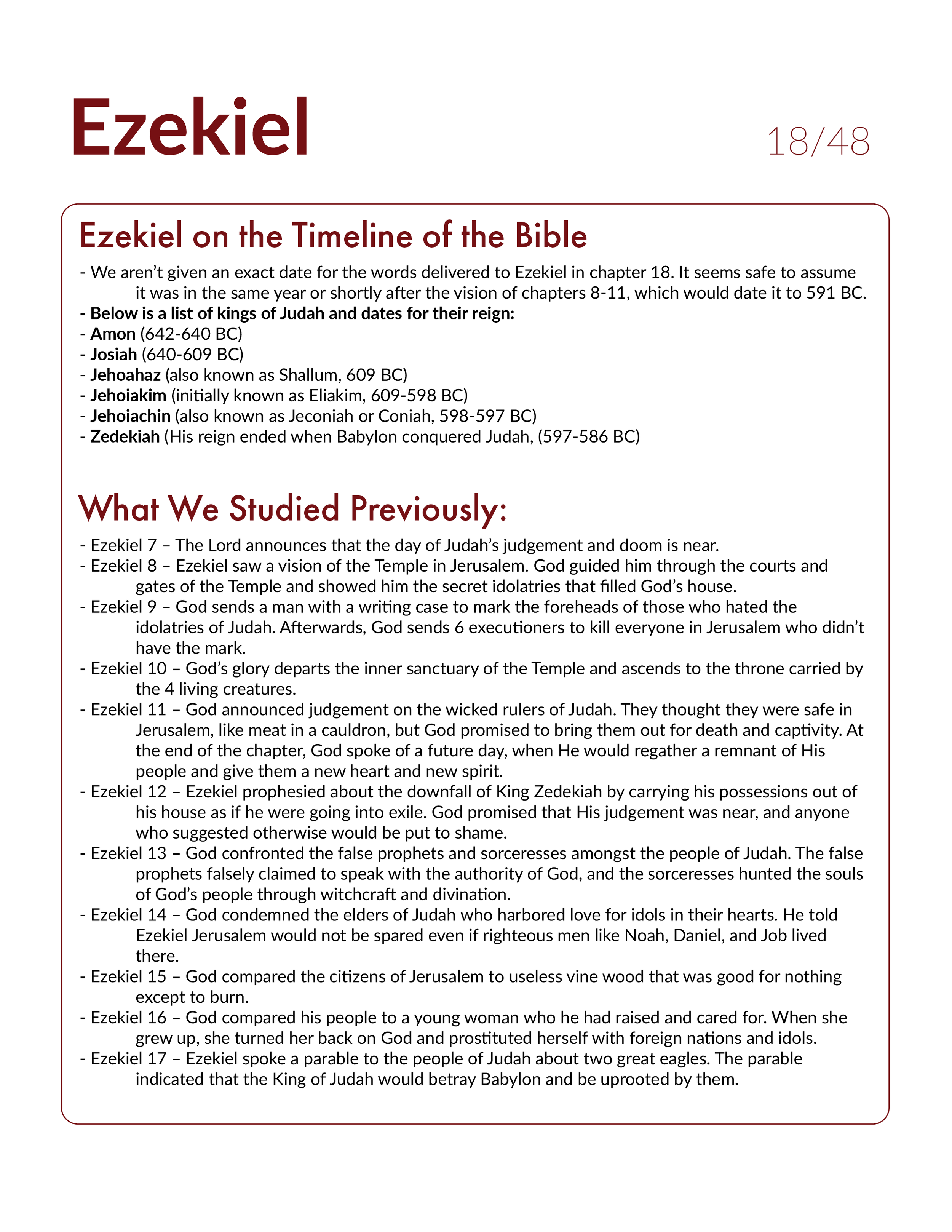
TIMELINE:
We aren’t given an exact date for the revelation given to Ezekiel in chapter 18. It seems safe to assume it was in the same year or shortly after the vision of chapters 8-11, which would date it to 591 BC.
Below is a list of kings of Judah and dates for their reign:
Amon (642-640 BC)
Josiah (640-609 BC)
Jehoahaz (also known as Shallum, 609 BC)
Jehoiakim (initially known as Eliakim, 609-598 BC)
Jehoiachin (also known as Jeconiah or Coniah, 598-597 BC)
Zedekiah (His reign ended when Babylon conquered Judah, (597-586 BC)
WHAT WE STUDIED PREVIOUSLY
Ezekiel 1 – Ezekiel had a vision of 4 living creatures, 4 wheels, and God’s throne.
Ezekiel 2 – God commissioned Ezekiel to be a prophet to his rebellious countrymen.
Ezekiel 3 – The end of the heavenly vision. Ezekiel ate a scroll of God’s words, and God called him to be a watchman over the people of Judah.
Ezekiel 4 – Ezekiel prophesies with an object lesson in the street by laying on his side for 430 days, eating rations of bread, and creating a siege scene with a brick that represents Jerusalem.
Ezekiel 5 – After the 430 days, Ezekiel cut off his hair divided it up into 3 parts and used it as a symbol for what would happen to the people of Jerusalem.
Ezekiel 6 – Ezekiel prophesies against the idol worshipers in Judah, telling them their bodies will be thrown at the feet of their powerless gods.
Ezekiel 7 – God spoke to Ezekiel about the day of His judgement. The end was near for the citizens of Jerusalem, and their doom was on the horizon.
Ezekiel 8 – Ezekiel saw a vision of the Temple in Jerusalem. God guided him through the courts and gates of the Temple and showed him the secret idolatries that filled God’s house.
Ezekiel 9 – God sends a man with a writing case to mark the foreheads of those who hated the idolatries of Judah. Afterwards, God sends 6 executioners to kill everyone in Jerusalem who didn’t have the mark.
Ezekiel 10 – God’s glory departed the inner sanctuary of the Temple and ascended to His throne carried by the 4 living creatures.
Ezekiel 11 – God announced judgement on the wicked rulers of Judah. They thought they were safe in Jerusalem, like meat in a cauldron, but God promised to bring them out for death and captivity. At the end of the chapter, God spoke of a future day, when He would regather a remnant of His people and give them a new heart and new spirit.
Ezekiel 12 – Ezekiel prophesied about the downfall of King Zedekiah by carrying his possessions out of his house as if he were going into exile. God promised that His judgement was near, and anyone who suggested otherwise would be put to shame.
Ezekiel 13 – God confronted the false prophets and sorceresses amongst the people of Judah. The false prophets falsely claimed to speak with the authority of God, and the sorceresses hunted the souls of God’s people through witchcraft and divination.
Ezekiel 14 – God condemned the elders of Judah who harbored love for idols in their hearts. He told Ezekiel Jerusalem would not be spared even if righteous men like Noah, Daniel, and Job lived there.
Ezekiel 15 – God compared the citizens of Jerusalem to useless vine wood that was good for nothing except to burn.
Ezekiel 16 – God compared his people to a young woman who he had raised and cared for. When she grew up, she turned her back on God and prostituted herself with foreign nations and idols.
Ezekiel 17 – Ezekiel spoke a parable to the people of Judah about two great eagles. The parable indicated that the King of Judah would betray Babylon and be uprooted by them.
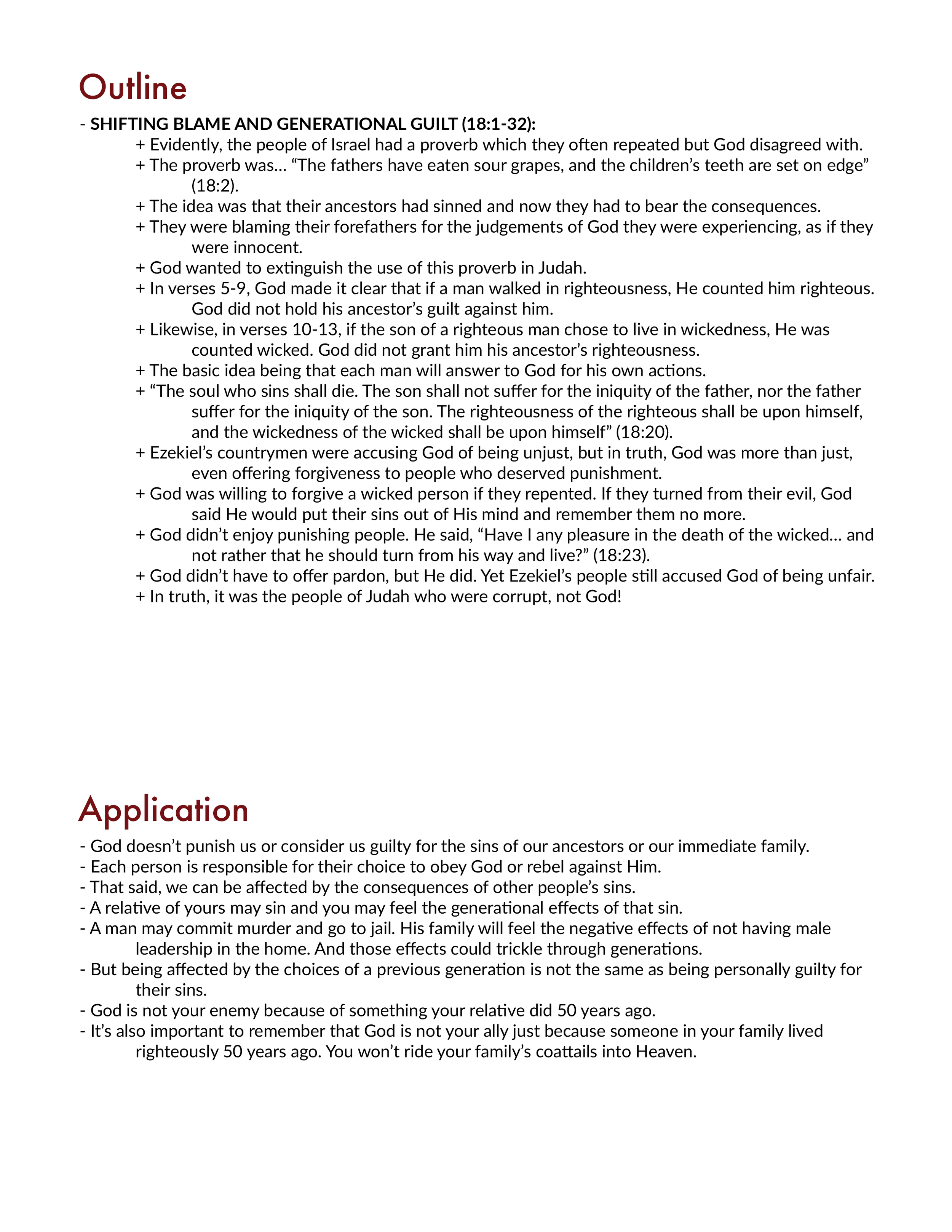
OUTLINE:
SHIFTING BLAME AND GENERATIONAL GUILT (18:1-32):
Evidently, the people of Israel had a proverb which they often repeated but God disagreed with.
The proverb was… “The fathers have eaten sour grapes, and the children’s teeth are set on edge” (18:2).
The idea was that their ancestors had sinned and now they had to bear the consequences.
They were blaming their forefathers for the judgements of God they were experiencing, as if they were innocent.
God wanted to extinguish the use of this proverb in Judah.
In verses 5-9, God made it clear that if a man walked in righteousness, He counted him righteous. God did not hold his ancestor’s guilt against him.
Likewise, in verses 10-13, if the son of a righteous man chose to live in wickedness, He was counted wicked. God did not grant him his ancestor’s righteousness.
The basic idea being that each man will answer to God for his own actions.
“The soul who sins shall die. The son shall not suffer for the iniquity of the father, nor the father suffer for the iniquity of the son. The righteousness of the righteous shall be upon himself, and the wickedness of the wicked shall be upon himself” (18:20).
Ezekiel’s countrymen were accusing God of being unjust, but in truth, God was more than just, even offering forgiveness to people who deserved punishment.
God was willing to forgive a wicked person if they repented. If they turned from their evil, God said He would put their sins out of His mind and remember them no more.
God didn’t enjoy punishing people. He said, “Have I any pleasure in the death of the wicked… and not rather that he should turn from his way and live?” (18:23).
God didn’t have to offer pardon, but He did. Yet Ezekiel’s people still accused God of being unfair.
In truth, it was the people of Judah who were corrupt, not God!
APPLICATION:
God doesn’t punish us or consider us guilty for the sins of our ancestors or our immediate family.
Each person is responsible for their choice to obey God or rebel against Him.
That said, we can be affected by the consequences of other people’s sins.
A relative of yours may sin and you may feel the generational effects of that sin.
A man may commit murder and go to jail. His family will feel the negative effects of not having male leadership in the home. And those effects could trickle through generations.
But being affected by the choices of a previous generation is not the same as being personally guilty for their sins.
God is not your enemy because of something your relative did 50 years ago.
It’s also important to remember that God is not your ally just because someone in your family lived righteously 50 years ago. You won’t ride your family’s coattails into Heaven.
