Ezekiel 34 - Bible Study, Explanation, and Application
Ezekiel 34 Bible Study
TIMELINE:
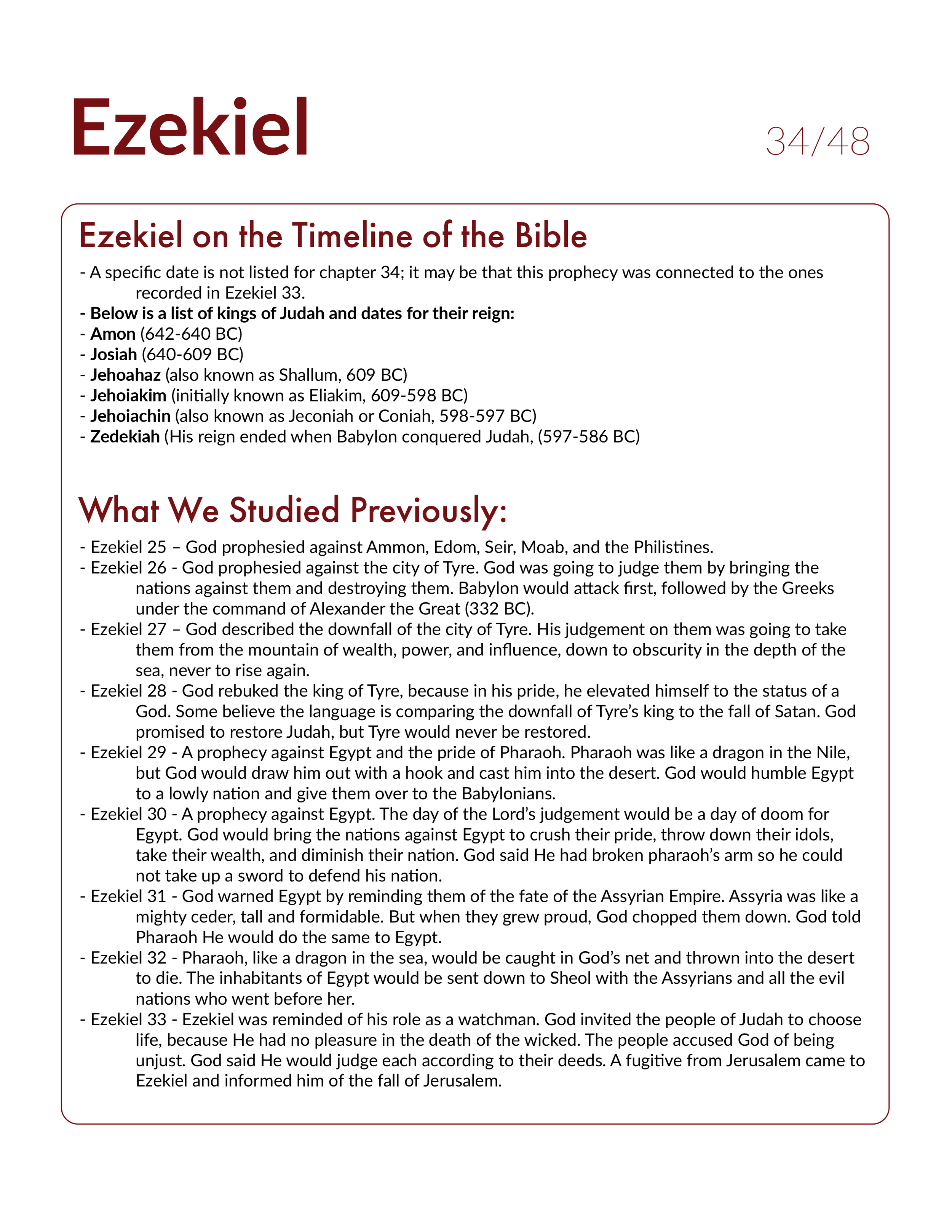
A specific date is not listed for chapter 34; it may be that this prophecy was connected to the ones recorded in Ezekiel 33.
Below is a list of kings of Judah and dates for their reign:
Amon (642-640 BC)
Josiah (640-609 BC)
Jehoahaz (also known as Shallum, 609 BC)
Jehoiakim (initially known as Eliakim, 609-598 BC)
Jehoiachin (also known as Jeconiah or Coniah, 598-597 BC)
Zedekiah (His reign ended when Babylon conquered Judah, (597-586 BC)
WHAT WE STUDIED PREVIOUSLY
Ezekiel 1 – Ezekiel had a vision of 4 living creatures, 4 wheels, and God’s throne.
Ezekiel 2 – God commissioned Ezekiel to be a prophet to his rebellious countrymen.
Ezekiel 3 – The end of the heavenly vision. Ezekiel ate a scroll of God’s words, and God called him to be a watchman over the people of Judah.
Ezekiel 4 – Ezekiel prophesies with an object lesson in the street by laying on his side for 430 days, eating rations of bread, and creating a siege scene with a brick that represents Jerusalem.
Ezekiel 5 – After the 430 days, Ezekiel cut off his hair divided it up into 3 parts and used it as a symbol for what would happen to the people of Jerusalem.
Ezekiel 6 – Ezekiel prophesies against the idol worshipers in Judah, telling them their bodies will be thrown at the feet of their powerless gods.
Ezekiel 7 – God spoke to Ezekiel about the day of His judgement. The end was near for the citizens of Jerusalem, and their doom was on the horizon.
Ezekiel 8 – Ezekiel saw a vision of the Temple in Jerusalem. God guided him through the courts and gates of the Temple and showed him the secret idolatries that filled God’s house.
Ezekiel 9 – God sends a man with a writing case to mark the foreheads of those who hated the idolatries of Judah. Afterwards, God sends 6 executioners to kill everyone in Jerusalem who didn’t have the mark.
Ezekiel 10 – God’s glory departed the inner sanctuary of the Temple and ascended to His throne carried by the 4 living creatures.
Ezekiel 11 – God announced judgement on the wicked rulers of Judah. They thought they were safe in Jerusalem, like meat in a cauldron, but God promised to bring them out for death and captivity. At the end of the chapter, God spoke of a future day, when He would regather a remnant of His people and give them a new heart and new spirit.
Ezekiel 12 – Ezekiel prophesied about the downfall of King Zedekiah by carrying his possessions out of his house as if he were going into exile. God promised that His judgement was near, and anyone who suggested otherwise would be put to shame.
Ezekiel 13 – God confronted the false prophets and sorceresses amongst the people of Judah. The false prophets falsely claimed to speak with the authority of God, and the sorceresses hunted the souls of God’s people through witchcraft and divination.
Ezekiel 14 – God condemned the elders of Judah who harbored love for idols in their hearts. He told Ezekiel Jerusalem would not be spared even if righteous men like Noah, Daniel, and Job lived there.
Ezekiel 15 – God compared the citizens of Jerusalem to useless vine wood that was good for nothing except to burn.
Ezekiel 16 – God compared his people to a young woman who he had raised and cared for. When she grew up, she turned her back on God and prostituted herself with foreign nations and idols.
Ezekiel 17 – Ezekiel spoke a parable to the people of Judah about two great eagles. The parable indicated that the King of Judah would betray Babylon and be uprooted by them.
Ezekiel 18 – The people of Judah were accusing God of punishing them for the sins of their ancestors. God clarified that each man was responsible and would be held accountable only for his own sins.
Ezekiel 19 – God lamented the unfaithfulness of His people through two laments, the lament of the lion cubs and the lament of the vine.
Ezekiel 20 - The elders of Israel wanted to consult with God, but God refused them based on their continual and cyclical rebellion against His laws. God spoke of His future judgement on Judah and His future grace that would restore the nation.
Ezekiel 21 – Ezekiel spoke of the sword of the Lord that God had sharpened to punish Judah. The king of Babylon stood at a fork in the road, and God was going to direct him and his army to Jerusalem.
Ezekiel 22 – God condemned Judah for a litany of sins and their total neglect of any attempt to keep His commands. He told them He would melt them down like metal within the furnace of Jerusalem.
Ezekiel 23 – God illustrated the unfaithfulness of Israel and Judah with a story about two sisters, Oholah and Oholibah.
Ezekiel 24 – God compared Jerusalem to a corroded pot that would be emptied and melted down. In the second half of the chapter, Ezekiel’s wife died, and God instructed him not to mourn for her publicly as a sign of the fate of the citizens of Jerusalem and their beloved city.
Ezekiel 25 – God prophesied against Ammon, Edom, Seir, Moab, and the Philistines.
Ezekiel 26 - God prophesied against the city of Tyre. God was going to judge them by bringing the nations against them and destroying them. Babylon would attack first, followed by the Greeks under the command of Alexander the Great (332 BC).
Ezekiel 27 – God described the downfall of the city of Tyre. His judgement on them was going to take them from the mountain of wealth, power, and influence, down to obscurity in the depth of the sea, never to rise again.
Ezekiel 28 - God rebuked the king of Tyre, because in his pride, he elevated himself to the status of a God. Some believe the language is comparing the downfall of Tyre’s king to the fall of Satan. God promised to restore Judah, but Tyre would never be restored.
Ezekiel 29 - A prophecy against Egypt and the pride of Pharaoh. Pharaoh was like a dragon in the Nile, but God would draw him out with a hook and cast him into the desert. God would humble Egypt to a lowly nation and give them over to the Babylonians.
Ezekiel 30 - A prophecy against Egypt. The day of the Lord’s judgement would be a day of doom for Egypt. God would bring the nations against Egypt to crush their pride, throw down their idols, take their wealth, and diminish their nation. God said He had broken pharaoh’s arm so he could not take up a sword to defend his nation.
Ezekiel 31 - God warned Egypt by reminding them of the fate of the Assyrian Empire. Assyria was like a mighty ceder, tall and formidable. But when they grew proud, God chopped them down. God told Pharaoh He would do the same to Egypt.
Ezekiel 32 - Pharaoh, like a dragon in the sea, would be caught in God’s net and thrown into the desert to die. The inhabitants of Egypt would be sent down to Sheol with the Assyrians and all the evil nations who went before her.
Ezekiel 33 - Ezekiel was reminded of his role as a watchman. God invited the people of Judah to choose life, because He had no pleasure in the death of the wicked. The people accused God of being unjust. God said He would judge each according to their deeds. A fugitive from Jerusalem came to Ezekiel and informed him of the fall of Jerusalem.
OUTLINE:
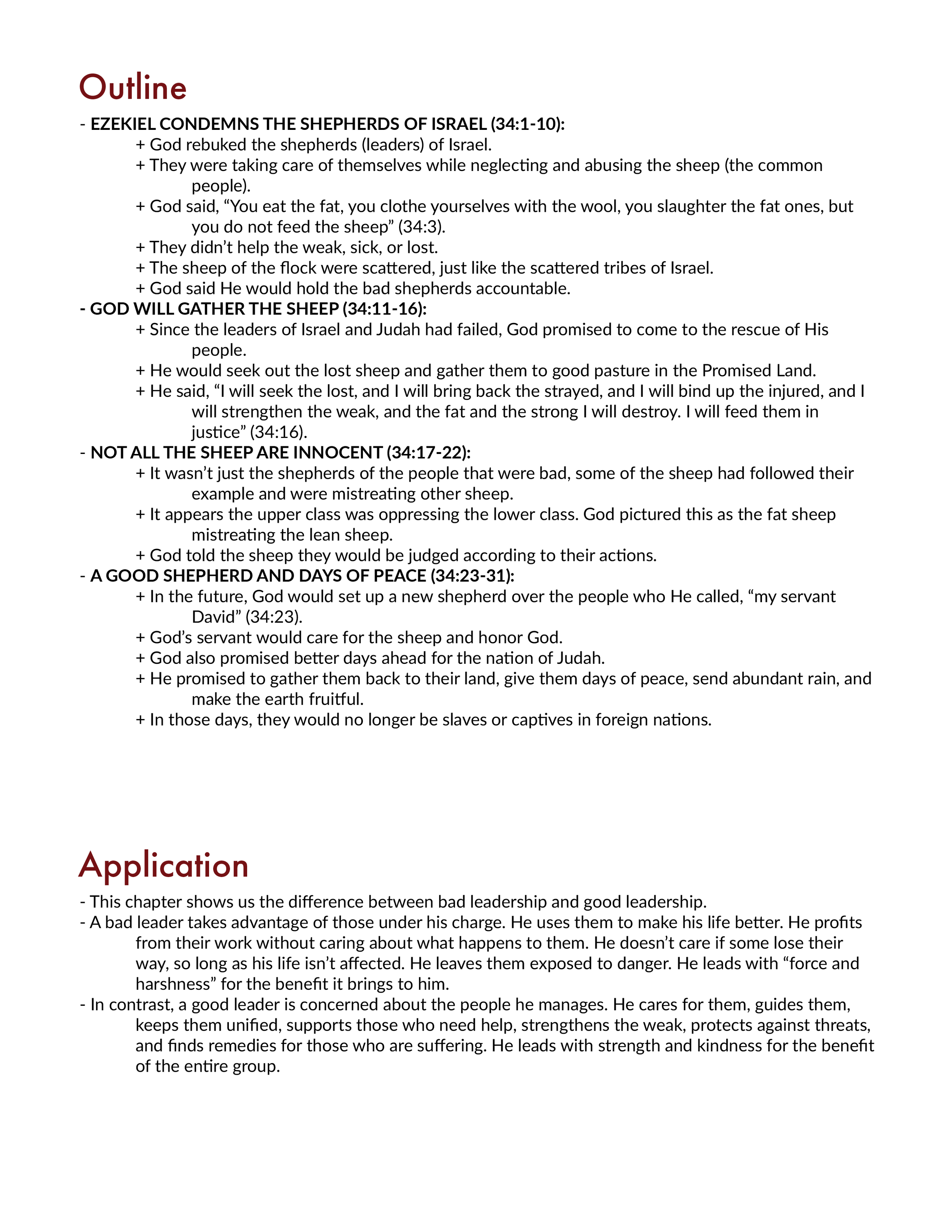
EZEKIEL CONDEMNS THE SHEPHERDS OF ISRAEL (34:1-10):
God rebuked the shepherds (leaders) of Israel.
They were taking care of themselves while neglecting and abusing the sheep (the common people).
God said, “You eat the fat, you clothe yourselves with the wool, you slaughter the fat ones, but you do not feed the sheep” (34:3).
They didn’t help the weak, sick, or lost.
The sheep of the flock were scattered, just like the scattered tribes of Israel.
God said He would hold the bad shepherds accountable.
GOD WILL GATHER THE SHEEP (34:11-16):
Since the leaders of Israel and Judah had failed, God promised to come to the rescue of His people.
He would seek out the lost sheep and gather them to good pasture in the Promised Land.
He said, “I will seek the lost, and I will bring back the strayed, and I will bind up the injured, and I will strengthen the weak, and the fat and the strong I will destroy. I will feed them in justice” (34:16).
NOT ALL THE SHEEP ARE INNOCENT (34:17-22):
It wasn’t just the shepherds of the people that were bad, some of the sheep had followed their example and were mistreating other sheep.
It appears the upper class was oppressing the lower class. God pictured this as the fat sheep mistreating the lean sheep.
God told the sheep they would be judged according to their actions.
A GOOD SHEPHERD AND DAYS OF PEACE (34:23-31):
In the future, God would set up a new shepherd over the people who He called, “my servant David” (34:23).
God’s servant would care for the sheep and honor God.
God also promised better days ahead for the nation of Judah.
He promised to gather them back to their land, give them days of peace, send abundant rain, and make the earth fruitful.
In those days, they would no longer be slaves or captives in foreign nations.
APPLICATION:
This chapter gives us the difference between bad leadership and good leadership. z
A bad leader takes advantage of those under his charge. He uses them to make his life better. He profits from their work without caring about what happens to them. He doesn’t care if some lose their way, so long as his life isn’t affected. He leaves them exposed to danger. He leads with “force and harshness” for the benefit it brings to him.
In contrast, a good leader is concerned about the people he manages. He cares for them, guides them, keeps them unified, supports those who need help, strengthens the weak, protects against threats, and finds remedies for those who are suffering. He leads with strength and kindness for the benefit of the entire group.
