Isaiah 48 - Bible Study in 5 Minutes
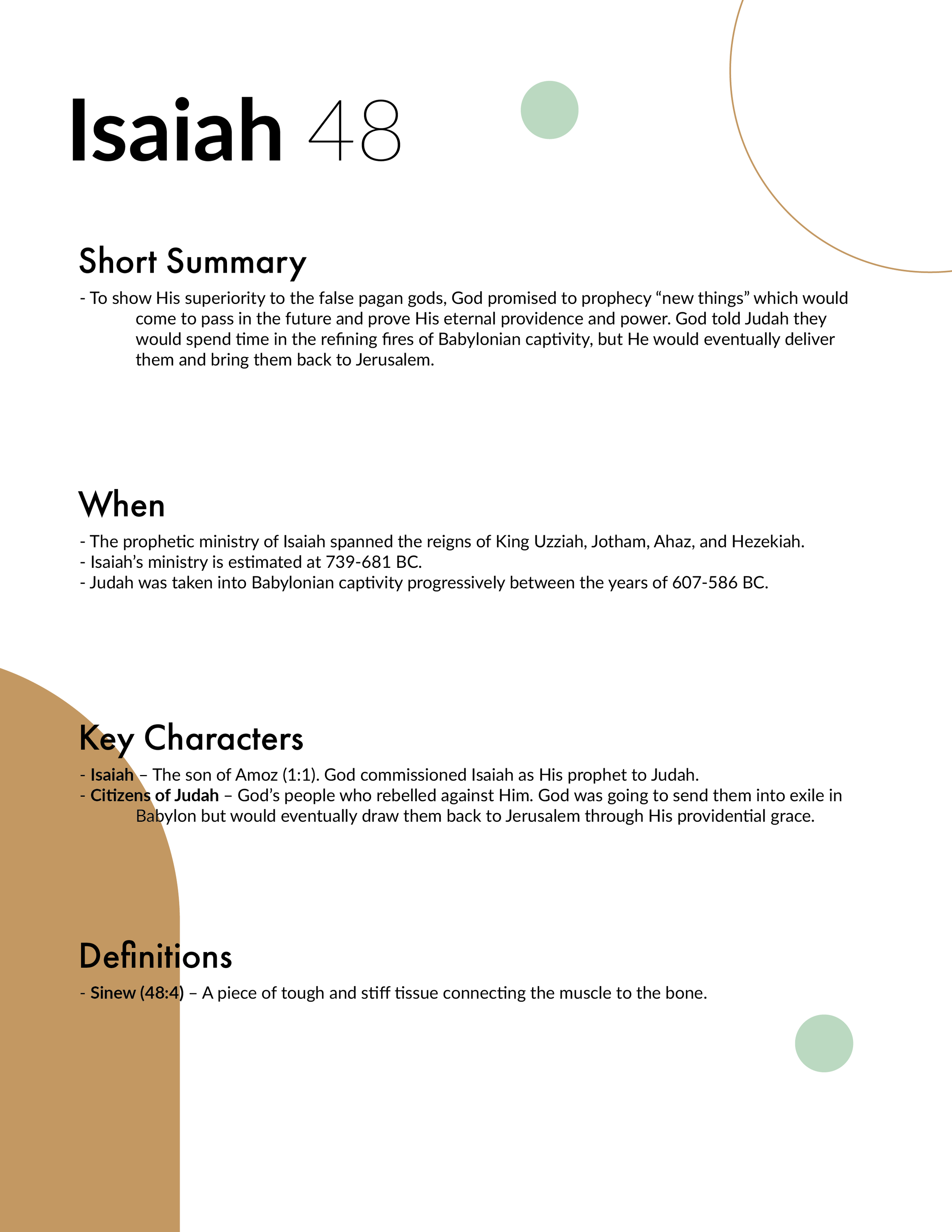
Isaiah 48 Short Summary:
To show His superiority to the false pagan gods, God promised to prophecy “new things” which would come to pass in the future and prove His eternal providence and power. God told Judah they would spend time in the refining fires of Babylonian captivity, but He would eventually deliver them and bring them back to Jerusalem.
Isaiah 48 Bible Study
TIMELINE:
The prophetic ministry of Isaiah spanned the reigns of King Uzziah, Jotham, Ahaz, and Hezekiah.
Isaiah’s ministry is thought to span from 739-681 BC.
The people of Judah were taken into Babylonian captivity progressively between the years of 607-586 BC.
KEY CHARACTERS:
Isaiah – The son of Amoz (1:1). God commissioned Isaiah as His prophet to Judah.
Citizens of Judah – God’s people who rebelled against Him. God was going to send them into exile in Babylon but would eventually draw them back to Jerusalem through His providential grace.
DEFINITIONS:
Sinew (48:4) – A piece of tough and stiff tissue connecting the muscle to the bone.
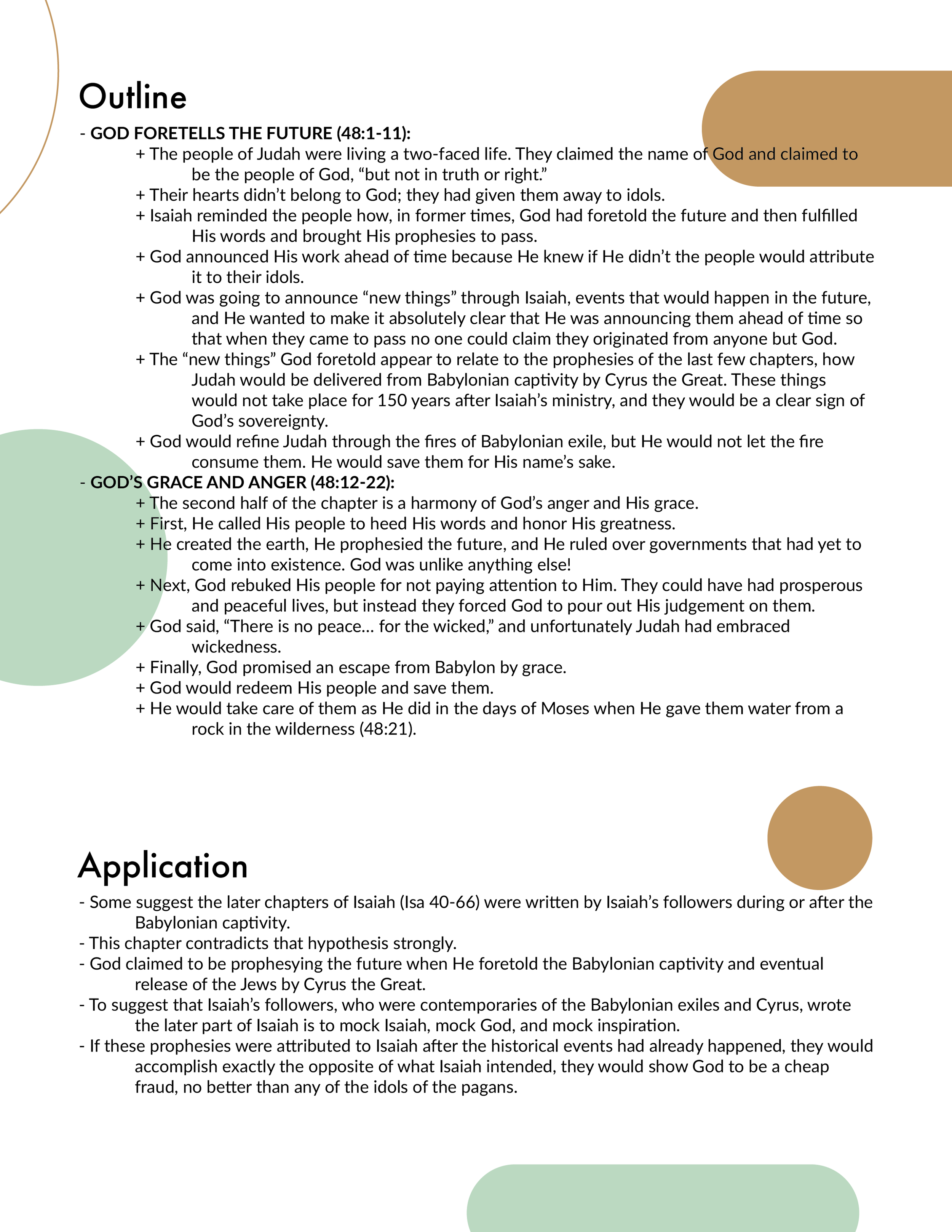
OUTLINE:
GOD FORETELLS THE FUTURE (48:1-11):
The people of Judah were living a two-faced life. They claimed the name of God and claimed to be the people of God, “but not in truth or right.”
Their hearts didn’t belong to God; they had given them away to idols.
Isaiah reminded the people how, in former times, God had foretold the future and then fulfilled His words and brought His prophesies to pass.
God announced His work ahead of time because He knew if He didn’t the people would attribute it to their idols.
God was going to announce “new things” through Isaiah, events that would happen in the future, and He wanted to make it absolutely clear that He was announcing them ahead of time so that when they came to pass no one could claim they originated from anyone but God.
The “new things” God foretold appear to relate to the prophesies of the last few chapters, how Judah would be delivered from Babylonian captivity by Cyrus the Great. These things would not take place for 150 years after Isaiah’s ministry, and they would be a clear sign of God’s sovereignty.
God would refine Judah through the fires of Babylonian exile, but He would not let the fire consume them. He would save them for His name’s sake.
GOD’S GRACE AND ANGER (48:12-22):
The second half of the chapter is a harmony of God’s anger and His grace.
First, He called His people to heed His words and honor His greatness.
He created the earth, He prophesied the future, and He ruled over governments that had yet to come into existence. God was unlike anything else!
Next, God rebuked His people for not paying attention to Him. They could have had prosperous and peaceful lives, but instead they forced God to pour out His judgement on them.
God said, “There is no peace… for the wicked,” and unfortunately Judah had embraced wickedness.
Finally, God promised an escape from Babylon by grace.
God would redeem His people and save them.
He would take care of them as He did in the days of Moses when He gave them water from a rock in the wilderness (48:21).
APPLICATION:
Some suggest the later chapters of Isaiah (Isa 40-66) were written by Isaiah’s followers during or after the Babylonian captivity.
This chapter contradicts that hypothesis strongly.
God claimed to be prophesying the future when He foretold the Babylonian captivity and eventual release of the Jews by Cyrus the Great.
To suggest that Isaiah’s followers, who were contemporaries of the Babylonian exiles and Cyrus, wrote the later part of Isaiah is to mock Isaiah, mock God, and mock inspiration.
If these prophesies were attributed to Isaiah after the historical events had already happened, they would accomplish exactly the opposite of what Isaiah intended, they would show God to be a cheap fraud, no better than any of the idols of the pagans.
