Jeremiah 1 - Bible Study, Explanation, and Application
Jeremiah 1 Bible Study
INTRO AND TIMELINE:
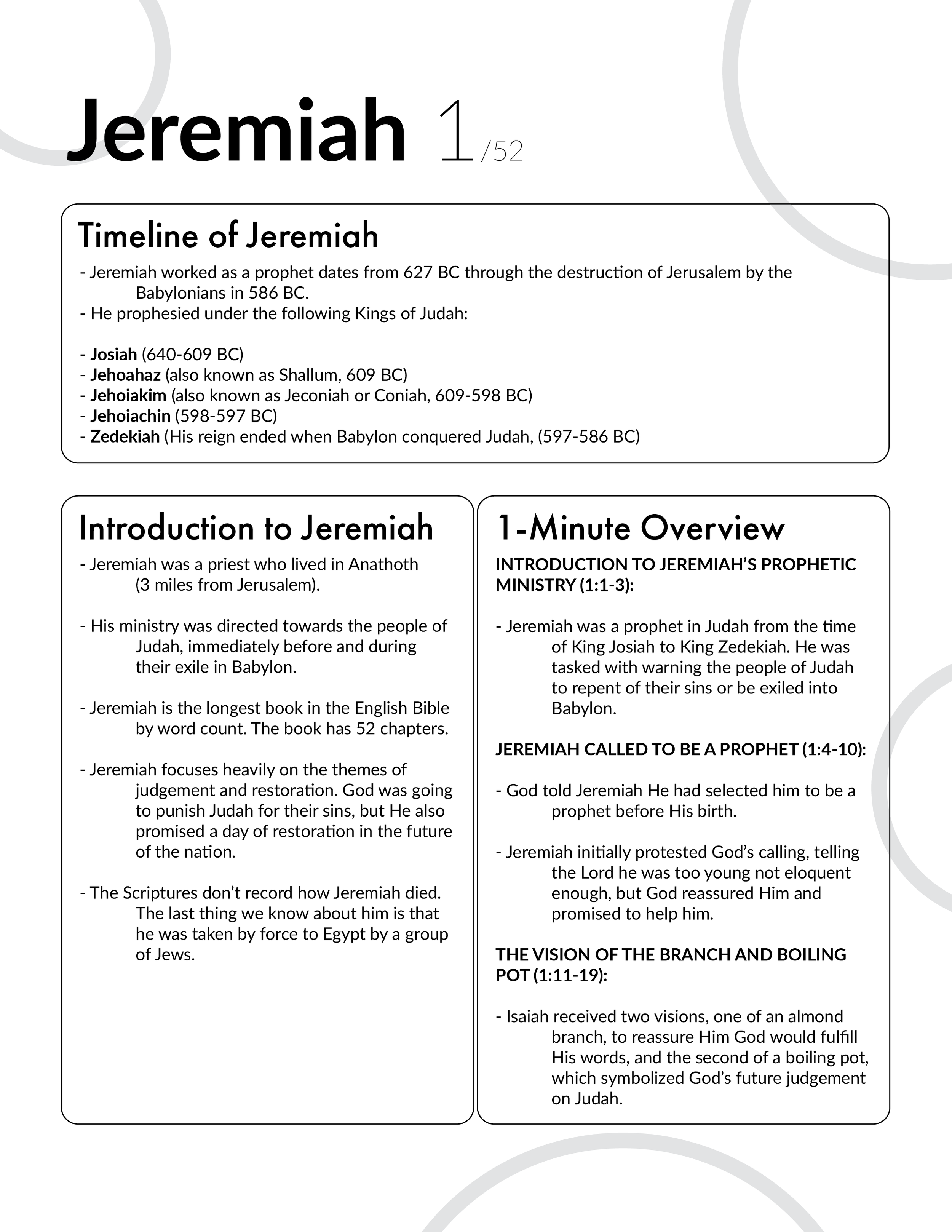
Jeremiah was a priest who lived in Anathoth (3 miles from Jerusalem). His ministry was directed towards the people of Judah, immediately before and during their exile in Babylon. His work as a prophet dates from 627 BC through the destruction of Jerusalem by the Babylonians in 586 BC.
Jeremiah is the longest book in the English Bible by word count. The book has 52 chapters.
Jeremiah prophesied under the following Kings of Judah:
Josiah (640-609 BC)
Jehoahaz (also known as Shallum, 609 BC)
Jehoiakim (also known as Jeconiah or Coniah, 609-598 BC)
Jehoiachin (598-597 BC)
Zedekiah (His reign ended when Babylon conquered Judah, (597-586 BC)
OUTLINE:
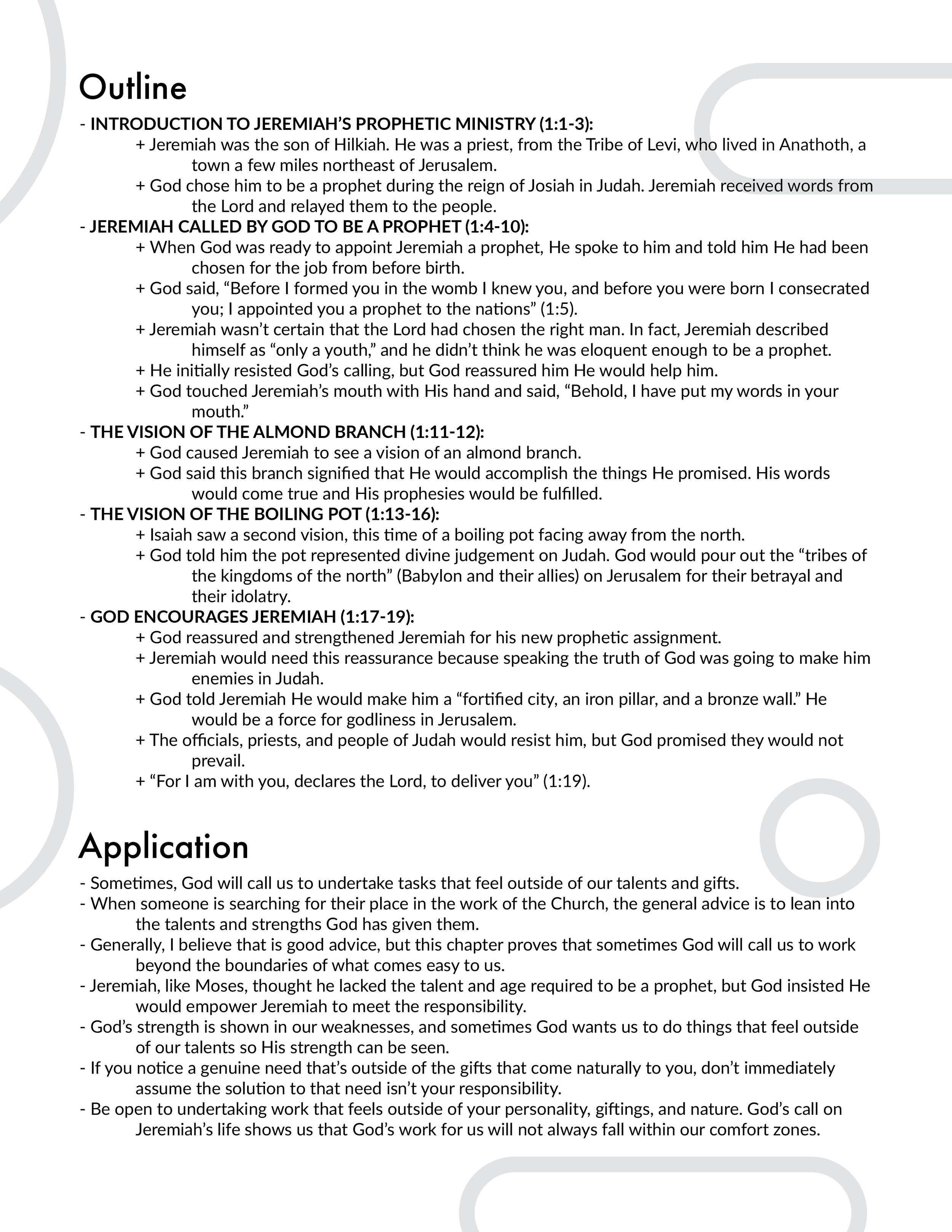
INTRODUCTION TO JEREMIAH’S PROPHETIC MINISTRY (1:1-3):
Jeremiah was the son of Hilkiah. He was a priest, from the Tribe of Levi, who lived in Anathoth, a town a few miles northeast of Jerusalem.
God chose him to be a prophet during the reign of Josiah in Judah. Jeremiah received words from the Lord and relayed them to the people.
JEREMIAH CALLED BY GOD TO BE A PROPHET (1:4-10):
When God was ready to appoint Jeremiah a prophet, He spoke to him and told him He had been chosen for the job from before birth.
God said, “Before I formed you in the womb I knew you, and before you were born I consecrated you; I appointed you a prophet to the nations” (1:5).
Jeremiah wasn’t certain that the Lord had chosen the right man. In fact, Jeremiah described himself as “only a youth,” and he didn’t think he was eloquent enough to be a prophet.
He initially resisted God’s calling, but God reassured him He would help him.
God touched Jeremiah’s mouth with His hand and said, “Behold, I have put my words in your mouth.
THE VISION OF THE ALMOND BRANCH (1:11-12):
God caused Jeremiah to see a vision of an almond branch.
God said this branch signified that He would accomplish the things He promised. His words would come true and His prophesies would be fulfilled.
THE VISION OF THE BOILING POT (1:13-16):
Isaiah saw a second vision, this time of a boiling pot facing away from the north.
God told him the pot represented divine judgement on Judah. God would pour out the “tribes of the kingdoms of the north” (Babylon and their allies) on Jerusalem for their betrayal and their idolatry.
GOD ENCOURAGES JEREMIAH (1:17-19):
God reassured and strengthened Jeremiah for his new prophetic assignment.
Jeremiah would need this reassurance because speaking the truth of God was going to make him enemies in Judah.
God told Jeremiah He would make him a “fortified city, an iron pillar, and a bronze wall.” He would be a force for godliness in Jerusalem.
The officials, priests, and people of Judah would resist him, but God promised they would not prevail.
“For I am with you, declares the Lord, to deliver you” (1:19).
APPLICATION:
Sometimes, God will call us to undertake tasks that feel outside of our talents and gifts.
When someone is searching for their place in the work of the Church, the general advice is to lean into the talents and strengths God has given them.
Generally, I believe that is good advice, but this chapter proves that sometimes God will call us to work beyond the boundaries of what comes easy to us.
Jeremiah, like Moses, thought he lacked the talent and age required to be a prophet, but God insisted He would empower Jeremiah to meet the responsibility.
God’s strength is shown in our weaknesses, and sometimes God wants us to do things that feel outside of our talents so His strength can be seen.
If you notice a genuine need that’s outside of the gifts that come naturally to you, don’t immediately assume the solution to that need isn’t your responsibility.
Be open to undertaking work that feels outside of your personality, giftings, and nature. God’s call on Jeremiah’s life shows us that God’s work for us will not always fall within our comfort zones.
