Jeremiah 10 - Bible Study, Explanation, and Application
Jeremiah 10 Bible Study
INTRO AND TIMELINE:
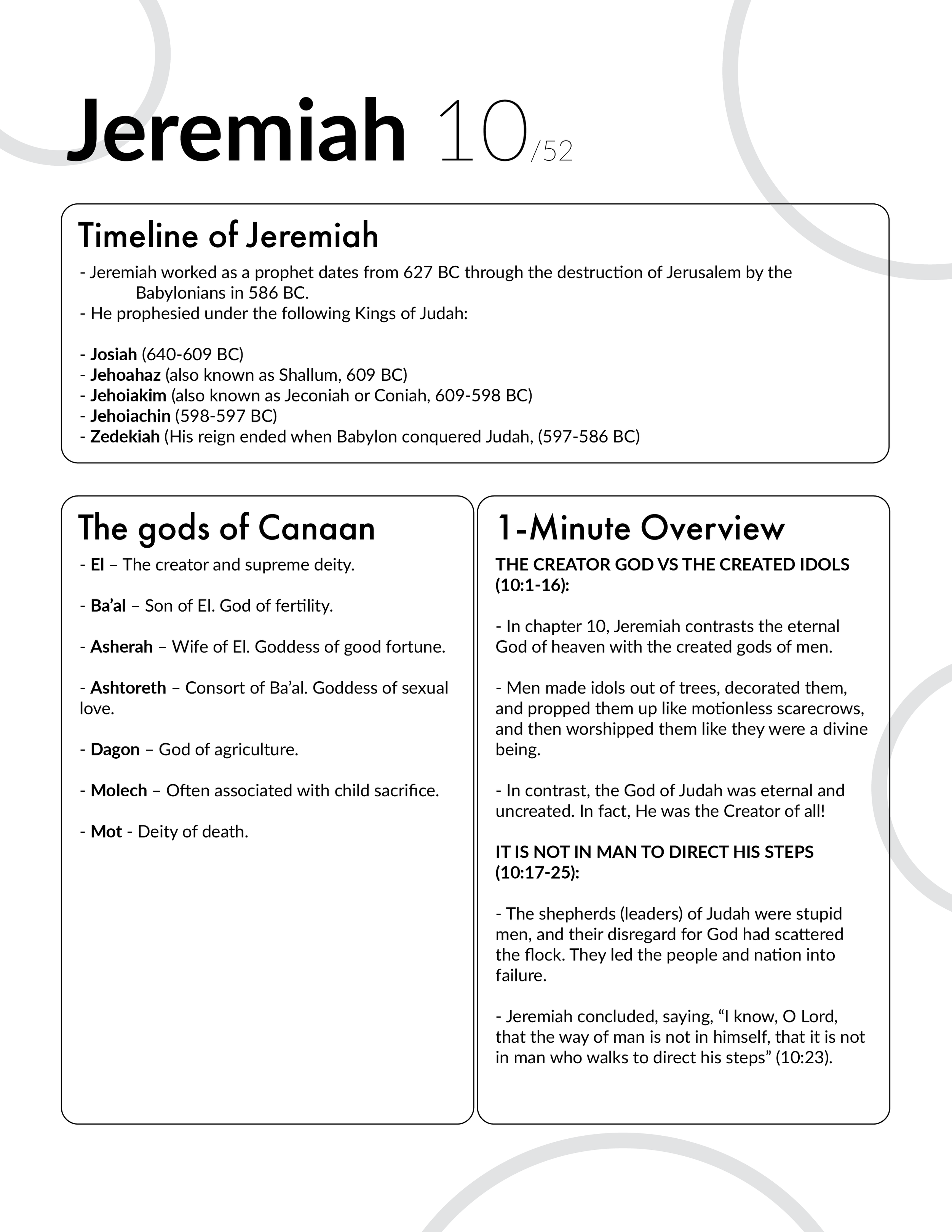
Jeremiah was a priest who lived in Anathoth (3 miles from Jerusalem). His ministry was directed towards the people of Judah, immediately before and during their exile in Babylon. His work as a prophet dates from 627 BC through the destruction of Jerusalem by the Babylonians in 586 BC.
Jeremiah is the longest book in the English Bible by word count. The book has 52 chapters.
Jeremiah prophesied under the following Kings of Judah:
Josiah (640-609 BC)
Jehoahaz (also known as Shallum, 609 BC)
Jehoiakim (also known as Jeconiah or Coniah, 609-598 BC)
Jehoiachin (598-597 BC)
Zedekiah (His reign ended when Babylon conquered Judah, (597-586 BC)
THE GODS OF CANAAN:
El – The creator and supreme deity.
Ba’al – Son of El. God of fertility.
Asherah – Wife of El. Goddess of good fortune.
Ashtoreth – Consort of Ba’al. Goddess of sexual love.
Dagon – God of agriculture.
Molech – Often associated with child sacrifice.
OUTLINE:
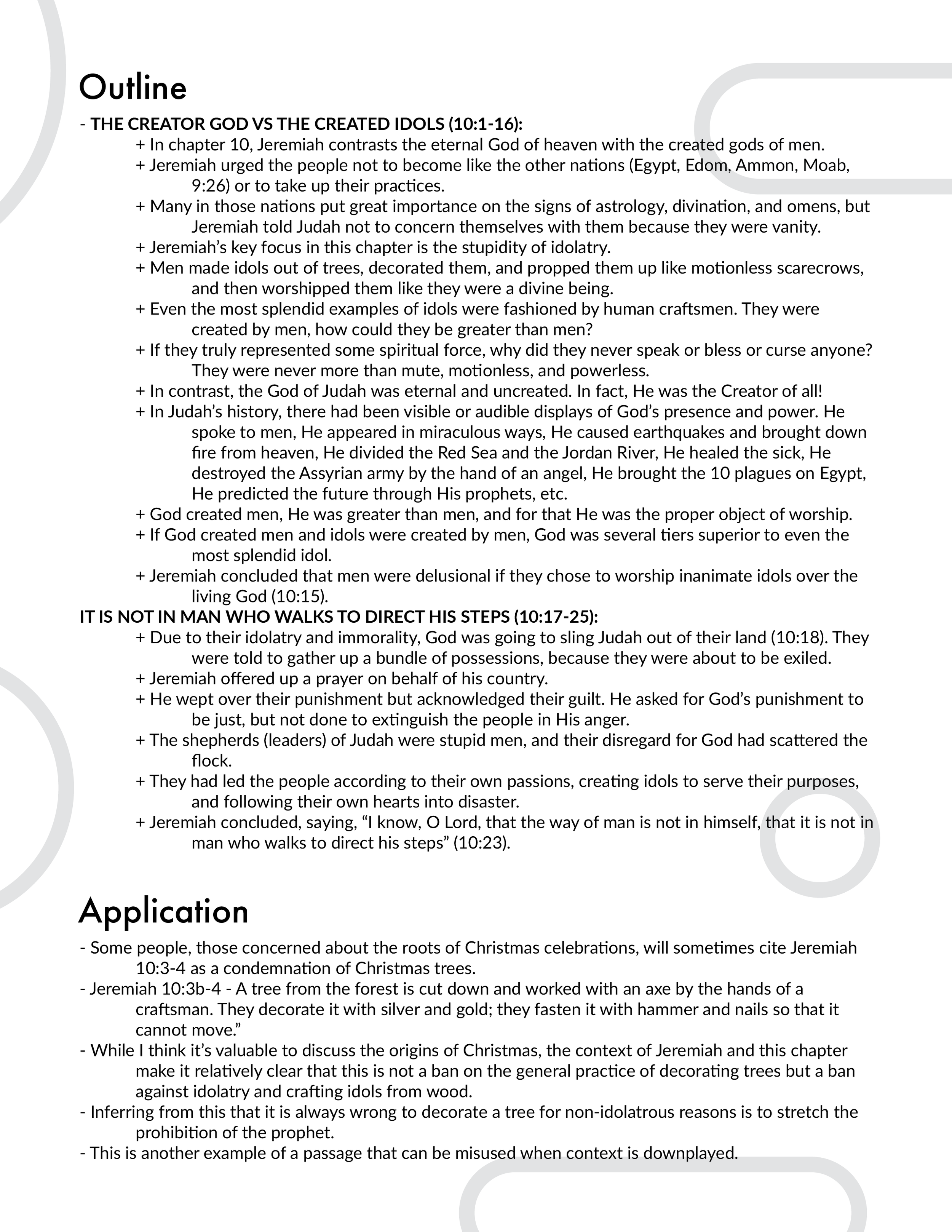
THE CREATOR GOD VS THE CREATED IDOLS (10:1-16):
In chapter 10, Jeremiah contrasts the eternal God of heaven with the created gods of men.
Jeremiah urged the people not to become like the other nations (Egypt, Edom, Ammon, Moab, 9:26) or to take up their practices.
Many in those nations put great importance on the signs of astrology, divination, and omens, but Jeremiah told Judah not to concern themselves with them because they were vanity.
Jeremiah’s key focus in this chapter is the stupidity of idolatry.
Men made idols out of trees, decorated them, and propped them up like motionless scarecrows, and then worshipped them like they were a divine being.
Even the most splendid examples of idols were fashioned by human craftsmen. They were created by men, how could they be greater than men?
If they truly represented some spiritual force, why did they never speak or bless or curse anyone? They were never more than mute, motionless, and powerless.
In contrast, the God of Judah was eternal and uncreated. In fact, He was the Creator of all!
In Judah’s history, there had been visible or audible displays of God’s presence and power. He spoke to men, He appeared in miraculous ways, He caused earthquakes and brought down fire from heaven, He divided the Red Sea and the Jordan River, He healed the sick, He destroyed the Assyrian army by the hand of an angel, He brought the 10 plagues on Egypt, He predicted the future through His prophets, etc.
God created men, He was greater than men, and for that He was the proper object of worship.
If God created men and idols were created by men, God was several tiers superior to even the most splendid idol.
Jeremiah concluded that men were delusional if they chose to worship inanimate idols over the living God (10:15).
IT IS NOT IN MAN WHO WALKS TO DIRECT HIS STEPS (10:17-25):
Due to their idolatry and immorality, God was going to sling Judah out of their land (10:18). They were told to gather up a bundle of possessions, because they were about to be exiled.
Jeremiah offered up a prayer on behalf of his country.
He wept over their punishment but acknowledged their guilt. He asked for God’s punishment to be just, but not done to extinguish the people in His anger.
The shepherds (leaders) of Judah were stupid men, and their disregard for God had scattered the flock.
They had led the people according to their own passions, creating idols to serve their purposes, and following their own hearts into disaster.
Jeremiah concluded, saying, “I know, O Lord, that the way of man is not in himself, that it is not in man who walks to direct his steps” (10:23).
APPLICATION:
Some people, those concerned about the roots of Christmas celebrations, will sometimes cite Jeremiah 10:3-4 as a condemnation of Christmas trees.
Jeremiah 10:3b-4 - A tree from the forest is cut down and worked with an axe by the hands of a craftsman. They decorate it with silver and gold; they fasten it with hammer and nails so that it cannot move.
While I think it’s valuable to discuss the origins of Christmas, the context of Jeremiah and this chapter make it relatively clear that this is not a ban on the general practice of decorating trees but a ban against idolatry and crafting idols from wood.
Inferring from this that it is always wrong to decorate a tree for non-idolatrous reasons is to stretch the prohibition of the prophet.
This is another example of a passage that can be misused when context is downplayed.
