Jeremiah 3 - Bible Study, Explanation, and Application
Jeremiah 3 Bible Study
INTRO AND TIMELINE:
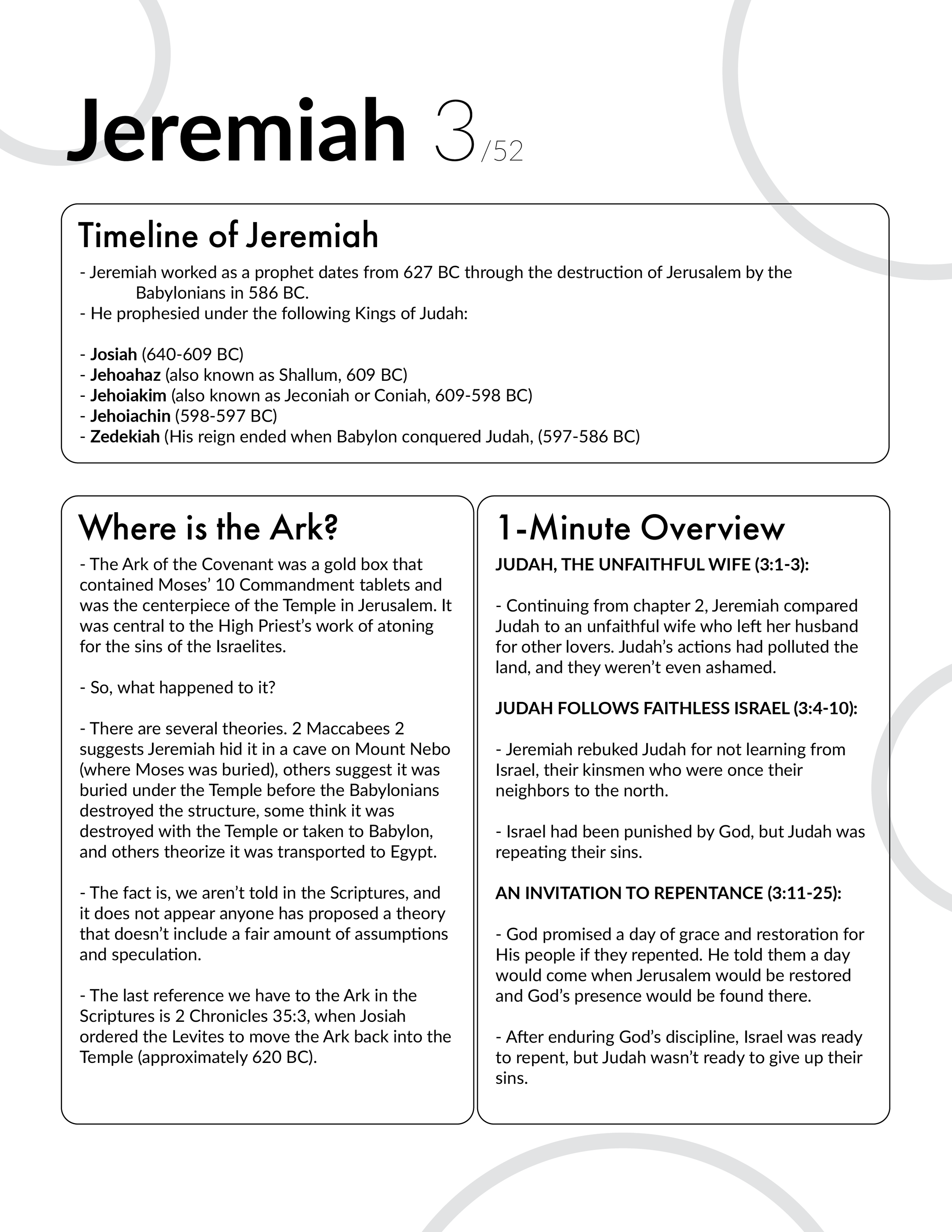
Jeremiah was a priest who lived in Anathoth (3 miles from Jerusalem). His ministry was directed towards the people of Judah, immediately before and during their exile in Babylon. His work as a prophet dates from 627 BC through the destruction of Jerusalem by the Babylonians in 586 BC.
Jeremiah is the longest book in the English Bible by word count. The book has 52 chapters.
Jeremiah prophesied under the following Kings of Judah:
Josiah (640-609 BC)
Jehoahaz (also known as Shallum, 609 BC)
Jehoiakim (also known as Jeconiah or Coniah, 609-598 BC)
Jehoiachin (598-597 BC)
Zedekiah (His reign ended when Babylon conquered Judah, (597-586 BC)
WHERE IS THE ARK OF THE COVENANT?
The Ark of the Covenant was a gold box that contained Moses’ 10 Commandment tablets and was the centerpiece of the Temple in Jerusalem. It was central to the High Priest’s work of atoning for the sins of the Israelites.
So, what happened to it?
There are several theories. 2 Maccabees 2 suggests Jeremiah hid it in a cave on Mount Nebo (where Moses was buried), others suggest it was buried under the Temple before the Babylonians destroyed the structure, some think it was destroyed with the Temple or taken to Babylon, and others theorize it was transported to Egypt.
The fact is, we aren’t told in the Scriptures, and it does not appear anyone has proposed a theory that doesn’t include a fair amount of assumptions and speculation.
The last reference we have to the Ark in the Scriptures is 2 Chronicles 35:3, when Josiah ordered the Levites to move the Ark back into the Temple (approximately 620 BC).
OUTLINE:
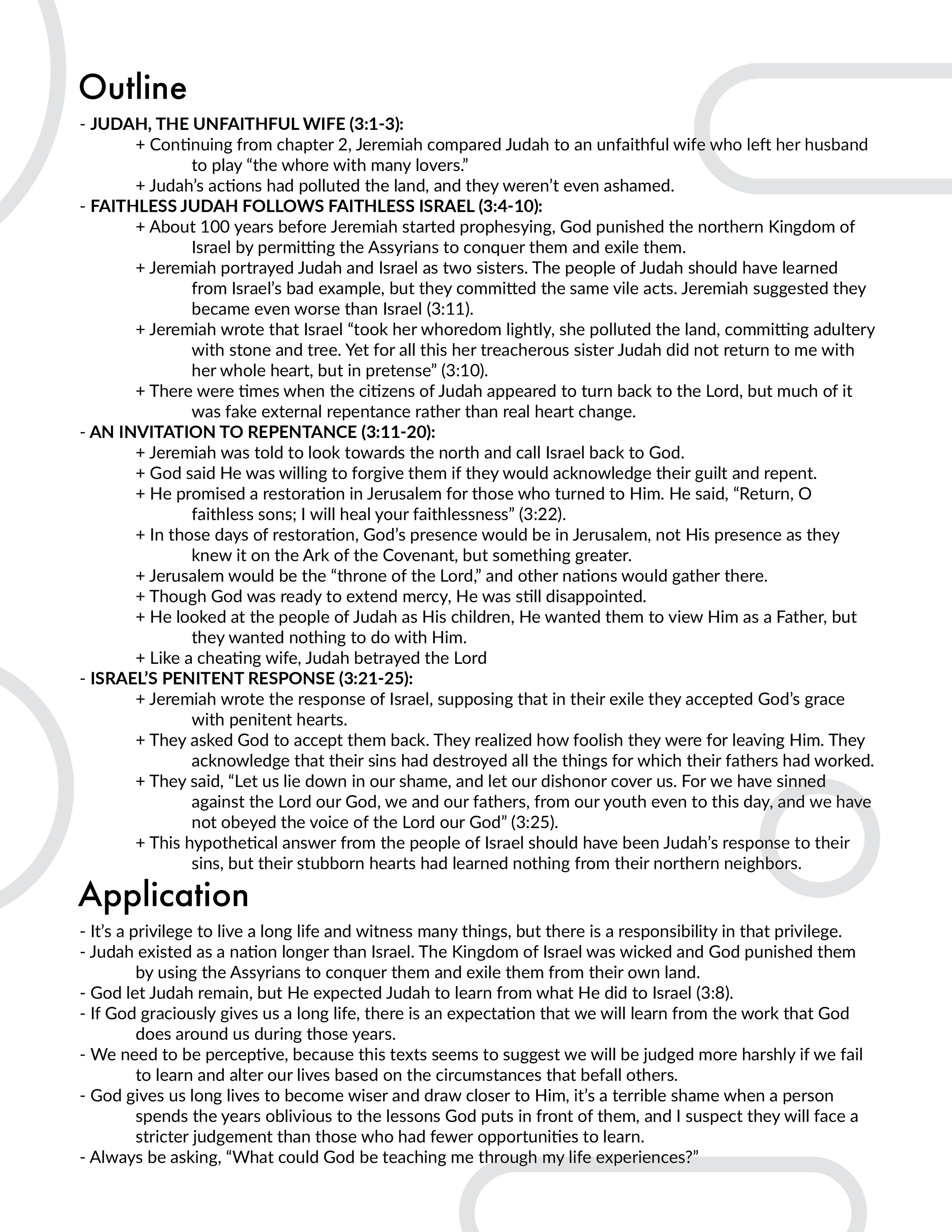
JUDAH, THE UNFAITHFUL WIFE (3:1-3):
Continuing from chapter 2, Jeremiah compared Judah to an unfaithful wife who left her husband to play “the whore with many lovers.”
Judah’s actions had polluted the land, and they weren’t even ashamed.
FAITHLESS JUDAH FOLLOWS FAITHLESS ISRAEL (3:4-10):
About 100 years before Jeremiah started prophesying, God punished the northern Kingdom of Israel by permitting the Assyrians to conquer them and exile them.
Jeremiah portrayed Judah and Israel as two sisters. The people of Judah should have learned from Israel’s bad example, but they committed the same vile acts. Jeremiah suggested they became even worse than Israel (3:11).
Jeremiah wrote that Israel “took her whoredom lightly, she polluted the land, committing adultery with stone and tree. Yet for all this her treacherous sister Judah did not return to me with her whole heart, but in pretense” (3:10).
There were times when the citizens of Judah appeared to turn back to the Lord, but much of it was fake external repentance rather than real heart change.
AN INVITATION TO REPENTANCE (3:11-20):
Jeremiah was told to look towards the north and call Israel back to God.
God said He was willing to forgive them if they would acknowledge their guilt and repent.
He promised a restoration in Jerusalem for those who turned to Him. He said, “Return, O faithless sons; I will heal your faithlessness” (3:22).
In those days of restoration, God’s presence would be in Jerusalem, not His presence as they knew it on the Ark of the Covenant, but something greater.
Jerusalem would be the “throne of the Lord,” and other nations would gather there.
Though God was ready to extend mercy, He was still disappointed.
He looked at the people of Judah as His children, He wanted them to view Him as a Father, but they wanted nothing to do with Him.
Like a cheating wife, Judah betrayed the Lord
ISRAEL’S PENITENT RESPONSE (3:21-25):
Jeremiah wrote the response of Israel, supposing that in their exile they accepted God’s grace with penitent hearts.
They asked God to accept them back. They realized how foolish they were for leaving Him. They acknowledge that their sins had destroyed all the things for which their fathers had worked.
They said, “Let us lie down in our shame, and let our dishonor cover us. For we have sinned against the Lord our God, we and our fathers, from our youth even to this day, and we have not obeyed the voice of the Lord our God” (3:25).
This hypothetical answer of the people of Israel should have been Judah’s response to their sins, but their stubborn hearts had learned nothing from their northern neighbors.
APPLICATION:
It’s a privilege to live a long life and witness many things, but within that privilege is an apparent responsibility.
Judah existed as a nation longer than Israel. The Kingdom of Israel was wicked and God punished them by using the Assyrians to conquer them and exile them from their own land.
God let Judah remain, but He expected Judah to learn from what He did to Israel (3:8).
If God graciously gives us a long life, there is an expectation that we will learn from the work that God does around us during those years.
We need to be perceptive, because this texts seems to suggest we will be judged more harshly if we fail to learn and alter our lives based on the circumstances that befall others.
God gives us long lives to become wiser and draw closer to Him, it’s a terrible shame when a person spends the years oblivious to the lessons God puts in front of them, and I suspect they will face a stricter judgement than those who had fewer opportunities to learn.
Always be asking, “What could God be teaching me through my life experiences?”
