Jeremiah 40 - Bible Study, Explanation, and Application
Jeremiah 40 Bible Study
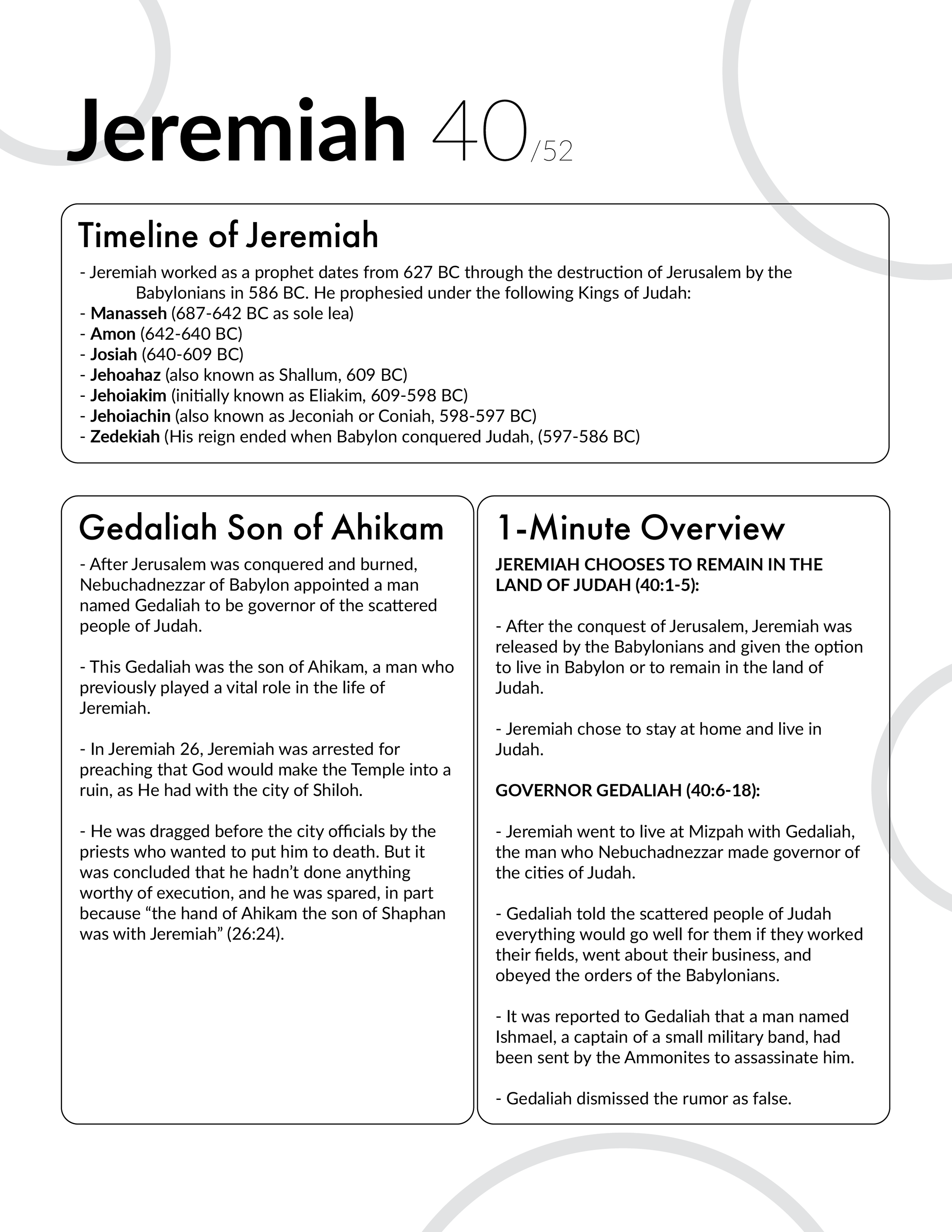
INTRO AND TIMELINE:
Jeremiah was a priest who lived in Anathoth (3 miles from Jerusalem). His ministry was directed towards the people of Judah, immediately before and during their exile in Babylon. His work as a prophet dates from 627 BC through the destruction of Jerusalem by the Babylonians in 586 BC.
Jeremiah is the longest book in the English Bible by word count. The book has 52 chapters.
Jeremiah prophesied under the following Kings of Judah:
Manasseh (687-642 BC)
Amos (642-640 BC)
Josiah (640-609 BC)
Jehoiakim (initially known as Eliakim, 609-598 BC)
Jehoiachin (also known as Jeconiah or Coniah, 598-597 BC)
Zedekiah (His reign ended when Babylon conquered Judah, (597-586 BC)
GEDALIAH THE SON OF AHIKAM:
After Jerusalem was conquered and burned, Nebuchadnezzar of Babylon appointed a man named Gedaliah to be governor of the scattered people of Judah.
This Gedaliah was the son of Ahikam, a man who previously played a vital role in the life of Jeremiah.
In Jeremiah 26, Jeremiah was arrested for preaching that God would make the Temple into a ruin, as He had with the city of Shiloh.
He was dragged before the city officials by the priests who wanted to put him to death. But it was concluded that he hadn’t done anything worthy of execution, and he was spared, in part because “the hand of Ahikam the son of Shaphan was with Jeremiah” (26:24).
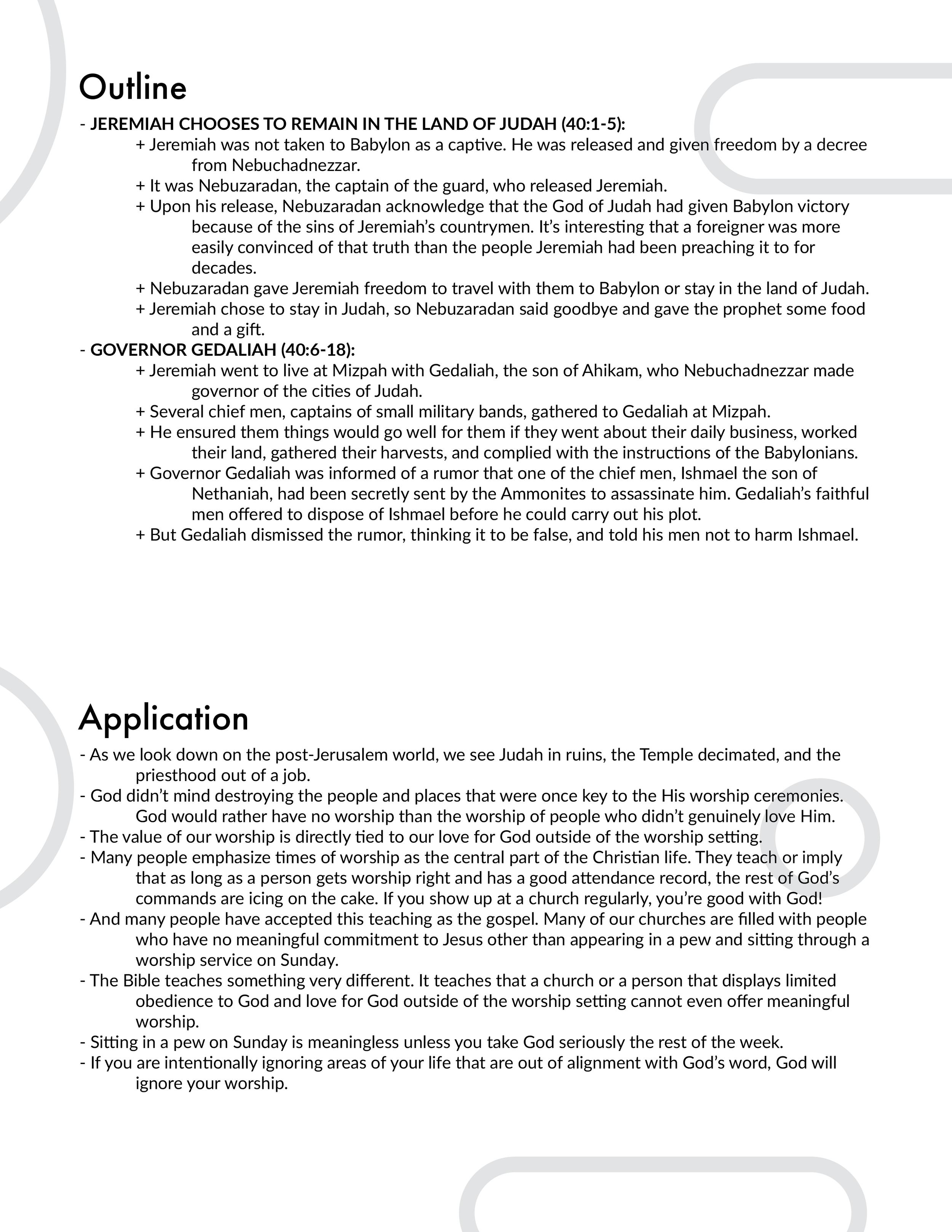
OUTLINE:
JEREMIAH CHOOSES TO REMAIN IN THE LAND OF JUDAH (40:1-5):
Jeremiah was not taken to Babylon as a captive. He was released and given freedom by a decree from Nebuchadnezzar.
It was Nebuzaradan, the captain of the guard, who released Jeremiah.
Upon his release, Nebuzaradan acknowledge that the God of Judah had given Babylon victory because of the sins of Jeremiah’s countrymen. It’s interesting that a foreigner was more easily convinced of that truth than the people Jeremiah had been preaching it to for decades.
Nebuzaradan gave Jeremiah freedom to travel with them to Babylon or stay in the land of Judah.
Jeremiah chose to stay in Judah, so Nebuzaradan said goodbye and gave the prophet some food and a gift.
GOVERNOR GEDALIAH (40:6-18):
Jeremiah went to live at Mizpah with Gedaliah, the son of Ahikam, who Nebuchadnezzar made governor of the cities of Judah.
Several chief men, captains of small military bands, gathered to Gedaliah at Mizpah.
He ensured them things would go well for them if they went about their daily business, worked their land, gathered their harvests, and complied with the instructions of the Babylonians.
Governor Gedaliah was informed of a rumor that one of the chief men, Ishmael the son of Nethaniah, had been secretly sent by the Ammonites to assassinate him. Gedaliah’s faithful men offered to dispose of Ishmael before he could carry out his plot.
But Gedaliah dismissed the rumor, thinking it to be false, and told his men not to harm Ishmael.
APPLICATION:
As we look down on the post-Jerusalem world, we see Judah in ruins, the Temple decimated, and the priesthood out of a job.
God didn’t mind destroying the people and places that were once key to the His worship ceremonies. God would rather have no worship than the worship of people who didn’t genuinely love Him.
The value of our worship is directly tied to our love for God outside of the worship setting.
Many people emphasize times of worship as the central part of the Christian life. They teach or imply that as long as a person gets worship right and has a good attendance record, the rest of God’s commands are icing on the cake. If you show up at a church regularly, you’re good with God!
And many people have accepted this teaching as the gospel. Many of our churches are filled with people who have no meaningful commitment to Jesus other than appearing in a pew and sitting through a worship service on Sunday.
The Bible teaches something very different. It teaches that a church or a person that displays limited obedience to God and love for God outside of the worship setting cannot even offer meaningful worship.
Sitting in a pew on Sunday is meaningless unless you take God seriously the rest of the week.
If you are intentionally ignoring areas of your life that are out of alignment with God’s word, God will ignore your worship.
