Jeremiah 44 - Bible Study, Explanation, and Application
Jeremiah 44 Bible Study
INTRO AND TIMELINE:
Jeremiah was a priest who lived in Anathoth (3 miles from Jerusalem). His ministry was directed towards the people of Judah, immediately before and during their exile in Babylon. His work as a prophet dates from 627 BC through the destruction of Jerusalem by the Babylonians in 586 BC.
Jeremiah is the longest book in the English Bible by word count. The book has 52 chapters.
Jeremiah prophesied under the following Kings of Judah:
Manasseh (687-642 BC)
Amos (642-640 BC)
Josiah (640-609 BC)
Jehoiakim (initially known as Eliakim, 609-598 BC)
Jehoiachin (also known as Jeconiah or Coniah, 598-597 BC)
Zedekiah (His reign ended when Babylon conquered Judah, (597-586 BC)
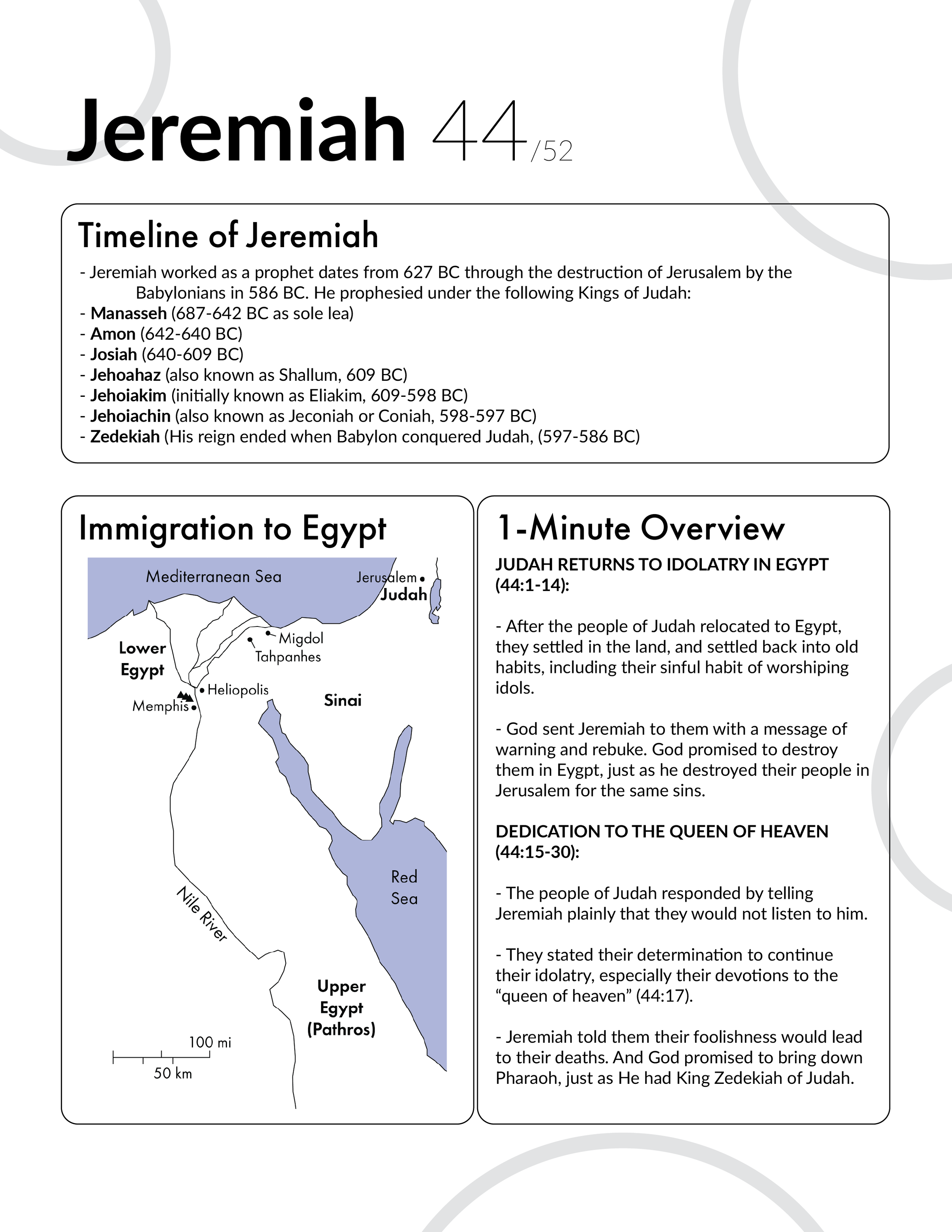
MAP OF KEY LOCATIONS IN JEREMIAH 44:

OUTLINE:
JUDAH RETURNS TO IDOLATRY IN EGYPT (44:1-14):
After the people of Judah relocated to Egypt, they settled in the land, and settled back into old habits, including their sinful habit of worshiping idols.
God sent Jeremiah to them with a message of warning and rebuke.
They all knew about God’s judgement on Jerusalem, and God assured them He would bring the same destruction to Egypt.
Though God sent them prophets persistently, they were even more persistent in their sins.
God asked them if it was really possible that they had already forgotten the sins of their fathers and the sins of the people now in exile in Babylon. Evidently, the answer was “yes.”
If, even after the destruction of Judah, God’s people hadn’t learned their lesson, there was nothing left for God to do but to destroy them.
God said, “I will take the remnant of Judah who have set their faces to come to the land of Egypt to live, and they shall all be consumed. In the land of Egypt they shall fall; by the sword and by famine they shall be consumed. From the least to the greatest, they shall die by the sword and by famine, and they shall become an oath, a horror, a curse, and a taunt… so that none of the remnant of Judah who have come to live in the land of Egypt shall escape or survive or return to the land of Judah, to which they desire to return to dwell there. For they shall not return, except some fugitives” (44:12, 14).
DEDICATION TO THE QUEEN OF HEAVEN (44:15-20):
The people of Judah responded by telling Jeremiah plainly that they would not listen to him.
They stated their determination to continue their idolatry, especially their devotions to the “queen of heaven” (44:17).
They concluded that it was their previous lack of devotion to the queen of heaven that had made their lives difficult.
The women of Judah seemed especially devoted to this idol. They told Jeremiah they were going to offer drink offerings and bake cakes for the idol so prosperity would return to them.
GOD’S SUPERIORITY OVER THE QUEEN OF HEAVEN (44:20-30):
Jeremiah rejected the foolish devotions of the people. He reminded them that it was because of their previous devotion to idols that God destroyed them. They had previously offered sacrifices to the queen of heaven in the streets of Jerusalem, and those sacrifices were not unnoticed by God, which was why Jerusalem no longer had inhabited streets.
Jeremiah warned the people that if they followed through with their devotions to the queen of heaven, the King of Heaven, the One True God, would destroy all the Jewish immigrants in Egypt, so that all people for all time would know who the real God was.
As a sign, God promised to deliver Pharaoh Hophra, king of Egypt, into the hand of his enemies, just as He had delivered King Zedekiah into the hands of Nebuchadnezzar.
APPLICATION:
It’s shocking that the people of Judah didn’t listen to Jeremiah after so many of his prophecies had played out before their eyes.
The resistance of the people in returning their devotion to God defies logic.
That rejection of logic was not a singular historical event. That rejection of rationality exists today, and has existed at every point in history.
There are people who hate the idea of submitting to God so much that they will go to any logical extreme, and even go so far as to discard logic, if it gives them an excuse to live without God.
Unfortunately, these people are often unmoved by truth and rational arguments, because they have hardened their hearts so firmly against the idea of God.
