Jeremiah 50 - Bible Study, Explanation, and Application
Jeremiah 50 Bible Study
INTRO AND TIMELINE:
Jeremiah was a priest who lived in Anathoth (3 miles from Jerusalem). His ministry was directed towards the people of Judah, immediately before and during their exile in Babylon. His work as a prophet dates from 627 BC through the destruction of Jerusalem by the Babylonians in 586 BC.
Jeremiah is the longest book in the English Bible by word count. The book has 52 chapters.
Jeremiah prophesied under the following Kings of Judah:
Manasseh (687-642 BC)
Amos (642-640 BC)
Josiah (640-609 BC)
Jehoiakim (initially known as Eliakim, 609-598 BC)
Jehoiachin (also known as Jeconiah or Coniah, 598-597 BC)
Zedekiah (His reign ended when Babylon conquered Judah, (597-586 BC)
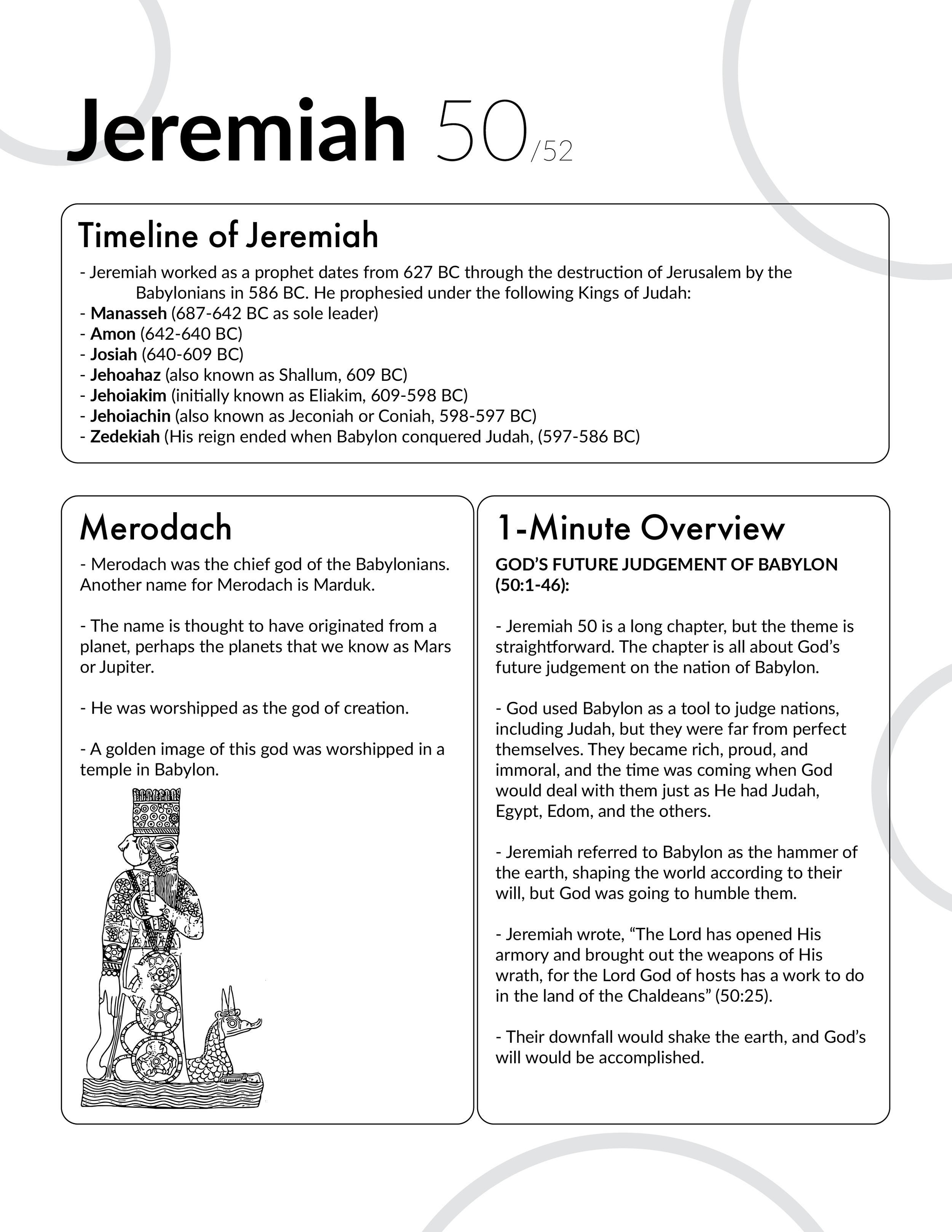
MERADOCH / MARDUK
Merodach was the chief god of the Babylonians.
Another name for Merodach is Marduk.
The name is thought to have originated from a planet, perhaps the planets that we know as Mars or Jupiter.
He was worshipped as the god of creation.
A golden image of this god was worshipped in a temple in Babylon.

OUTLINE:
GOD’S FUTURE JUDGEMENT OF BABYLON (50:1-46):
Jeremiah 50 is a long chapter, but the theme is straightforward. The chapter is all about God’s future judgement on the nation of Babylon.
God used Babylon as a tool to judge nations, including Judah, but they were far from perfect themselves. They became rich, proud, and immoral, and the time was coming when God would deal with them just as He had Judah, Egypt, Edom, and the others.
Babylon’s chief idol, Merodach, would not be able to save the nation from what God was bringing against them.
God would make the great city of Babylon a haunt for wild animals and desert sand.
When this happened, there would be a gathering of God’s people back to the land of promise. They would gather physically but also spiritually. Their hearts would be turned back to God, saying, “Come, let us join ourselves to the Lord in an everlasting covenant that will never be forgotten” (50:5).
Israel had been a scattered flock, but God promised to return them to their pasture.
God would pardon the sins of His people.
He was gathering nations to plunder Babylon.
Jeremiah referred to them as the hammer of the earth, shaping the world according to their will, but God was going to humble them.
“The Lord has opened His armory and brought out the weapons of His wrath, for the Lord God of hosts has a work to do in the land of the Chaldeans” (50:25).
The country that held Judah captive was strong, but the Redeemer of Judah was stronger (50:34).
Part of Babylon’s punishment was due to the way they treated Israel and Judah. God punished Assyria for it already, now He would punish Babylon.
Their demise was also God’s vengeance for His temple (50:28).
A nation, whose name will be revealed in the next chapter, was being sent by God to bring a destruction on Babylon that Jeremiah compared to the divine destruction of Sodom and Gomorrah.
Their downfall would shake the earth, and God’s will would be done.
APPLICATION:
Sometimes preachers, pastors, priests, teachers, and other people of influence in churches fall into the trap of thinking that since God uses them to bless and benefit others, they should be allowed to hold on to their pet sins and get a pass from God.
As we learn from Babylon, just because God uses a person, maybe even uses them powerfully, doesn’t mean He will not judge them for their sins.
Don’t mistake God using you for God’s approval of all your actions.
