Lamentations 1 - Bible Study, Explanation, and Application
Lamentations 1 Bible Study
TIMELINE:
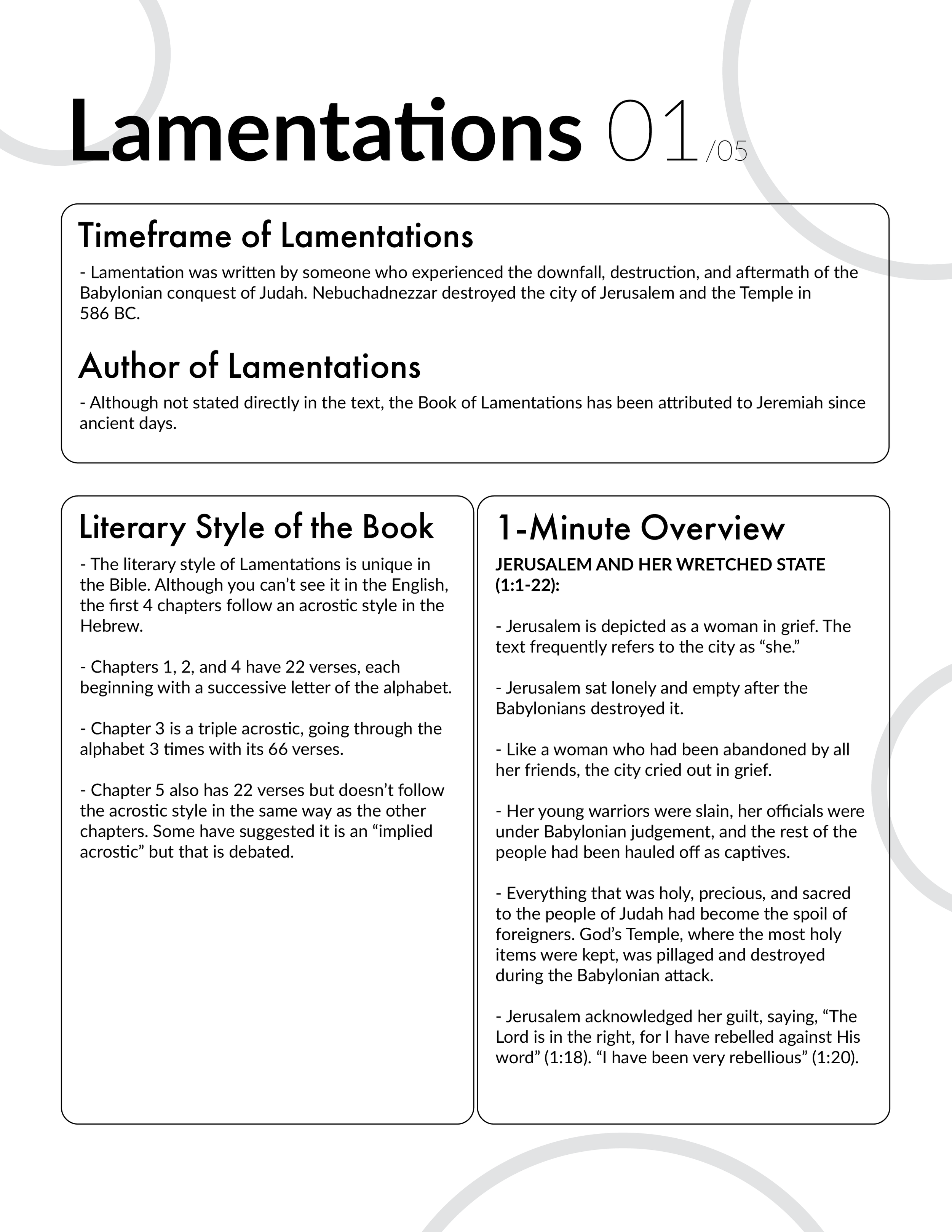
Lamentation was written by someone who experienced the downfall, destruction, and aftermath of the Babylonian conquest of Judah. Nebuchadnezzar destroyed the city of Jerusalem and the Temple in 586 BC.
AUTHOR:
Although not stated directly in the text, the Book of Lamentations has been attributed to Jeremiah since ancient days.
LITERARY STYLE OF THE BOOK
The literary style of Lamentations is unique in the Bible. Although you can’t see it in the English, the first 4 chapters follow an acrostic style in the Hebrew.
Chapters 1, 2, and 4 have 22 verses, each beginning with a successive letter of the alphabet.
Chapter 3 is a triple acrostic, going through the alphabet 3 times with its 66 verses.
Chapter 5 also has 22 verses but doesn’t follow the acrostic style in the same way as the other chapters. Some have suggested it is an “implied acrostic” but that is debated.
OUTLINE:
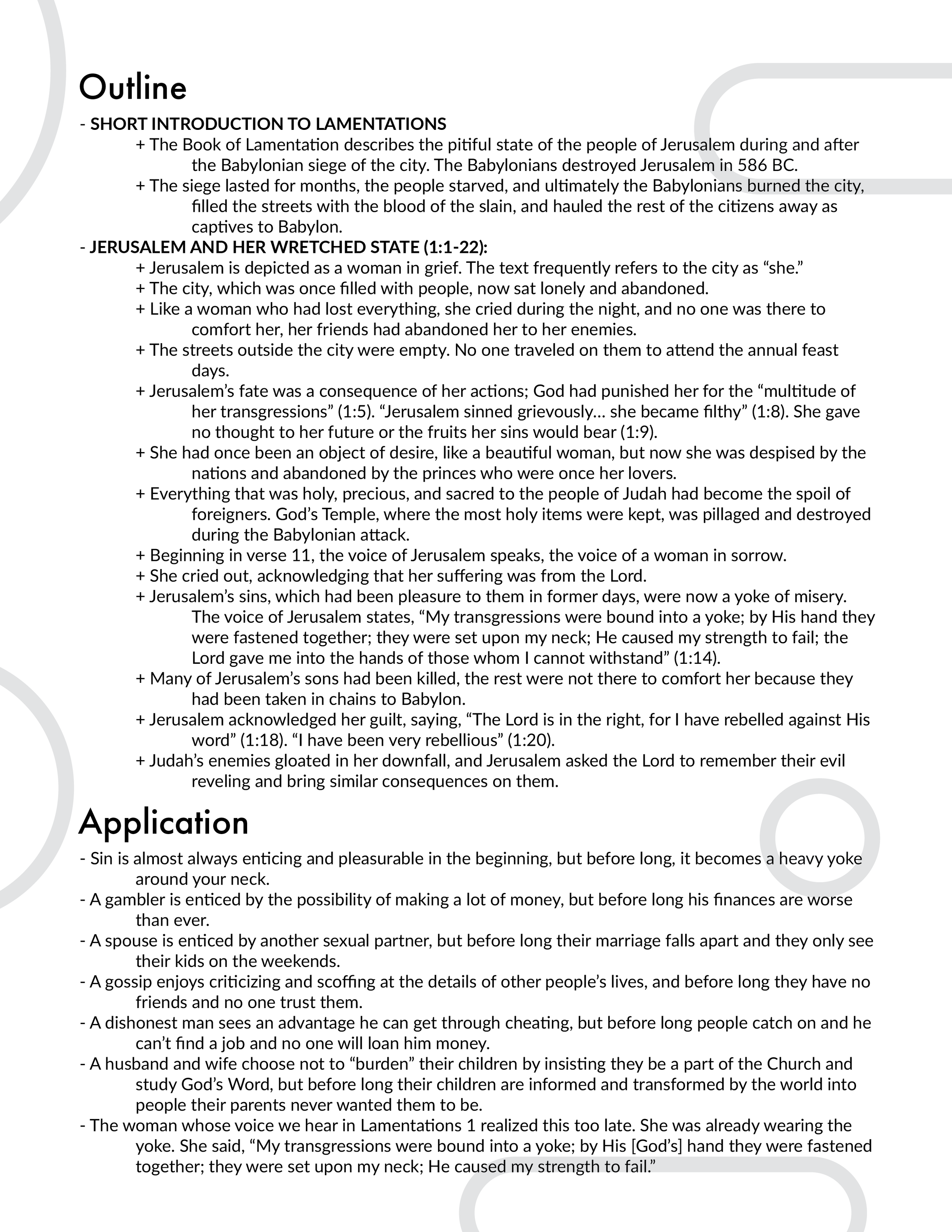
SHORT INTRODUCTION TO LAMENTATIONS
The Book of Lamentation describes the pitiful state of the people of Jerusalem during and after the Babylonian siege of the city. The Babylonians destroyed Jerusalem in 586 BC.
The siege lasted for months, the people starved, and ultimately the Babylonians burned the city, filled the streets with the blood of the slain, and hauled the rest of the citizens away as captives to Babylon.
JERUSALEM AND HER WRETCHED STATE (1:1-22):
Jerusalem is depicted as a woman in grief. The text frequently refers to the city as “she.”
The city, which was once filled with people, now sat lonely and abandoned.
Like a woman who had lost everything, she cried during the night, and no one was there to comfort her, her friends had abandoned her to her enemies.
The streets outside the city were empty. No one traveled on them to attend the annual feast days.
Jerusalem’s fate was a consequence of her actions; God had punished her for the “multitude of her transgressions” (1:5). “Jerusalem sinned grievously… she became filthy” (1:8). She gave no thought to her future or the fruits her sins would bear (1:9).
She had once been an object of desire, like a beautiful woman, but now she was despised by the nations and abandoned by the princes who were once her lovers.
Everything that was holy, precious, and sacred to the people of Judah had become the spoil of foreigners. God’s Temple, where the most holy items were kept, was pillaged and destroyed during the Babylonian attack.
Beginning in verse 11, the voice of Jerusalem speaks, the voice of a woman in sorrow.
She cried out, acknowledging that her suffering was from the Lord.
Jerusalem’s sins, which had been pleasure to them in former days, were now a yoke of misery. The voice of Jerusalem states, “My transgressions were bound into a yoke; by His hand they were fastened together; they were set upon my neck; He caused my strength to fail; the Lord gave me into the hands of those whom I cannot withstand” (1:14).
Many of Jerusalem’s sons had been killed, the rest were not there to comfort her because they had been taken in chains to Babylon.
Jerusalem acknowledged her guilt, saying, “The Lord is in the right, for I have rebelled against His word” (1:18). “I have been very rebellious” (1:20).
Judah’s enemies gloated in her downfall, and Jerusalem asked the Lord to remember their evil reveling and bring similar consequences on them.
APPLICATION:
Sin is almost always enticing and pleasurable in the beginning, but before long, it becomes a heavy yoke around your neck.
A gambler is enticed by the possibility of making a lot of money, but before long his finances are worse than ever.
A spouse is enticed by another sexual partner, but before long their marriage falls apart and they only see their kids on the weekends.
A gossip enjoys criticizing and scoffing at the details of other people’s lives, and before long they have no friends and no one trust them.
A dishonest man sees an advantage he can get through cheating, but before long people catch on and he can’t find a job and no one will loan him money.
A husband and wife choose not to “burden” their children by insisting they be a part of the Church and study God’s Word, but before long their children are informed and transformed by the world into people their parents never wanted them to be.
The woman whose voice we hear in Lamentations 1 realized this too late. She was already wearing the yoke. She said, “My transgressions were bound into a yoke; by His [God’s] hand they were fastened together; they were set upon my neck; He caused my strength to fail.”
