Jeremiah 15 - Bible Study, Explanation, and Application
Jeremiah 15 Bible Study
INTRO AND TIMELINE:
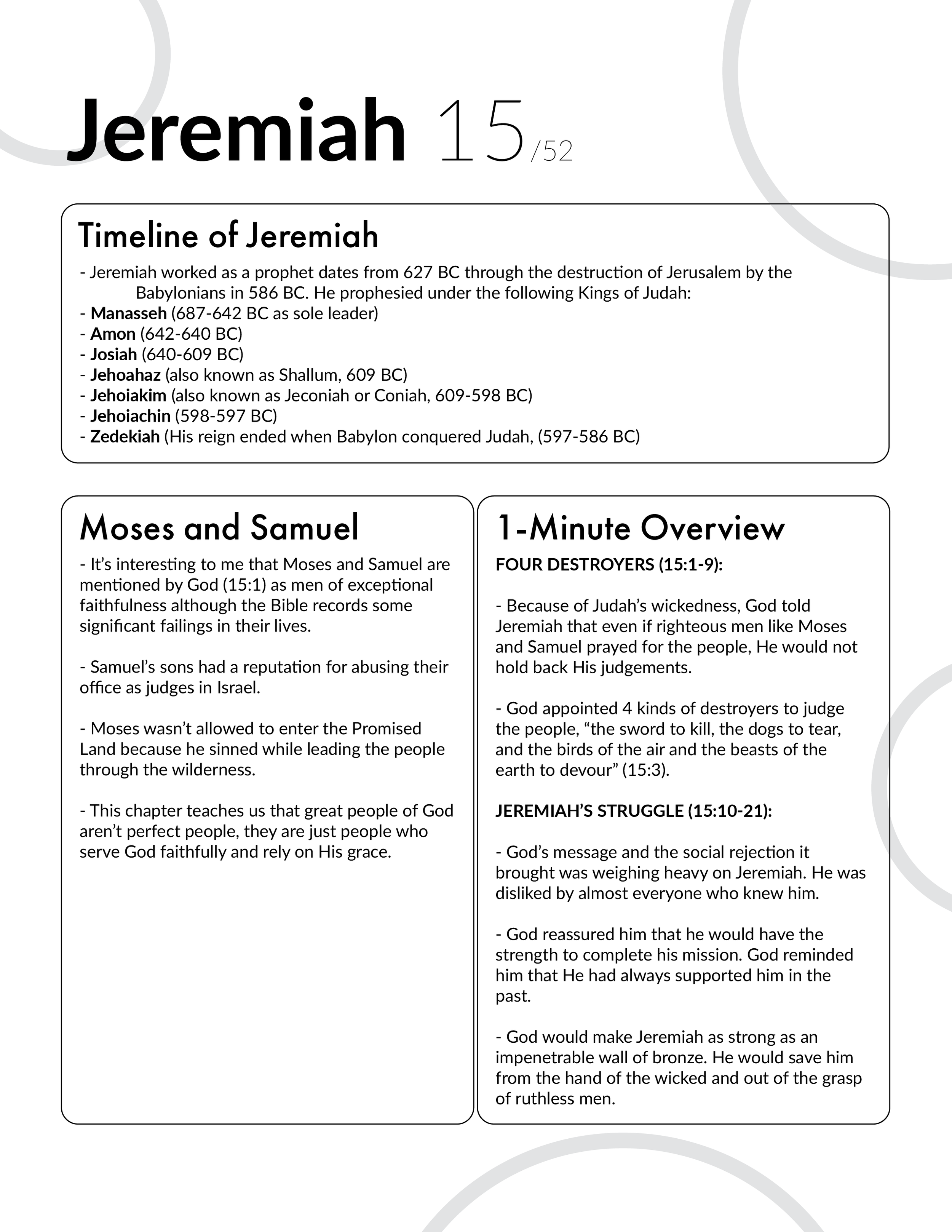
Jeremiah was a priest who lived in Anathoth (3 miles from Jerusalem). His ministry was directed towards the people of Judah, immediately before and during their exile in Babylon. His work as a prophet dates from 627 BC through the destruction of Jerusalem by the Babylonians in 586 BC.
Jeremiah is the longest book in the English Bible by word count. The book has 52 chapters.
Jeremiah prophesied under the following Kings of Judah:
Manasseh (687-642 BC)
Amos (642-640 BC)
Josiah (640-609 BC)
Jehoahaz (also known as Shallum, 609 BC)
Jehoiakim (also known as Jeconiah or Coniah, 609-598 BC)
Jehoiachin (598-597 BC)
Zedekiah (His reign ended when Babylon conquered Judah, (597-586 BC)
MOSES AND SAMUEL:
It’s interesting to me that Moses and Samuel are mentioned by God (15:1) as men of exceptional faithfulness although the Bible records some significant failings in their lives.
Samuel’s sons had a reputation for abusing their office as judges in Israel.
Moses wasn’t allowed to enter the Promised Land because he sinned while leading the people through the wilderness.
This chapter teaches us that great people of God aren’t perfect people, they are just people who serve God faithfully and rely on His grace.
OUTLINE:
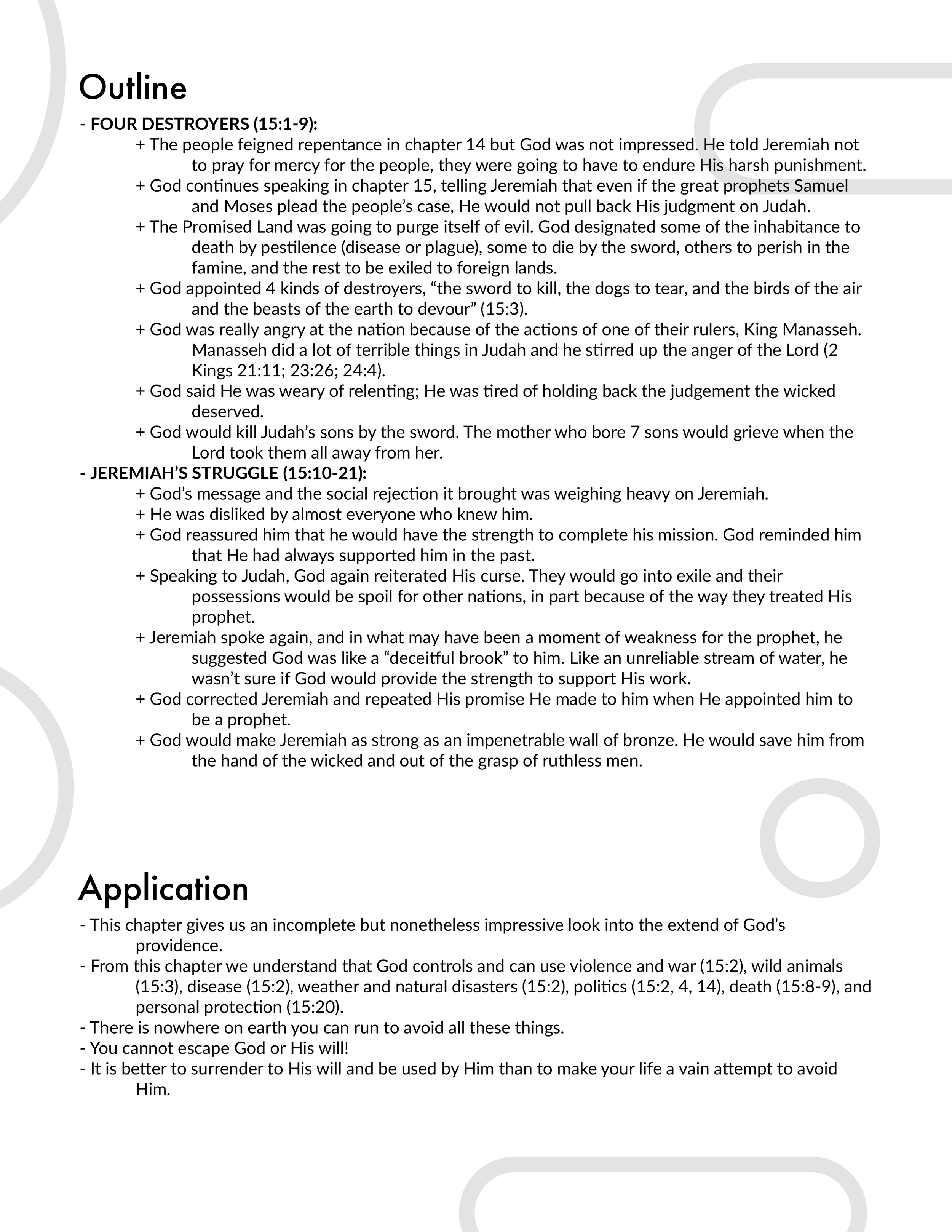
FOUR DESTROYERS (15:1-9):
The people feigned repentance in chapter 14 but God was not impressed. He told Jeremiah not to pray for mercy for the people, they were going to have to endure His harsh punishment.
God continues speaking in chapter 15, telling Jeremiah that even if the great prophets Samuel and Moses plead the people’s case, He would not pull back His judgment on Judah.
The Promised Land was going to purge itself of evil. God designated some of the inhabitance to death by pestilence (disease or plague), some to die by the sword, others to perish in the famine, and the rest to be exiled to foreign lands.
God appointed 4 kinds of destroyers, “the sword to kill, the dogs to tear, and the birds of the air and the beasts of the earth to devour” (15:3).
God was really angry at the nation because of the actions of one of their rulers, King Manasseh. Manasseh did a lot of terrible things in Judah and he stirred up the anger of the Lord (2 Kings 21:11; 23:26; 24:4).
God said He was weary of relenting; He was tired of holding back the judgement the wicked deserved.
God would kill Judah’s sons by the sword. The mother who bore 7 sons would grieve when the Lord took them all away from her.
JEREMIAH’S STRUGGLE (15:10-21):
God’s message and the social rejection it brought was weighing heavy on Jeremiah.
He was disliked by almost everyone who knew him.
God reassured him that he would have the strength to complete his mission. God reminded him that He had always supported him in the past.
Speaking to Judah, God again reiterated His curse. They would go into exile and their possessions would be spoil for other nations, in part because of the way they treated His prophet.
Jeremiah spoke again, and in what may have been a moment of weakness for the prophet, he suggested God was like a “deceitful brook” to him. Like an unreliable stream of water, he wasn’t sure if God would provide the strength to support His work.
God corrected Jeremiah and repeated His promise He made to him when He appointed him to be a prophet.
God would make Jeremiah as strong as an impenetrable wall of bronze. He would save him from the hand of the wicked and out of the grasp of ruthless men.
APPLICATION:
This chapter gives us an incomplete but nonetheless impressive look into the extend of God’s providence.
From this chapter we understand that God controls and can use violence and war (15:2), wild animals (15:3), disease (15:2), weather and natural disasters (15:2), politics (15:2, 4, 14), death (15:8-9), and personal protection (15:20).
There is nowhere on earth you can run to avoid all these things.
You cannot escape God or His will!
It is better to surrender to His will and be used by Him than to make your life a vain attempt to avoid Him.
