Jeremiah 17 - Bible Study, Explanation, and Application

Jeremiah 17 Bible Study
INTRO AND TIMELINE:
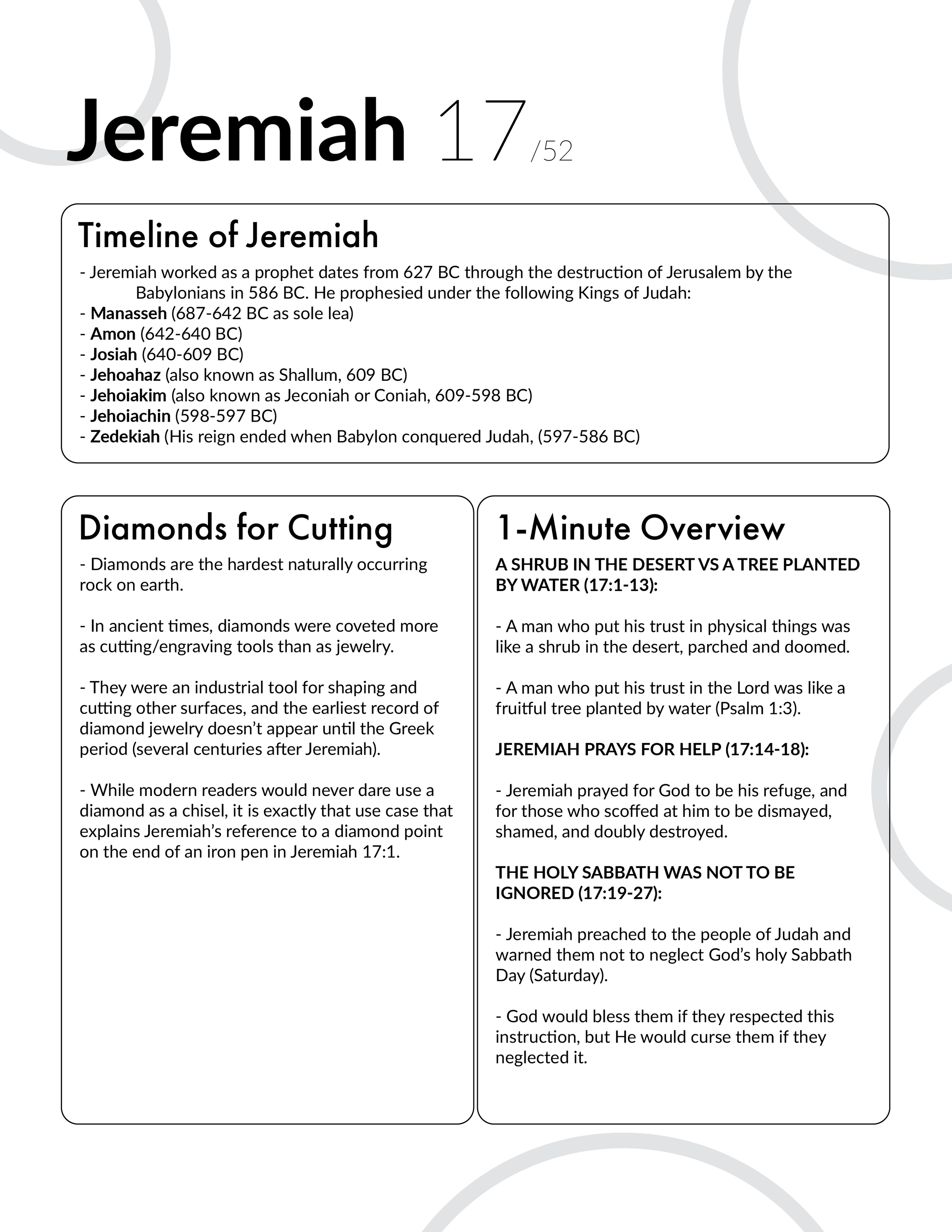
Jeremiah was a priest who lived in Anathoth (3 miles from Jerusalem). His ministry was directed towards the people of Judah, immediately before and during their exile in Babylon. His work as a prophet dates from 627 BC through the destruction of Jerusalem by the Babylonians in 586 BC.
Jeremiah is the longest book in the English Bible by word count. The book has 52 chapters.
Jeremiah prophesied under the following Kings of Judah:
Manasseh (687-642 BC)
Amos (642-640 BC)
Josiah (640-609 BC)
Jehoahaz (also known as Shallum, 609 BC)
Jehoiakim (also known as Jeconiah or Coniah, 609-598 BC)
Jehoiachin (598-597 BC)
Zedekiah (His reign ended when Babylon conquered Judah, (597-586 BC)
DIAMONDS FOR CUTTING:
Diamonds are the hardest naturally occurring rock on earth.
In ancient times, diamonds were coveted more as cutting/engraving tools than as jewelry.
They were an industrial tool for shaping and cutting other surfaces, and the earliest record of diamond jewelry doesn’t appear until the Greek period (several centuries after Jeremiah).
While modern readers would never dare use a diamond as a chisel, it is exactly that use case that explains Jeremiah’s reference to a diamond point on the end of an iron pen in Jeremiah 17:1.
OUTLINE:
A SHRUB IN THE DESERT VS A TREE PLANTED BY WATER (17:1-13):
Judah’s sins were engraved on their hearts as if cut there with an iron pen with a diamond tip.
Their children were exposed to the Asherim idols and the worship of false gods.
God was going to take all their wealth and give it to foreigners as the price for their sins.
A man who put his trust in physical things was like a shrub in the desert, parched and doomed.
A man who put his trust in the Lord was like a fruitful tree planted by water (Psalm 1:3).
Jeremiah wrote that the human heart often leads people astray. It leads us to put our trust in the physical, and its impulses must be corrected by the words of God. He wrote, “The heart is deceitful above all things, and desperately sick” (17:9).
Every human who turned away from the Lord’s direction would end up in shame, having put their trust in earthly hopes. Their names would be written on the earth but not in heaven.
JEREMIAH PRAYS FOR HELP (17:14-18):
Jeremiah’s trust was in the Lord, but he was being persecuted by men with carnal minds.
These men mocked his work as a prophet.
Jeremiah prayed for God to be his refuge, and for those who scoffed at him to be dismayed, shamed, and doubly destroyed.
THE HOLY SABBATH WAS NOT TO BE IGNORED (17:19-27):
Jeremiah was told to go to the People’s Gate and preach to the people of Jerusalem instructing them to ensure they observed God’s Sabbath Day of rest (Saturday).
They were warned not to neglect the Sabbath as their ancestors had.
God would bless them if they respected this instruction, but He would curse them if they neglected it.
APPLICATION:
Why would someone want to work on the Sabbath Day?
Maybe they owned a shop and that was another day to make income. Maybe they needed to be somewhere the next week, and they wanted that day to travel. Maybe they thought Sabbath was a wasted day they could have been accomplishing house chores.
Travelling and working weren’t bad things, but sometimes things that aren’t inherently bad can become bad when we give them place over God’s special day.
While I don’t believe the New Testament requires Christians to keep a Sabbath Day, I think there is application of this principle within the life of the Church.
God tells us not to fail to assemble with the Church for worship and fellowship (Heb 10:25). While schedules differ slightly, almost universally, churches gather on Sunday morning. Is it too much for God to ask us to be there?
We are free to do almost anything we want the rest of the week. Is Sunday too much to ask?
The people of Judah thought Saturday was too much to ask, and their lack of devotion to God is obvious to us, what does it say about us when we can’t be bothered to hold space for God one day a week?
