Jeremiah 18 - Bible Study, Explanation, and Application
Jeremiah 18 Bible Study
INTRO AND TIMELINE:
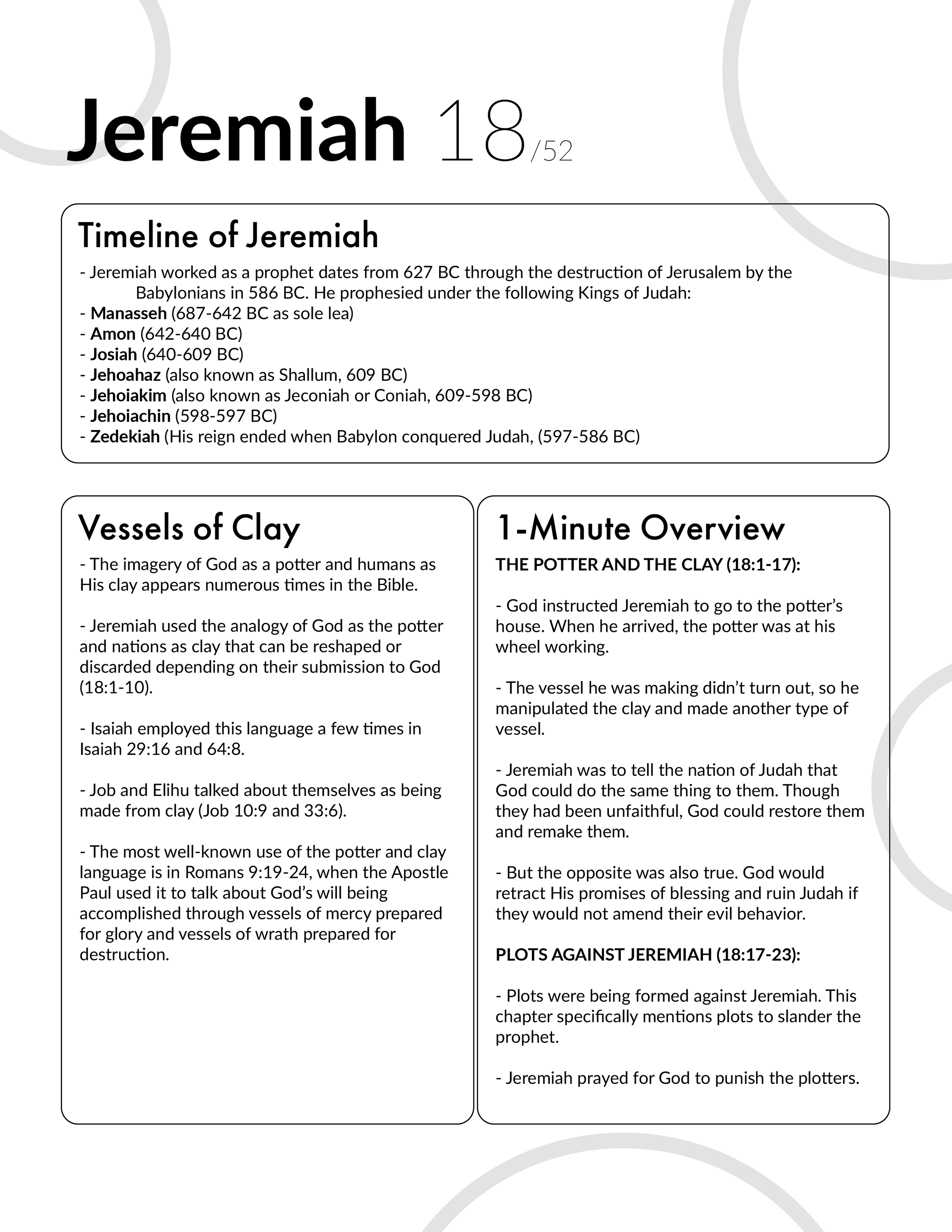
Jeremiah was a priest who lived in Anathoth (3 miles from Jerusalem). His ministry was directed towards the people of Judah, immediately before and during their exile in Babylon. His work as a prophet dates from 627 BC through the destruction of Jerusalem by the Babylonians in 586 BC.
Jeremiah is the longest book in the English Bible by word count. The book has 52 chapters.
Jeremiah prophesied under the following Kings of Judah:
Manasseh (687-642 BC)
Amos (642-640 BC)
Josiah (640-609 BC)
Jehoahaz (also known as Shallum, 609 BC)
Jehoiakim (also known as Jeconiah or Coniah, 609-598 BC)
Jehoiachin (598-597 BC)
Zedekiah (His reign ended when Babylon conquered Judah, (597-586 BC)
VESSELS OF CLAY:
The imagery of God as a potter and humans as His clay appears numerous times in the Bible.
Jeremiah used the analogy of God as the potter and nations as clay that can be reshaped or discarded depending on their submission to God (18:1-10).
Isaiah employed this language a few times in Isaiah 29:16 and 64:8.
Job and Elihu talked about themselves as being made from clay (Job 10:9 and 33:6).
The most well-known use of the potter and clay language is in Romans 9:19-24, when the Apostle Paul used it to talk about God’s will being accomplished through vessels of mercy prepared for glory and vessels of wrath prepared for destruction.
OUTLINE:
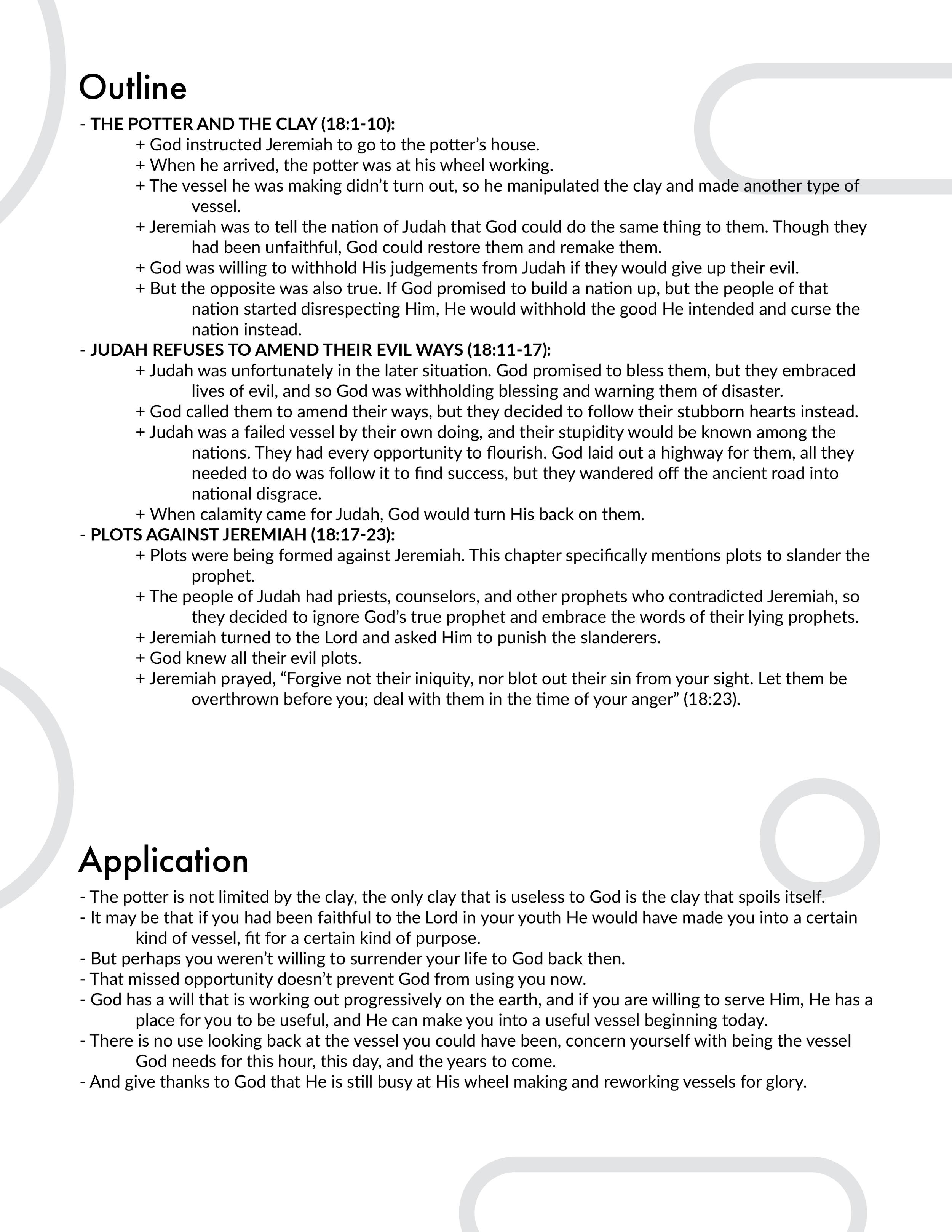
THE POTTER AND THE CLAY (18:1-10):
God instructed Jeremiah to go to the potter’s house.
When he arrived, the potter was at his wheel working.
The vessel he was making didn’t turn out, so he manipulated the clay and made another type of vessel.
Jeremiah was to tell the nation of Judah that God could do the same thing to them. Though they had been unfaithful, God could restore them and remake them.
God was willing to withhold His judgements from Judah if they would give up their evil.
But the opposite was also true. If God promised to build a nation up, but the people of that nation started disrespecting God, He would withhold the good He intended and curse the nation instead.
JUDAH REFUSES TO AMEND THEIR EVIL WAYS (18:11-17):
Judah was unfortunately in the later situation. God promised to bless them, but they embraced lives of evil, and so God was withholding blessing and warning them of disaster.
God called them to amend their ways, but they decided to follow their stubborn hearts instead.
Judah was a failed vessel by their own doing, and their stupidity would be known among the nations. They had every opportunity to flourish. God laid out a highway for them, all they needed to do was follow it to find success, but they wandered off the ancient road into national disgrace.
When calamity came for Judah, God would turn His back on them.
PLOTS AGAINST JEREMIAH (18:17-23):
Plots were being formed against Jeremiah. This chapter specifically mentions plots to slander the prophet.
The people of Judah had priests, counselors, and other prophets who contradicted Jeremiah, so they decided to ignore God’s true prophet and embrace the words of their lying prophets.
Jeremiah turned to the Lord and asked Him to punish the slanderers.
God knew all their evil plots.
Jeremiah prayed, “Forgive not their iniquity, nor blot out their sin from your sight. Let them be overthrown before you; deal with them in the time of your anger” (18:23).
APPLICATION:
The potter is not limited by the clay, the only clay that is useless to God is the clay that spoils itself.
It may be that if you had been faithful to the Lord in your youth He would have made you into a certain kind of vessel, fit for a certain kind of purpose.
But perhaps you weren’t willing to surrender your life to God back then.
That missed opportunity doesn’t prevent God from using you now.
God has a will that is working out progressively on the earth, and if you are willing to serve Him, He has a place for you to be useful, and He can make you into a useful vessel beginning today.
There is no use looking back at the vessel you could have been, concern yourself with being the vessel God needs for this hour, this day, and the years to come.
And give thanks to God that He is still busy at His wheel making and reworking vessels for glory.
