Jeremiah 19 - Bible Study, Explanation, and Application
Jeremiah 19 Bible Study
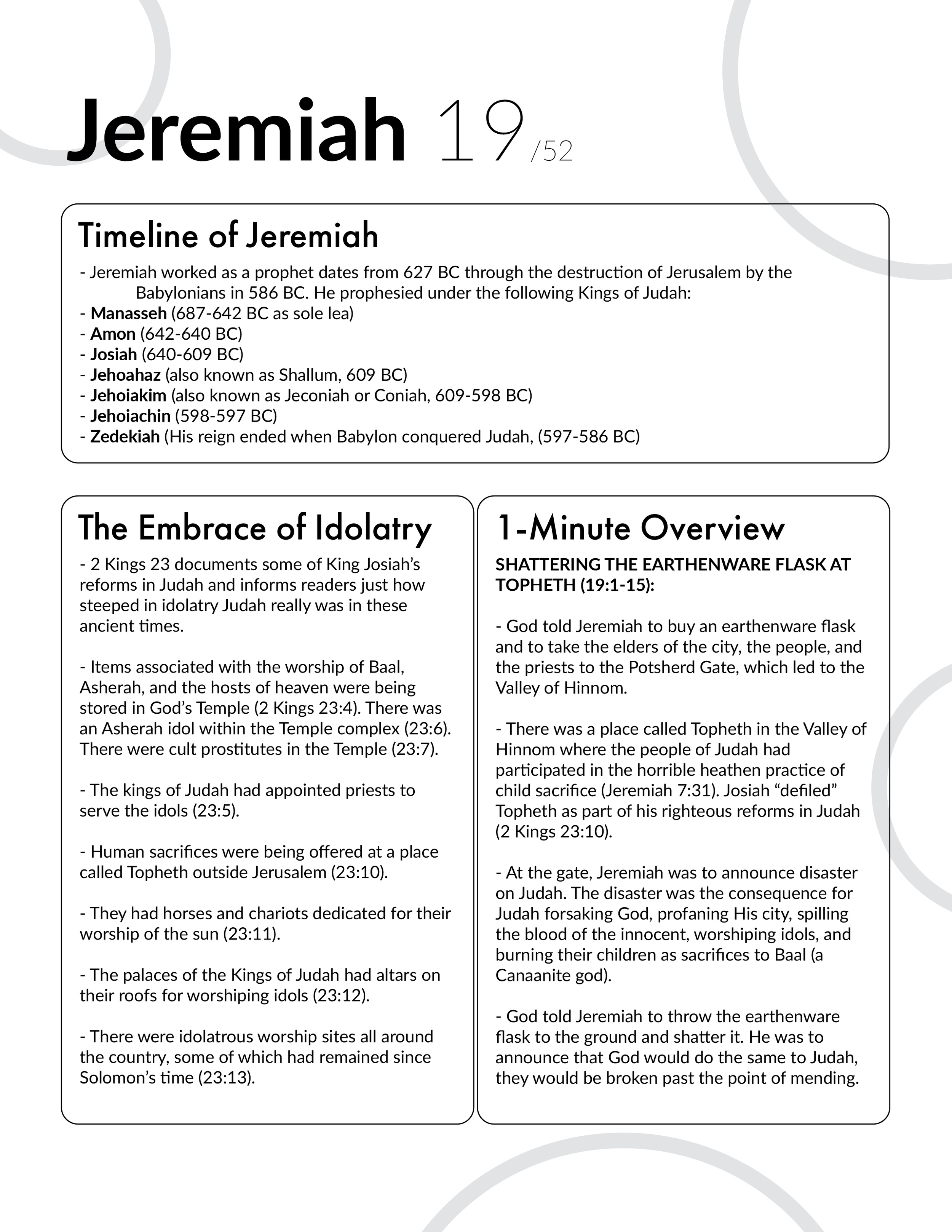
INTRO AND TIMELINE:
Jeremiah was a priest who lived in Anathoth (3 miles from Jerusalem). His ministry was directed towards the people of Judah, immediately before and during their exile in Babylon. His work as a prophet dates from 627 BC through the destruction of Jerusalem by the Babylonians in 586 BC.
Jeremiah is the longest book in the English Bible by word count. The book has 52 chapters.
Jeremiah prophesied under the following Kings of Judah:
Manasseh (687-642 BC)
Amos (642-640 BC)
Josiah (640-609 BC)
Jehoahaz (also known as Shallum, 609 BC)
Jehoiakim (also known as Jeconiah or Coniah, 609-598 BC)
Jehoiachin (598-597 BC)
Zedekiah (His reign ended when Babylon conquered Judah, (597-586 BC)
EMBRACE OF IDOLATRY:
2 Kings 23 documents some of King Josiah’s reforms in Judah and informs readers just how steeped in idolatry Judah really was in these ancient times.
Items associated with the worship of Baal, Asherah, and the hosts of heaven were being stored in God’s Temple (2 Kings 23:4).
There was an Asherah idol within the Temple complex (23:6).
There were cult prostitutes in the Temple (23:7).
The kings of Judah had appointed priests to serve the idols (23:5).
Human sacrifices were being offered at a place called Topheth outside Jerusalem (23:10).
They had horses and chariots dedicated for their worship of the sun (23:11).
The palaces of the Kings of Judah had altars on their roofs for worshiping idols (23:12).
There were idolatrous worship sites all around the country, some of which had remained since Solomon’s time (23:13).
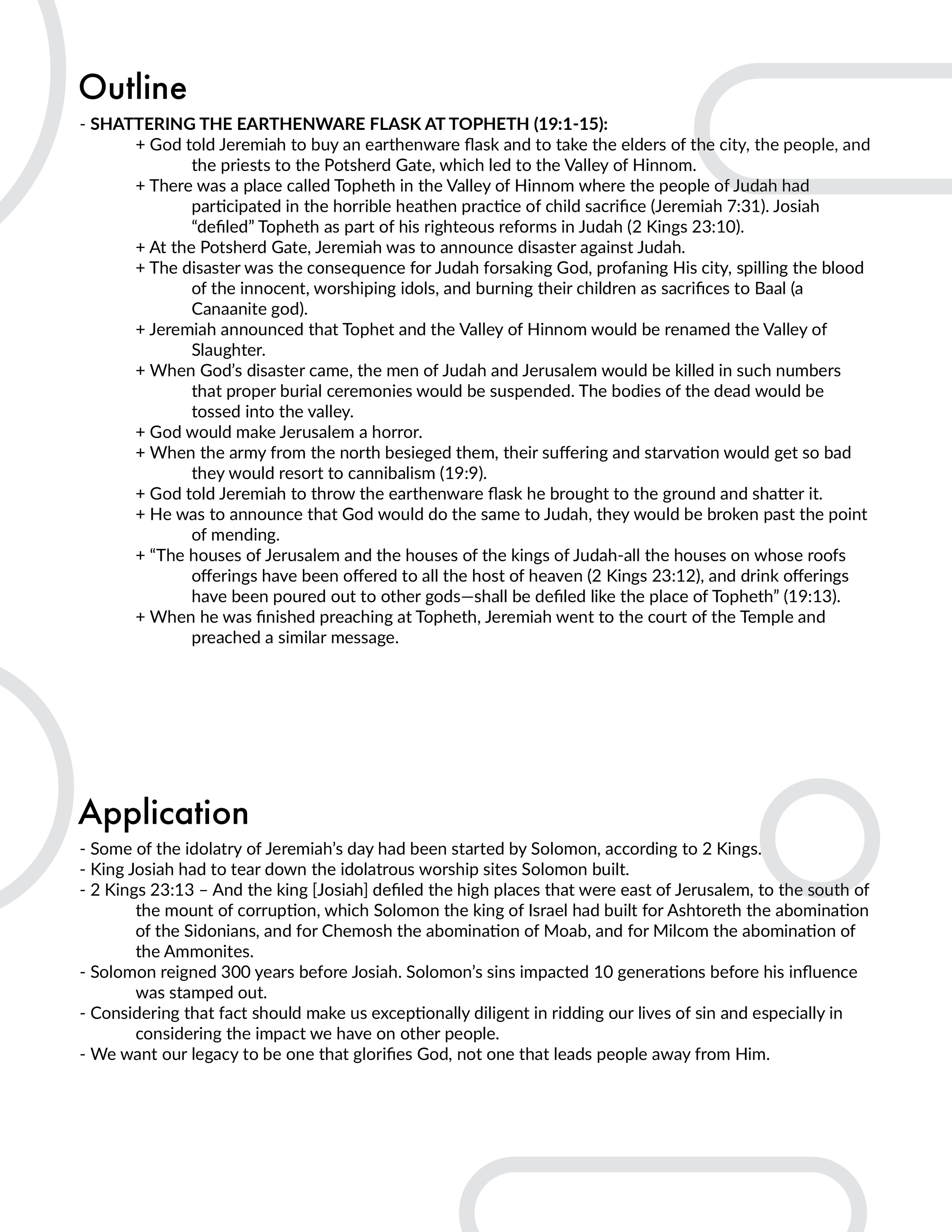
OUTLINE:
SHATTERING THE EARTHENWARE FLASK AT TOPHETH (19:1-15):
God told Jeremiah to buy an earthenware flask and to take the elders of the city, the people, and the priests to the Potsherd Gate, which led to the Valley of Hinnom.
There was a place called Topheth in the Valley of Hinnom where the people of Judah had participated in the horrible heathen practice of child sacrifice (Jeremiah 7:31). Josiah “defiled” Topheth as part of his righteous reforms in Judah (2 Kings 23:10).
At the Potsherd Gate, Jeremiah was to announce disaster against Judah.
The disaster was the consequence for Judah forsaking God, profaning His city, spilling the blood of the innocent, worshiping idols, and burning their children as sacrifices to Baal (a Canaanite god).
Jeremiah announced that Tophet and the Valley of Hinnom would be renamed the Valley of Slaughter.
When God’s disaster came, the men of Judah and Jerusalem would be killed in such numbers that proper burial ceremonies would be suspended. The bodies of the dead would be tossed into the valley.
God would make Jerusalem a horror.
When the army from the north besieged them, their suffering and starvation would get so bad they would resort to cannibalism (19:9).
God told Jeremiah to throw the earthenware flask he brought to the ground and shatter it.
He was to announce that God would do the same to Judah, they would be broken past the point of mending.
“The houses of Jerusalem and the houses of the kings of Judah-all the houses on whose roofs offerings have been offered to all the host of heaven (2 Kings 23:12), and drink offerings have been poured out to other gods—shall be defiled like the place of Topheth” (19:13).
When he was finished preaching at Topheth, Jeremiah went to the court of the Temple and preached a similar message.
APPLICATION:
Some of the idolatry of Jeremiah’s day had been started by Solomon, according to 2 Kings.
King Josiah had to tear down the idolatrous worship sites Solomon built.
2 Kings 23:13 – And the king [Josiah] defiled the high places that were east of Jerusalem, to the south of the mount of corruption, which Solomon the king of Israel had built for Ashtoreth the abomination of the Sidonians, and for Chemosh the abomination of Moab, and for Milcom the abomination of the Ammonites.
Solomon reigned 300 years before Josiah. Solomon’s sins impacted 10 generations before his influence was stamped out.
Considering that fact should make us exceptionally diligent in ridding our lives of sin and especially in considering the impact we have on other people.
We want our legacy to be one that glorifies God, not one that leads people away from Him.
