Jeremiah 22 - Bible Study, Explanation, and Application
Jeremiah 22 Bible Study
INTRO AND TIMELINE:
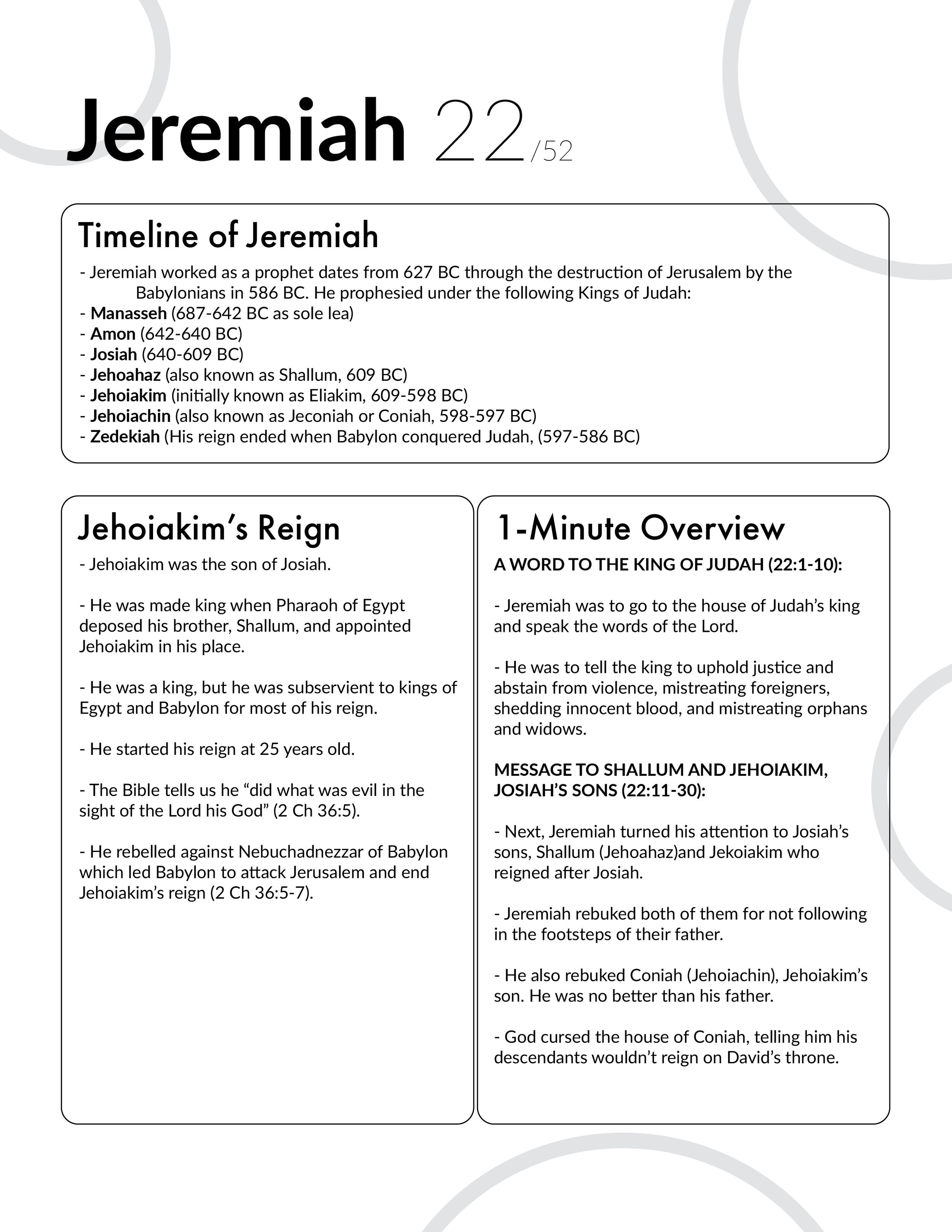
Jeremiah was a priest who lived in Anathoth (3 miles from Jerusalem). His ministry was directed towards the people of Judah, immediately before and during their exile in Babylon. His work as a prophet dates from 627 BC through the destruction of Jerusalem by the Babylonians in 586 BC.
Jeremiah is the longest book in the English Bible by word count. The book has 52 chapters.
Jeremiah prophesied under the following Kings of Judah:
Manasseh (687-642 BC)
Amos (642-640 BC)
Josiah (640-609 BC)
Jehoahaz (also known as Shallum, 609 BC)
Jehoiakim (also known as Jeconiah or Coniah, 609-598 BC)
Jehoiachin (598-597 BC)
Zedekiah (His reign ended when Babylon conquered Judah, (597-586 BC)
JEHOIAKIM’S REIGN:
Jehoiakim was the son of Josiah.
He was made king when Pharaoh of Egypt deposed his brother, Shallum, and appointed Jehoiakim in his place.
He was a king, but he was subservient to kings of Egypt and Babylon for most of his reign.
He started his reign at 25 years old. The Bible
tells us he “did what was evil in the sight of the Lord his God” (2 Ch 36:5).
He rebelled against Nebuchadnezzar of Babylon which led Babylon to attack Jerusalem and end Jehoiakim’s reign (2 Ch 36:5-7).
OUTLINE:
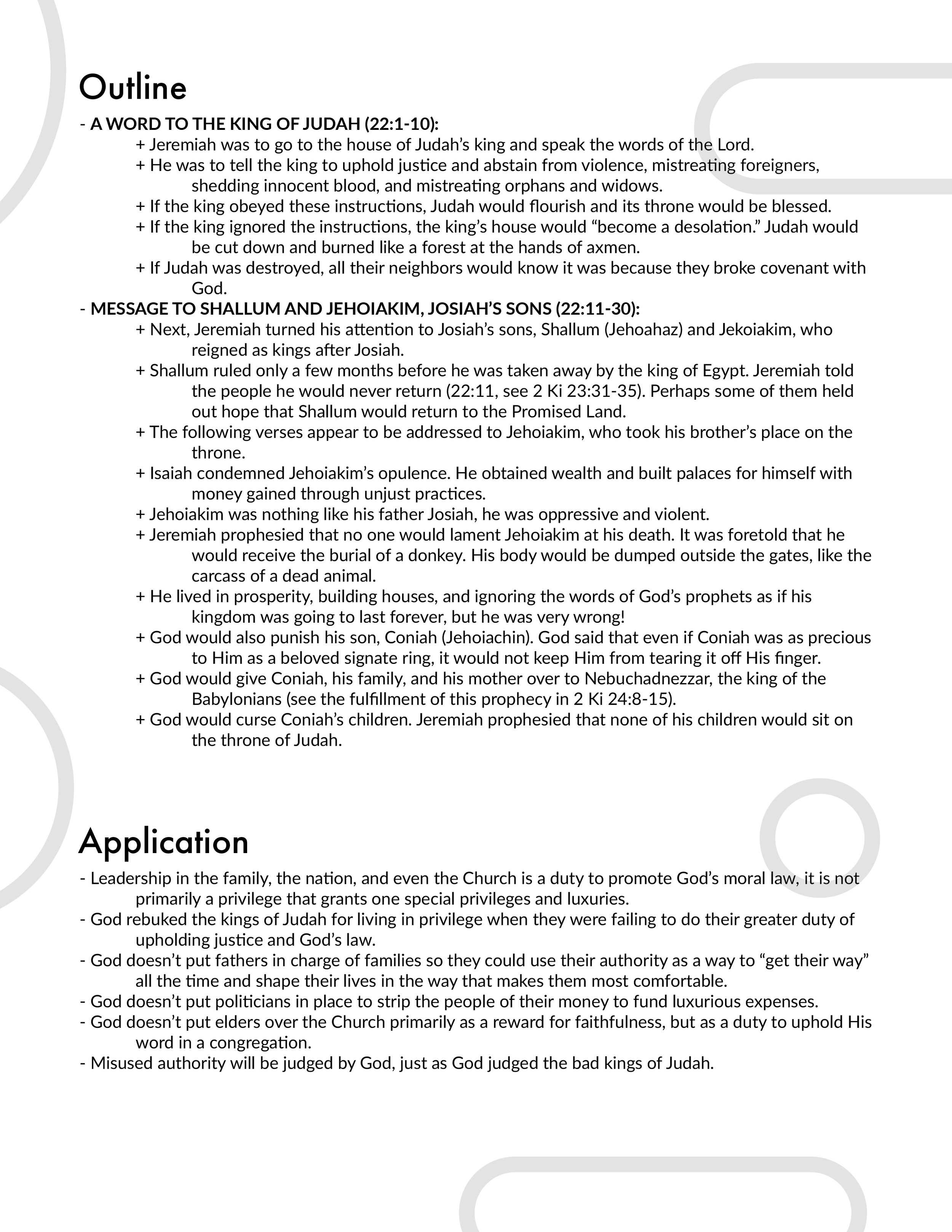
A WORD TO THE KING OF JUDAH (22:1-10):
Jeremiah was to go to the house of Judah’s king and speak the words of the Lord.
He was to tell the king to uphold justice and abstain from violence, mistreating foreigners, shedding innocent blood, and mistreating orphans and widows.
If the king obeyed these instructions, Judah would flourish and its throne would be blessed.
If the king ignored the instructions, the king’s house would “become a desolation.” Judah would be cut down and burned like a forest at the hands of axmen.
If Judah was destroyed, all their neighbors would know it was because they broke covenant with God.
MESSAGE TO SHALLUM AND JEHOIAKIM, JOSIAH’S SONS (22:11-30):
Next, Jeremiah turned his attention to Josiah’s sons, Shallum (Jehoahaz) and Jekoiakim, who reigned as kings after Josiah.
Shallum ruled only a few months before he was taken away by the king of Egypt. Jeremiah told the people he would never return (22:11, see 2 Ki 23:31-35). Perhaps some of them held out hope that Shallum would return to the Promised Land.
The following verses appear to be addressed to Jehoiakim, who took his brother’s place on the throne.
Isaiah condemned Jehoiakim’s opulence. He obtained wealth and built palaces for himself with money gained through unjust practices.
Jehoiakim was nothing like his father Josiah, he was oppressive and violent.
Jeremiah prophesied that no one would lament Jehoiakim at his death. It was foretold that he would receive the burial of a donkey. His body would be dumped outside the gates, like the carcass of a dead animal.
He lived in prosperity, building houses, and ignoring the words of God’s prophets as if his kingdom was going to last forever, but he was very wrong!
God would also punish his son, Coniah (Jehoiachin). God said that even if Coniah was as precious to Him as a beloved signate ring, it would not keep Him from tearing it off His finger.
God would give Coniah, his family, and his mother over to Nebuchadnezzar, the king of the Babylonians (see the fulfillment of this prophecy in 2 Ki 24:8-15).
God would curse Coniah’s children. Jeremiah prophesied that none of his children would sit on the throne of Judah.
APPLICATION:
Leadership in the family, the nation, and even the Church is a duty to promote God’s moral law, it is not primarily a privilege that grants one special privileges and luxuries.
God rebuked the kings of Judah for living in privilege when they were failing to do their greater duty of upholding justice and God’s law.
God doesn’t put fathers in charge of families so they could use their authority as a way to “get their way” all the time and shape their lives in the way that makes them most comfortable.
God doesn’t put politicians in place to strip the people of their money to fund luxurious expenses.
God doesn’t put elders over the Church primarily as a reward for faithfulness, but as a duty to uphold His word in a congregation.
Misused authority will be judged by God, just as God judged the bad kings of Judah.
