Jeremiah 23 - Bible Study, Explanation, and Application
Jeremiah 23 Bible Study
INTRO AND TIMELINE:
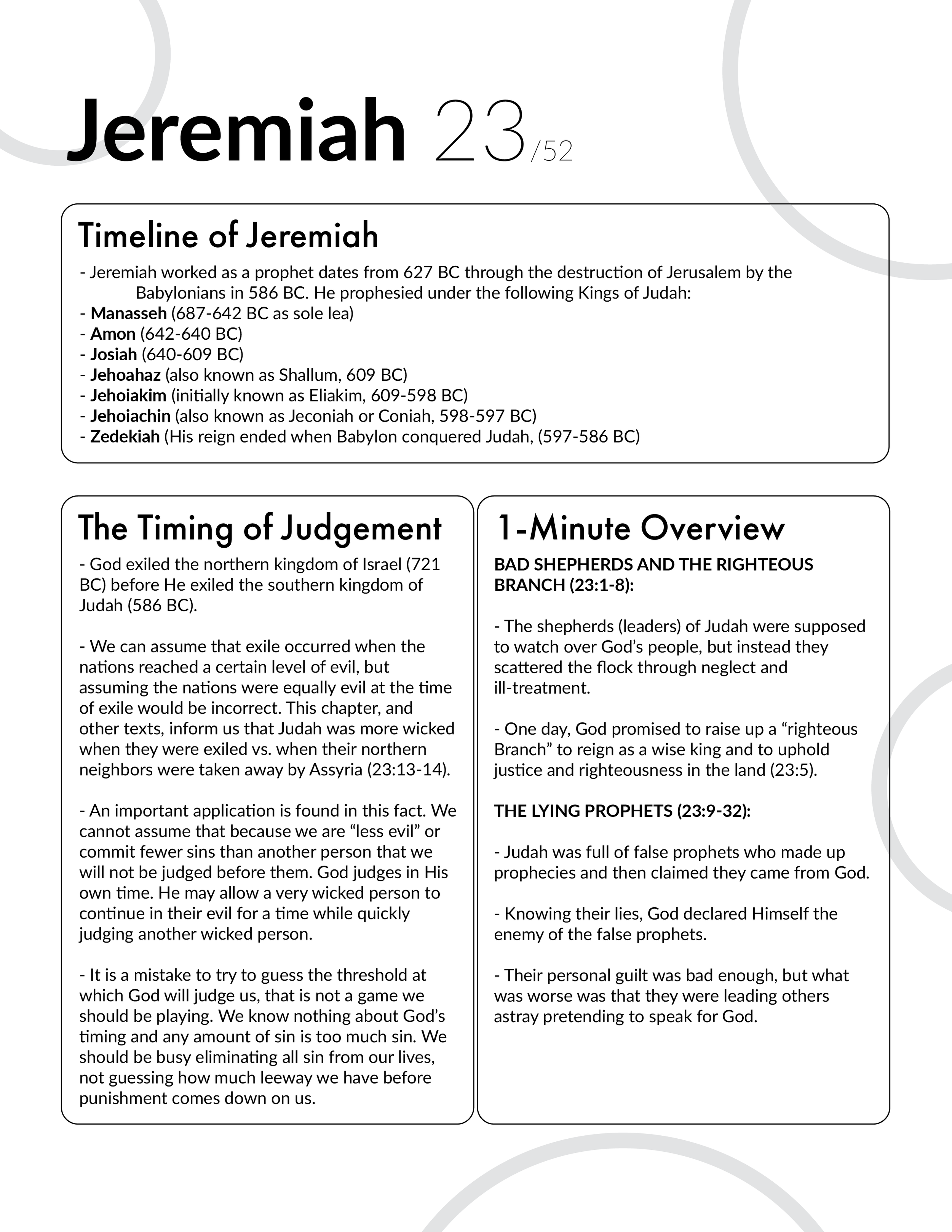
Jeremiah was a priest who lived in Anathoth (3 miles from Jerusalem). His ministry was directed towards the people of Judah, immediately before and during their exile in Babylon. His work as a prophet dates from 627 BC through the destruction of Jerusalem by the Babylonians in 586 BC.
Jeremiah is the longest book in the English Bible by word count. The book has 52 chapters.
Jeremiah prophesied under the following Kings of Judah:
Manasseh (687-642 BC)
Amos (642-640 BC)
Josiah (640-609 BC)
Jehoiakim (initially known as Eliakim, 609-598 BC)
Jehoiachin (also known as Jeconiah or Coniah, 598-597 BC)
Zedekiah (His reign ended when Babylon conquered Judah, (597-586 BC)
TIMING OF JUDGEMENT:
God exiled the northern kingdom of Israel (721 BC) before He exiled the southern kingdom of Judah (586 BC).
It’s easy to assume that exile occurred when the nations reached a certain level of evil, but assuming the nations were equally evil at the time of exile would be incorrect.
This chapter, and other texts, inform us that Judah was significantly more wicked when they were exiled vs. when their northern neighbors were taken away by Assyria (23:13-14).
An important application is found in this fact. We cannot assume that because we are “less evil” or commit fewer sins than another person that we will not be judged before them.
God judges in His own time. He may allow a very wicked person to continue in their evil for a time while quickly judging another wicked person.
It is a mistake to try to guess the threshold at which God will judge us, that is not a game we should be playing. We know nothing about God’s timing and any amount of sin is too much sin.
We should be busy eliminating all sin from our lives, not guessing how much leeway we have before punishment comes down on us.
OUTLINE:
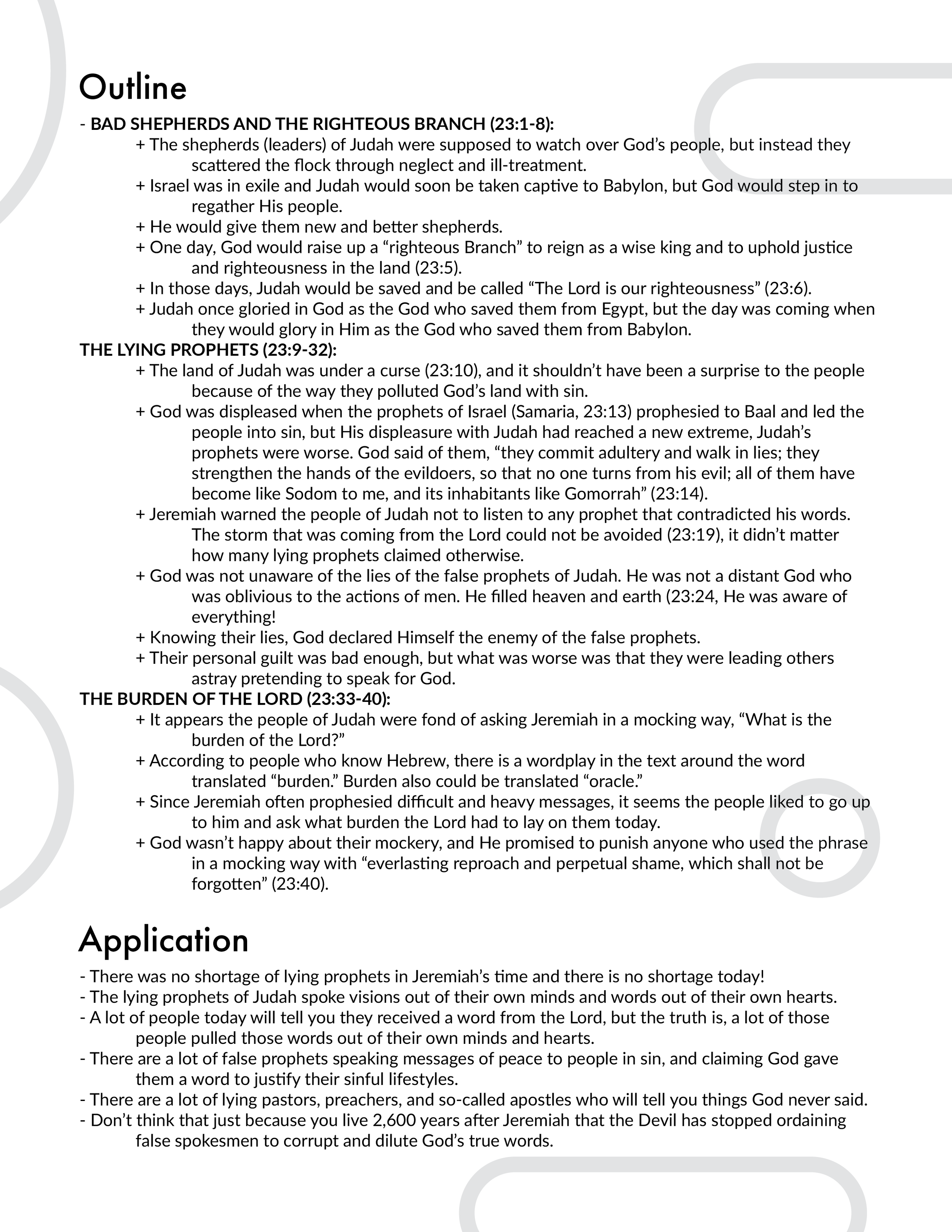
BAD SHEPHERDS AND THE RIGHTEOUS BRANCH (23:1-8):
The shepherds (leaders) of Judah were supposed to watch over God’s people, but instead they scattered the flock through neglect and ill-treatment.
Israel was in exile and Judah would soon be taken captive to Babylon, but God would step in to regather His people.
He would give them new and better shepherds.
One day, God would raise up a “righteous Branch” to reign as a wise king and to uphold justice and righteousness in the land (23:5).
In those days, Judah would be saved and be called “The Lord is our righteousness” (23:6).
Judah once gloried in God as the God who saved them from Egypt, but the day was coming when they would glory in Him as the God who saved them from Babylon.
THE LYING PROPHETS (23:9-32):
The land of Judah was under a curse (23:10), and it shouldn’t have been a surprise to the people because of the way they polluted God’s land with sin.
God was displeased when the prophets of Israel (Samaria, 23:13) prophesied to Baal and led the people into sin, but His displeasure with Judah had reached a new extreme, Judah’s prophets were worse. God said of them, “they commit adultery and walk in lies; they strengthen the hands of the evildoers, so that no one turns from his evil; all of them have become like Sodom to me, and its inhabitants like Gomorrah” (23:14).
Jeremiah warned the people of Judah not to listen to any prophet that contradicted his words. The storm that was coming from the Lord could not be avoided (23:19), it didn’t matter how many lying prophets claimed otherwise.
God was not unaware of the lies of the false prophets of Judah. He was not a distant God who was oblivious to the actions of men. He filled heaven and earth (23:24, He was aware of everything!
Knowing their lies, God declared Himself the enemy of the false prophets.
Their personal guilt was bad enough, but what was worse was that they were leading others astray pretending to speak for God.
THE BURDEN OF THE LORD (23:33-40):
It appears the people of Judah were fond of asking Jeremiah in a mocking way, “What is the burden of the Lord?”
According to people who know Hebrew, there is a wordplay in the text around the word translated “burden.” Burden also could be translated “oracle.”
Sense Jeremiah often prophesied difficult and heavy messages, it seems the people liked to go up to him and ask what burden the Lord had to lay on them today.
God wasn’t happy about their mockery, and He promised to punish anyone who used the phrase in a mocking way with “everlasting reproach and perpetual shame, which shall not be forgotten” (23:40).
APPLICATION:
There was no shortage of lying prophets in Jeremiah’s time and there is no shortage of lying prophets today!
God said the lying prophets of Judah spoke visions out of their own minds and words out of their own hearts.
A lot of people today will tell you they received a word from the Lord, but the truth is, a lot of those people pulled those words out of their own minds and hearts.
There are a lot of false prophets speaking messages of peace to people in sin, and claiming God gave them a word to justify their sinful lifestyles.
There are a lot of lying pastors, preachers, and so-called apostles who will tell you things that God never said.
Don’t think that just because you live 2,600 years after Jeremiah that the Devil has stopped ordaining false spokesmen to corrupt and dilute God’s true words.
