Jeremiah 26 - Bible Study, Explanation, and Application
Jeremiah 26 Bible Study
INTRO AND TIMELINE:
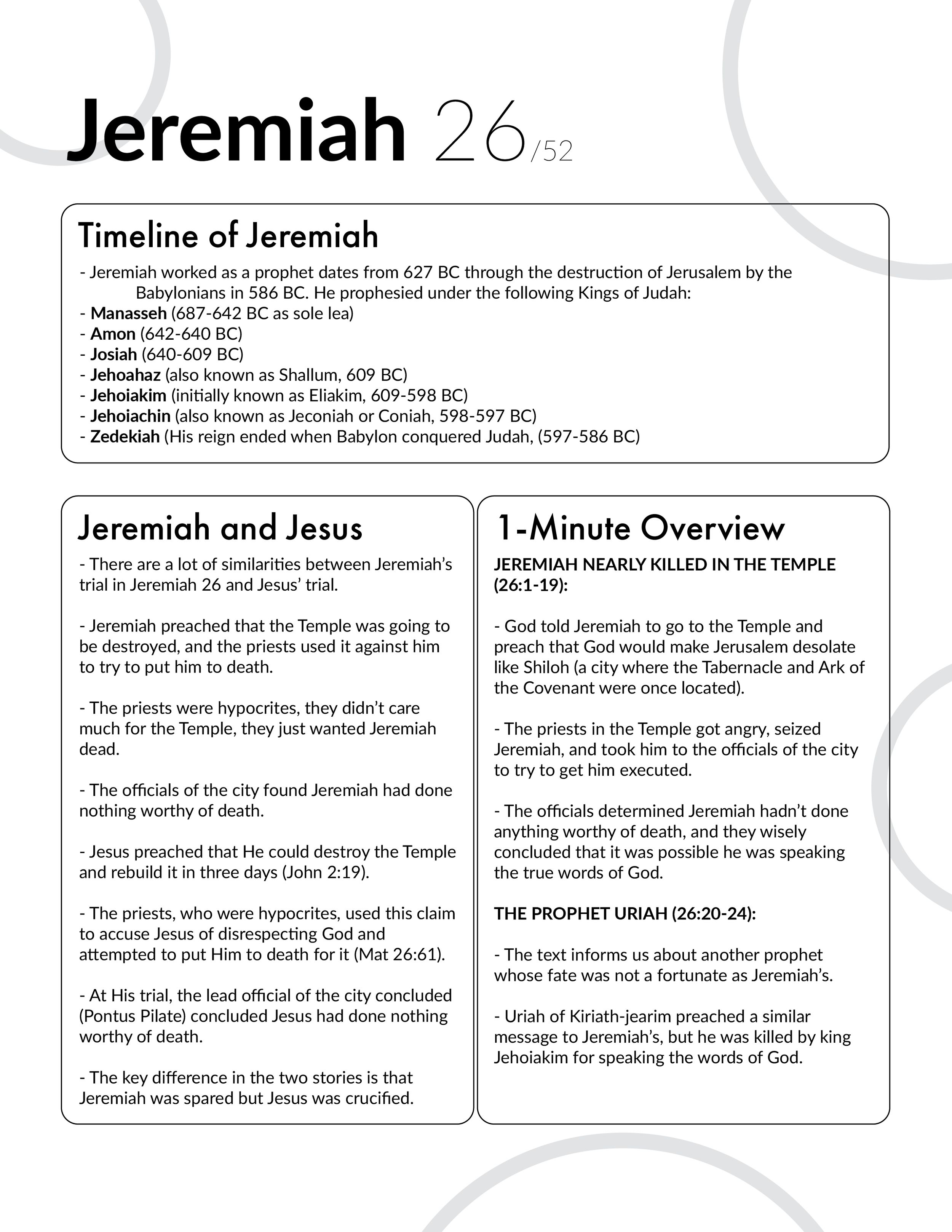
Jeremiah was a priest who lived in Anathoth (3 miles from Jerusalem). His ministry was directed towards the people of Judah, immediately before and during their exile in Babylon. His work as a prophet dates from 627 BC through the destruction of Jerusalem by the Babylonians in 586 BC.
Jeremiah is the longest book in the English Bible by word count. The book has 52 chapters.
Jeremiah prophesied under the following Kings of Judah:
Manasseh (687-642 BC)
Amos (642-640 BC)
Josiah (640-609 BC)
Jehoiakim (initially known as Eliakim, 609-598 BC)
Jehoiachin (also known as Jeconiah or Coniah, 598-597 BC)
Zedekiah (His reign ended when Babylon conquered Judah, (597-586 BC)
JEREMIAH AND JESUS:
There are a lot of similarities between Jeremiah’s trial in Jeremiah 26 and Jesus’ trial.
Jeremiah preached that the Temple was going to be destroyed, and the priests used it against him to try to put him to death.
The priests were hypocrites, they didn’t care much for the Temple, they just wanted Jeremiah dead.
The officials of the city found Jeremiah had done nothing worthy of death.
Jesus preached that He could destroy the Temple and rebuild it in three days (John 2:19).
The priests used this claim to accuse Jesus of disrespecting God and attempted to put Him to death for it (Matthew 26:61).
At His trial, the lead official of the city concluded (Pontus Pilate) concluded Jesus had done nothing worthy of death.
The key difference in the two stories is that Jeremiah was spared but Jesus was crucified.
OUTLINE:
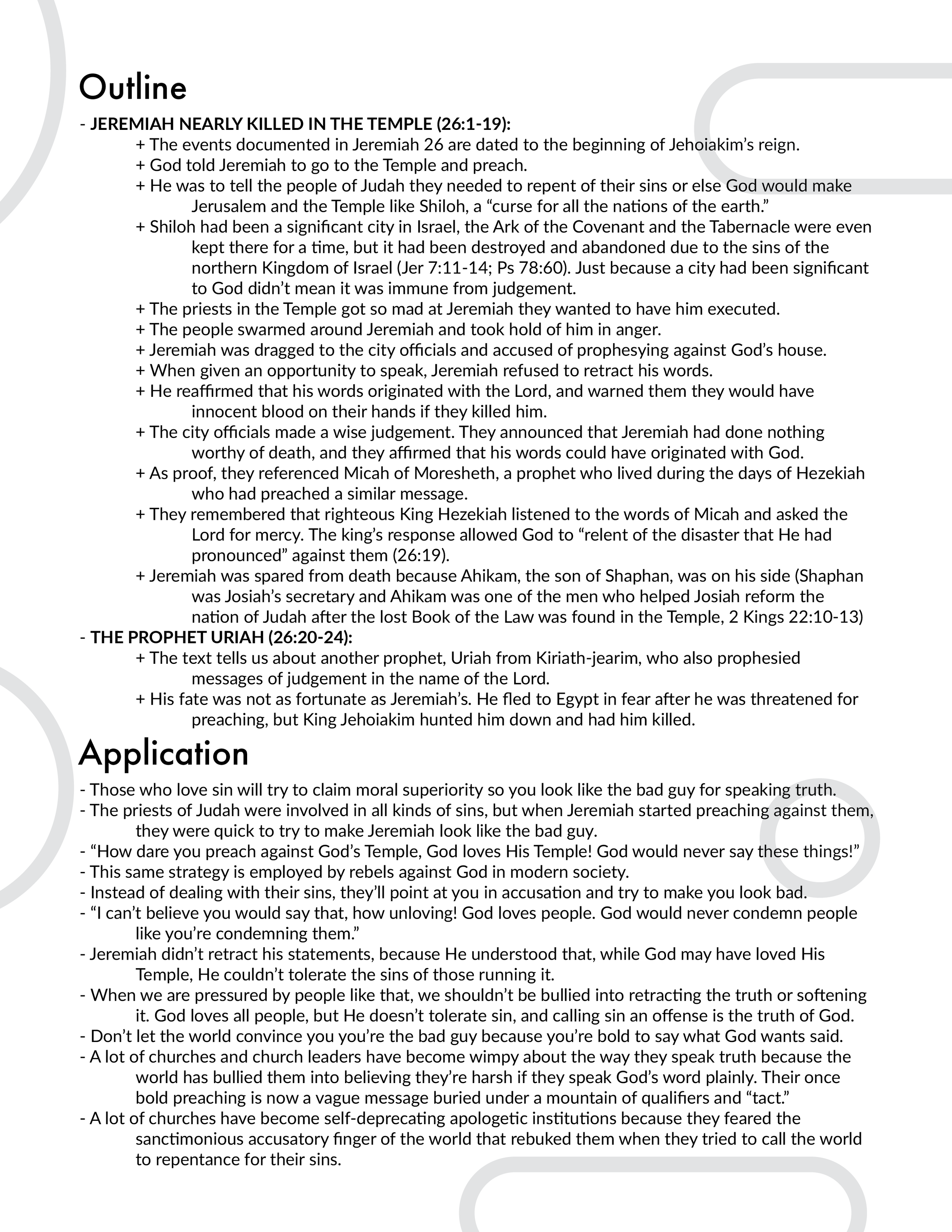
JEREMIAH NEARLY KILLED IN THE TEMPLE (26:1-19):
The events documented in Jeremiah 26 are dated to the beginning of Jehoiakim’s reign.
God told Jeremiah to go to the Temple and preach.
He was to tell the people of Judah they needed to repent of their sins or else God would make Jerusalem and the Temple like Shiloh, a “curse for all the nations of the earth.”
Shiloh had been a significant city in Israel, the Ark of the Covenant and the Tabernacle were even kept there for a time, but it had been destroyed and abandoned due to the sins of the northern Kingdom of Israel (Jer 7:11-14; Ps 78:60). Just because a city had been significant to God didn’t mean it was immune from judgement.
The priests in the Temple got so mad at Jeremiah they wanted to have him executed.
The people swarmed around Jeremiah and took hold of him in anger.
Jeremiah was dragged to the city officials and accused of prophesying against God’s house.
When given an opportunity to speak, Jeremiah refused to retract his words, he told the people to amend their sinful ways.
He reaffirmed that his words originated with the Lord, and warned them they would have innocent blood on their hands if they killed him.
The city officials made a wise judgement. They announced that Jeremiah had done nothing worthy of death, and they affirmed that his words could have originated with God.
As proof, they referenced Micah of Moresheth, a prophet who lived during the days of Hezekiah who had preached a similar message.
They remembered that righteous King Hezekiah listened to the words of Micah and asked the Lord for mercy. The king’s response allowed God to “relent of the disaster that He had pronounced” against them (26:19).
Jeremiah was spared from death because Ahikam, the son of Shaphan, was on his side (Shaphan was Josiah’s secretary and Ahikam was one of the men who helped Josiah reform the nation of Judah after the lost Book of the Law was found in the Temple, 2 Kings 22:10-13)
THE PROPHET URIAH (26:20-24):
The text tells us about another prophet, Uriah from Kiriath-jearim, who also prophesied messages of judgement in the name of the Lord.
His fate was not as fortunate as Jeremiah’s.
He fled to Egypt in fear after he was threatened for preaching, but King Jehoiakim hunted him down and had him killed.
APPLICATION:
Those who are rebelliously involved in sin will always try to claim moral superiority and make you look like the bad guy for speaking God’s truth.
The priests of Judah were involved in all kinds of sins, but when Jeremiah started preaching against them, they were quick to try to make Jeremiah look like the bad guy.
“How dare you preach against God’s Temple, God loves His Temple! You are saying things God would never say!”
This same strategy is employed by by rebels against God in modern society.
Instead of dealing with their own sins, they’ll point at you in accusation and try to make you look like the bad guy.
“I can’t believe you would say that, how unloving! God loves people. God would never condemn people like you’re condemning them.”
Jeremiah didn’t retract his statements, because He understood that, while God may have loved His Temple, He couldn’t tolerate the sins of those running it.
When we are pressured by people like that, we shouldn’t be bullied into retracting the truth or softening it, because while God loves all people, He doesn’t tolerate sin, and calling sin a condemnable offense is the true word of God.
Don’t let the world convince you you’re the bad guy because you are bold enough to say what God wants said.
In recent years, a lot of churches and church leaders have become very wimpy about the way they speak truth because the world has bullied them into believing they are harsh if they speak God’s words plainly. Their once bold preaching is now a vague message buried under a mountain of qualifiers and “tact.”
A lot of churches have become self-deprecating apologetic institutions because they feared the sanctimonious accusatory finger of the world that rebuked them when they tried to call the world to repentance for their sins.
Jeremiah was no wimp. Jesus was no wimp. We need to model their preaching.
