Jeremiah 29 - Bible Study, Explanation, and Application
Jeremiah 29 Bible Study
INTRO AND TIMELINE:
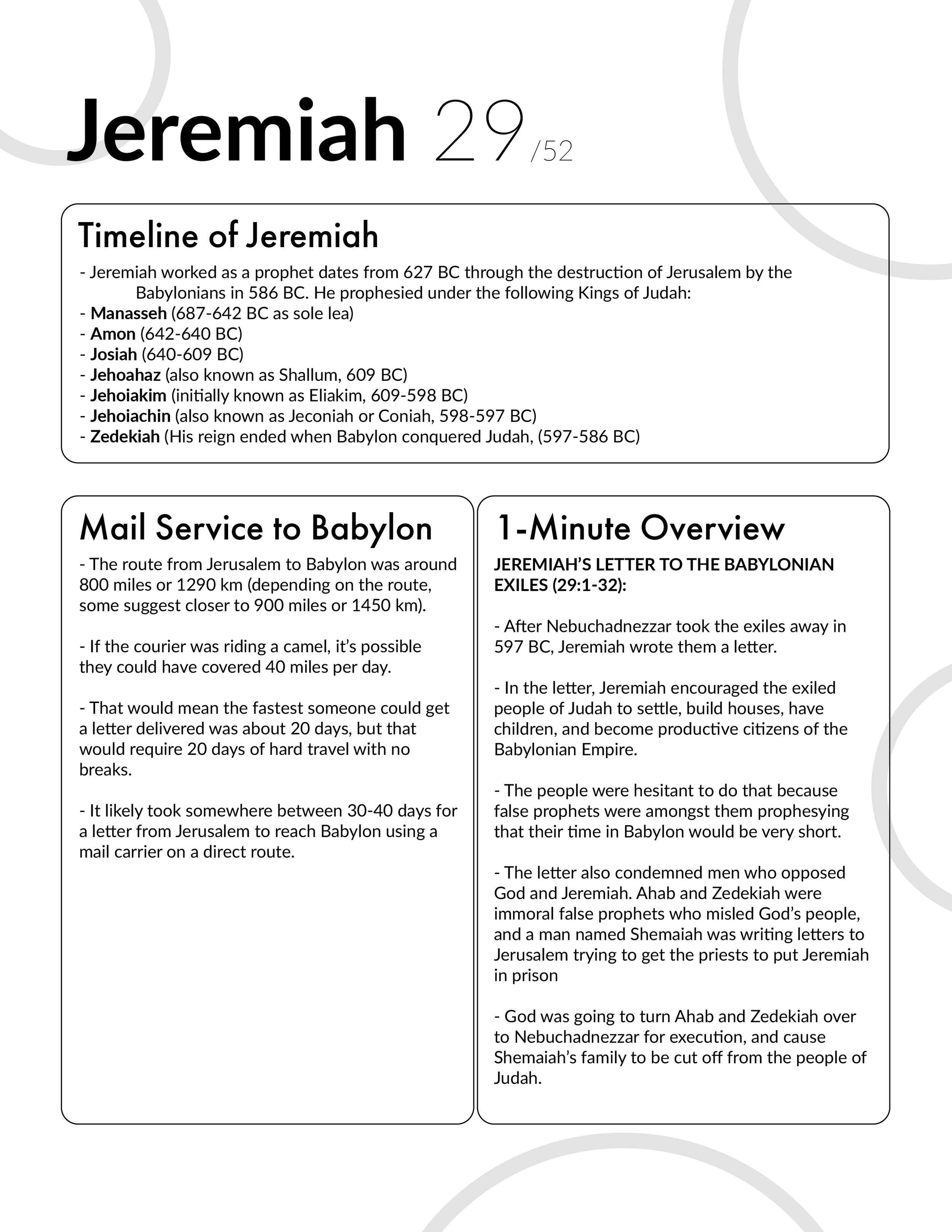
Jeremiah was a priest who lived in Anathoth (3 miles from Jerusalem). His ministry was directed towards the people of Judah, immediately before and during their exile in Babylon. His work as a prophet dates from 627 BC through the destruction of Jerusalem by the Babylonians in 586 BC.
Jeremiah is the longest book in the English Bible by word count. The book has 52 chapters.
Jeremiah prophesied under the following Kings of Judah:
Manasseh (687-642 BC)
Amos (642-640 BC)
Josiah (640-609 BC)
Jehoiakim (initially known as Eliakim, 609-598 BC)
Jehoiachin (also known as Jeconiah or Coniah, 598-597 BC)
Zedekiah (His reign ended when Babylon conquered Judah, (597-586 BC)
MAIL SERVICE TO BABYLON:
The route from Jerusalem to Babylon was around 800 miles or 1290 km (depending on the route, some suggest closer to 900 miles or 1450 km).
If the courier was riding a camel, it’s possible they could cover 40 miles per day.
That would mean the fastest someone could get a letter delivered was about 20 days, but that would require 20 days of hard travel with no breaks.
It likely took somewhere between 30-40 days for a letter from Jerusalem to reach Babylon using a mail carrier on a direct route.
OUTLINE:
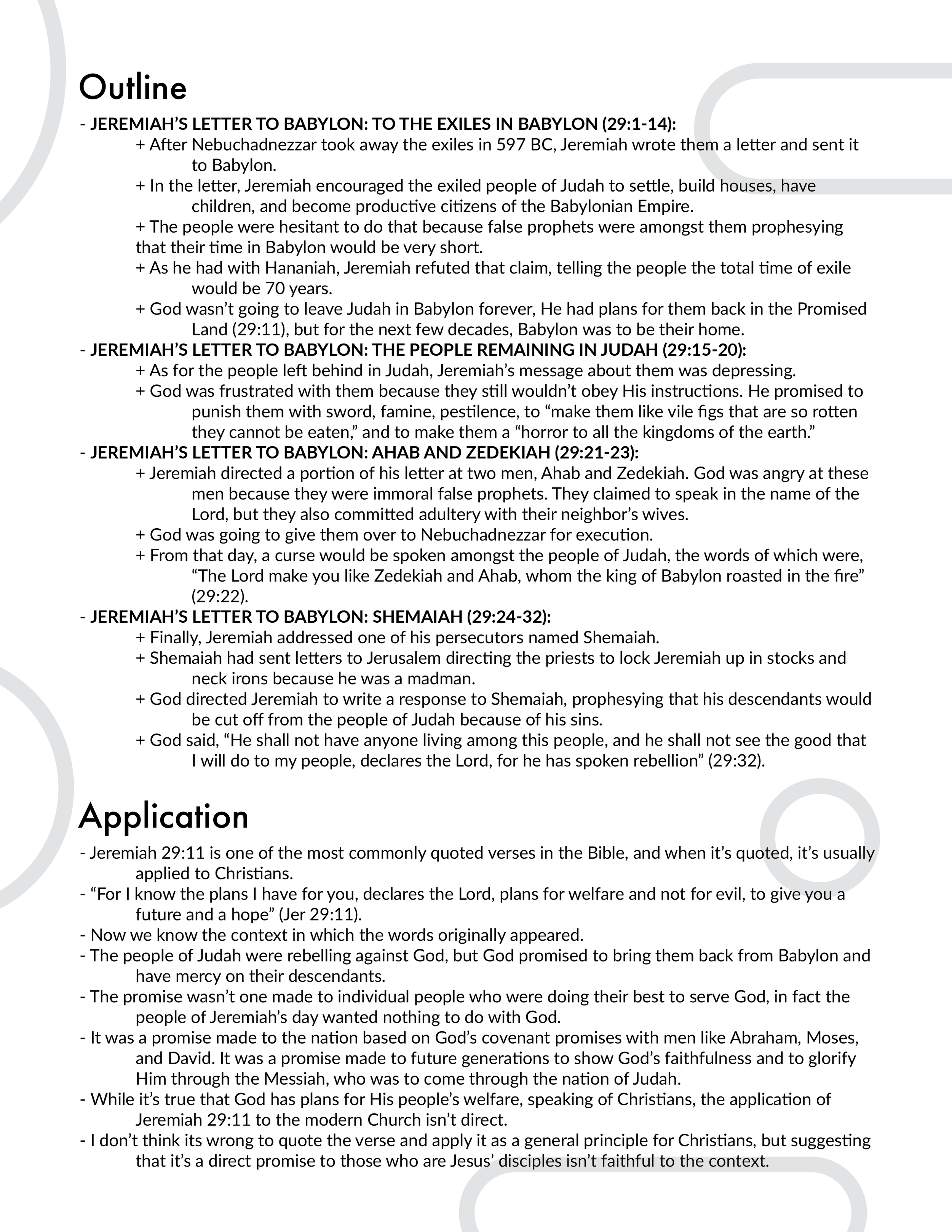
JEREMIAH’S LETTER TO BABYLON: TO THE EXILES IN BABYLON (29:1-14):
After Nebuchadnezzar took away the exiles in 597 BC, Jeremiah wrote them a letter and sent it to Babylon.
In the letter, Jeremiah encouraged the exiled people of Judah to settle, build houses, have children, and become productive citizens of the Babylonian Empire.
The people were hesitant to do that because false prophets were amongst them prophesying that their time in Babylon would be very short.
As he had with Hananiah, Jeremiah refuted that claim, telling the people the total time of exile would be 70 years.
God wasn’t going to leave Judah in Babylon forever, He had plans for them back in the Promised Land (29:11), but for the next few decades, Babylon was to be their home.
JEREMIAH’S LETTER TO BABYLON: THE PEOPLE REMAINING IN JUDAH (29:15-20):
As for the people left behind in Judah, Jeremiah’s message about them was depressing.
God was frustrated with them because they still wouldn’t obey His instructions. He promised to punish them with sword, famine, pestilence, to “make them like vile figs that are so rotten they cannot be eaten,” and to make them a “horror to all the kingdoms of the earth.”
JEREMIAH’S LETTER TO BABYLON: AHAB AND ZEDEKIAH (29:21-23):
Jeremiah directed a portion of his letter at two men, Ahab and Zedekiah. God was angry at these men because they were immoral false prophets. They claimed to speak in the name of the Lord, but they also committed adultery with their neighbor’s wives.
God was going to give them over to Nebuchadnezzar for execution.
From that day, a curse would be spoken amongst the people of Judah, the words of which were, “The Lord make you like Zedekiah and Ahab, whom the king of Babylon roasted in the fire” (29:22).
JEREMIAH’S LETTER TO BABYLON: SHEMAIAH (29:24-32):
Finally, Jeremiah addressed one of his persecutors named Shemaiah.
Shemaiah had sent letters to Jerusalem directing the priests to lock Jeremiah up in stocks and neck irons because he was a madman.
God directed Jeremiah to write a response to Shemaiah, prophesying that his descendants would be cut off from the people of Judah because of his sins.
God said, “He shall not have anyone living among this people, and he shall not see the good that I will do to my people, declares the Lord, for he has spoken rebellion” (29:32).
APPLICATION:
Jeremiah 29:11 is one of the most commonly quoted verses in the Bible, and when it’s quoted, it’s usually applied to Christians.
“For I know the plans I have for you, declares the Lord, plans for welfare and not for evil, to give you a future and a hope” (Jer 29:11).
Now we know the context in which the words originally appeared.
The people of Judah were rebelling against God, but God promised to bring them back from Babylon and have mercy on their descendants.
The promise wasn’t one made to individual people who were doing their best to serve God, in fact the people of Jeremiah’s day wanted nothing to do with God.
It was a promise made to the nation based on God’s covenant promises with men like Abraham, Moses, and David. It was a promise made to future generations to show God’s faithfulness and to glorify Him through the Messiah, who was to come through the nation of Judah.
While it’s true that God has plans for His people’s welfare, speaking of Christians, the application of Jeremiah 29:11 to the modern Church isn’t direct.
I don’t think its wrong to quote the verse and apply it as a general principle for Christians, but suggesting that it’s a direct promise to those who are Jesus’ disciples isn’t faithful to the context.
