Jeremiah 30 - Bible Study, Explanation, and Application
Jeremiah 30 Bible Study
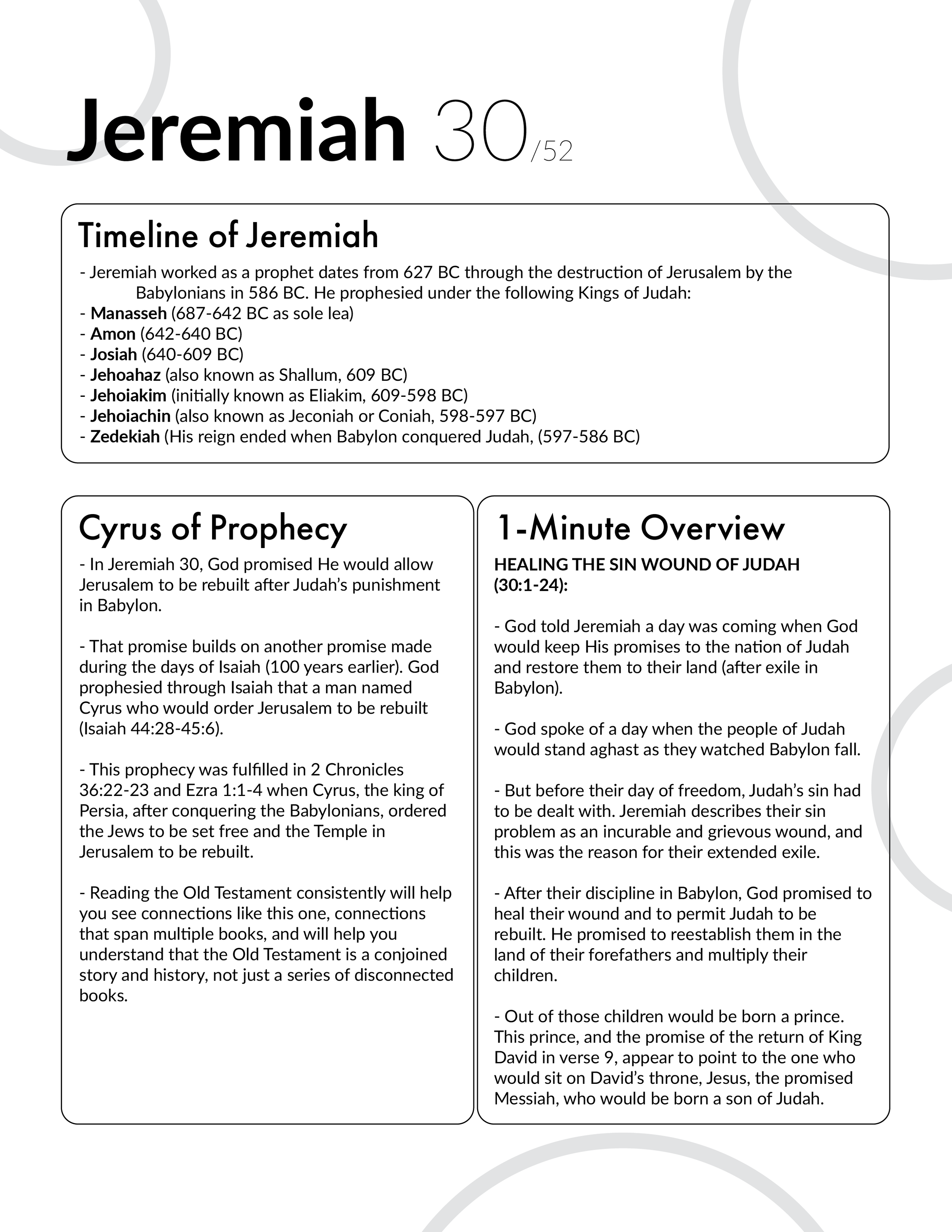
INTRO AND TIMELINE:
Jeremiah was a priest who lived in Anathoth (3 miles from Jerusalem). His ministry was directed towards the people of Judah, immediately before and during their exile in Babylon. His work as a prophet dates from 627 BC through the destruction of Jerusalem by the Babylonians in 586 BC.
Jeremiah is the longest book in the English Bible by word count. The book has 52 chapters.
Jeremiah prophesied under the following Kings of Judah:
Manasseh (687-642 BC)
Amos (642-640 BC)
Josiah (640-609 BC)
Jehoiakim (initially known as Eliakim, 609-598 BC)
Jehoiachin (also known as Jeconiah or Coniah, 598-597 BC)
Zedekiah (His reign ended when Babylon conquered Judah, (597-586 BC)
CYRUS OF PROPHECY:
In Jeremiah 30, God promised He would allow Jerusalem to be rebuilt after Judah’s punishment in Babylon.
That promise builds on another promise made during the days of Isaiah (100 years earlier). God prophesied through Isaiah that a man named Cyrus would order Jerusalem to be rebuilt (Isaiah 44:28-45:6).
This prophecy was fulfilled in 2 Chronicles 36:22-23 and Ezra 1:1-4 when Cyrus, the king of Persia, after conquering the Babylonians, ordered the Jews to be set free and the Temple in Jerusalem to be rebuilt.
Reading the Old Testament consistently will help you see connections like this one, connections that span multiple books, and will help you understand that the Old Testament is a conjoined story and history, not just a series of disconnected books.
OUTLINE:
HEALING THE SIN WOUND OF JUDAH (30:1-24):
God told Jeremiah to write down his prophesies in a book, because a day was coming when God would keep His promises to the nation of Judah and restore them to their land (after their exile in Babylon).
God spoke of a day when men would stand aghast with their hands on their stomachs like pregnant women, their faces pale as they watched Babylon fall.
The day would be distressing to the people of Judah, but it would ultimately lead to their freedom.
What Jeremiah almost certainly had in mind is the downfall of the Babylonian Empire brought about by the Medes and Persians (539-537 BC).
King Cyrus of Persia gave the Jews permission to leave Babylon and return to their land.
But before their day of freedom, Judah’s sin had to be dealt with. Jeremiah describes their sin problem as an incurable and grievous wound, and this was the reason for their extended exile.
God said, “Why do you cry out over your hurt? Your pain is incurable. Because your guilt is great, because your sins are flagrant, I have done these things to you” (30:15).
After their discipline in Babylon, God promised to heal their wound and to permit Judah to be rebuilt. He promised to reestablish them in the land of their forefathers and multiply their children.
Out of those children would be born a prince, one who could draw near to God and approach Him, something that no man could do.
This prince, and the promise of the return of King David in verse 9, appear to point to the one who would sit on David’s throne, Jesus, the promised Messiah, who would be born a son of Judah.
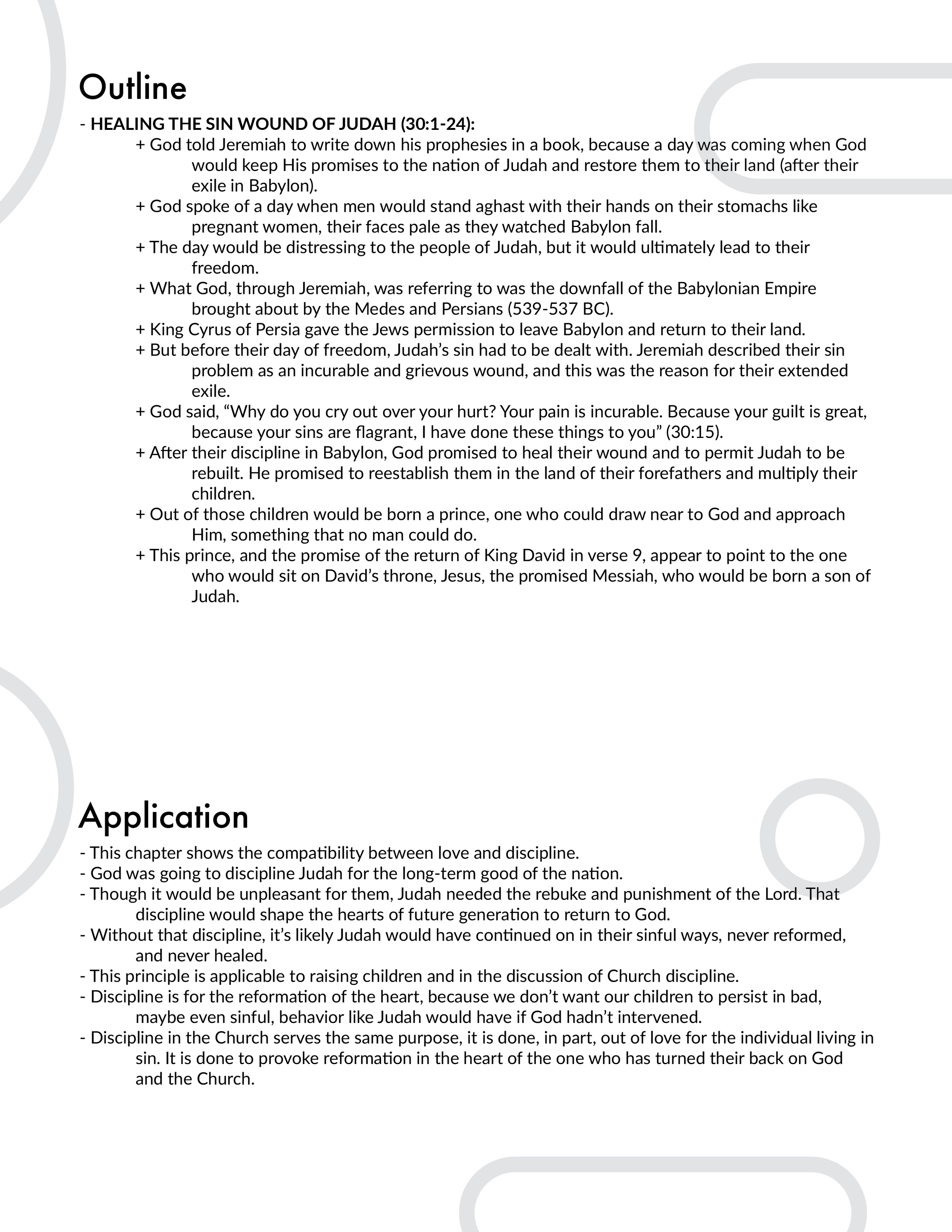
APPLICATION:
This chapter shows the compatibility between love and discipline.
God was going to discipline Judah for the long-term good of the nation.
Though it would be unpleasant for them, Judah needed the rebuke and punishment of the Lord. That discipline would shape the hearts of future generation to return to God.
Without that discipline, it’s likely Judah would have continued on in their sinful ways, never reformed, and never healed.
This principle is applicable to raising children and in the discussion of Church discipline.
Discipline is for the reformation of the heart, because we don’t want our children to persist in bad, maybe even sinful, behavior like Judah would have if God hadn’t intervened.
Discipline in the Church serves the same purpose, it is done, in part, out of love for the individual living in sin. It is done to provoke reformation in the heart of the one who has turned their back on God and the Church.
