Jeremiah 31 - Bible Study, Explanation, and Application
Jeremiah 31 Bible Study
INTRO AND TIMELINE:
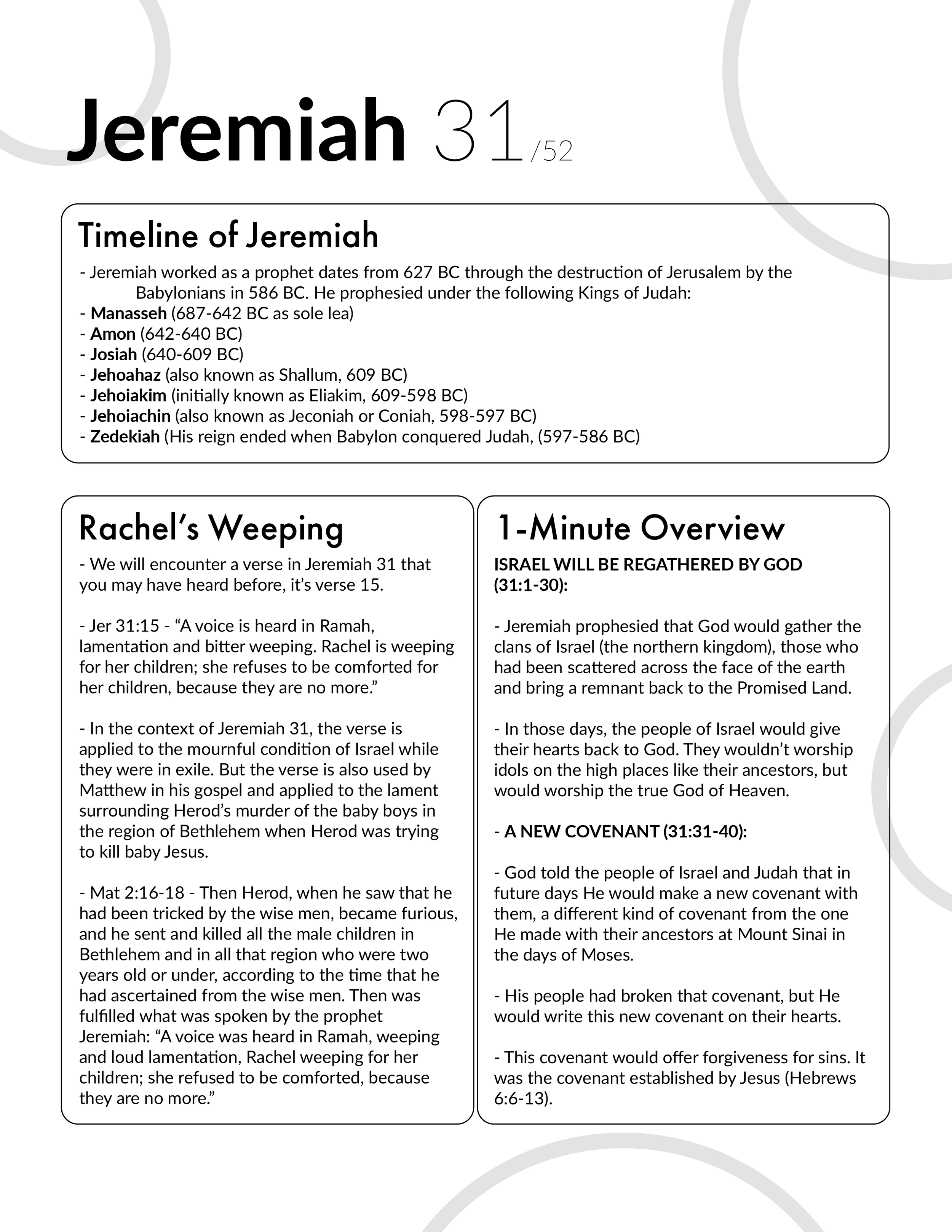
Jeremiah was a priest who lived in Anathoth (3 miles from Jerusalem). His ministry was directed towards the people of Judah, immediately before and during their exile in Babylon. His work as a prophet dates from 627 BC through the destruction of Jerusalem by the Babylonians in 586 BC.
Jeremiah is the longest book in the English Bible by word count. The book has 52 chapters.
Jeremiah prophesied under the following Kings of Judah:
Manasseh (687-642 BC)
Amos (642-640 BC)
Josiah (640-609 BC)
Jehoiakim (initially known as Eliakim, 609-598 BC)
Jehoiachin (also known as Jeconiah or Coniah, 598-597 BC)
Zedekiah (His reign ended when Babylon conquered Judah, (597-586 BC)
RACHEL’S WEEPING:
We will encounter a verse in Jeremiah 31 that you may have heard before, it’s verse 15.
Jer 31:15 - “A voice is heard in Ramah, lamentation and bitter weeping. Rachel is weeping for her children; she refuses to be comforted for her children, because they are no more.”
In the context of Jeremiah 31, the verse is applied to the mournful condition of Israel while they were in exile.
But the verse is also used by Matthew in his gospel and applied to the lament surrounding Herod’s murder of the baby boys in the region of Bethlehem when Herod was trying to kill baby Jesus.
Mat 2:16-18 - Then Herod, when he saw that he had been tricked by the wise men, became furious, and he sent and killed all the male children in Bethlehem and in all that region who were two years old or under, according to the time that he had ascertained from the wise men. Then was fulfilled what was spoken by the prophet Jeremiah: “A voice was heard in Ramah, weeping and loud lamentation, Rachel weeping for her children; she refused to be comforted, because they are no more.”
OUTLINE:
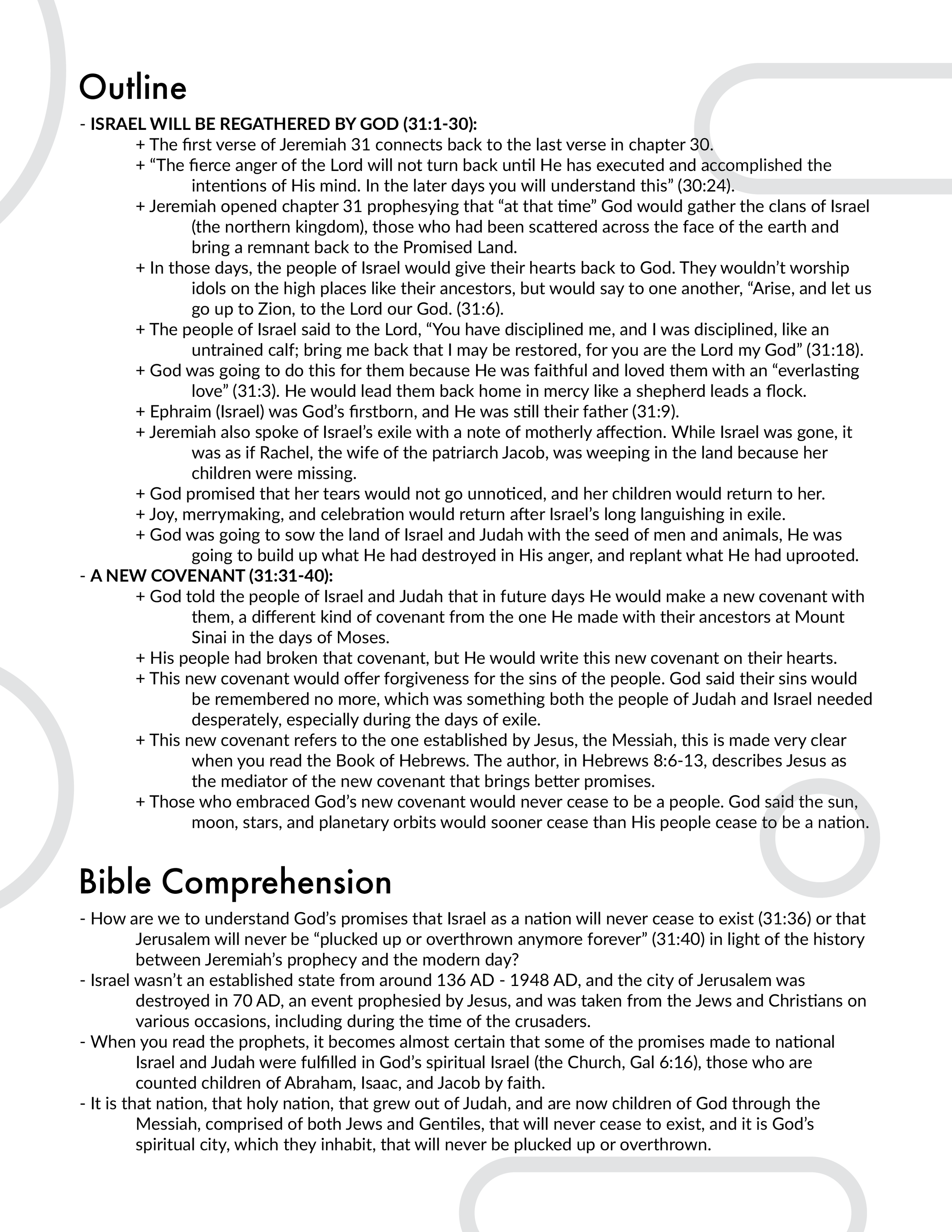
ISRAEL WILL BE REGATHERED BY GOD (31:1-30):
The first verse of Jeremiah 31 connects back to the last verse in chapter 30.
“The fierce anger of the Lord will not turn back until He has executed and accomplished the intentions of His mind. In the later days you will understand this” (30:24).
Jeremiah opened chapter 31 prophesying that “at that time” God would gather the clans of Israel (the northern kingdom), those who had been scattered across the face of the earth and bring a remnant back to the Promised Land.
In those days, the people of Israel would give their hearts back to God. They wouldn’t worship idols on the high places like their ancestors, but would say to one another, “Arise, and let us go up to Zion, to the Lord our God. (31:6).
The people of Israel said to the Lord, “You have disciplined me, and I was disciplined, like an untrained calf; bring me back that I may be restored, for you are the Lord my God” (31:18).
God was going to do this for them because He was faithful and loved them with an “everlasting love” (31:3). He would lead them back home in mercy like a shepherd leads a flock.
Ephraim (Israel) was God’s firstborn, and He was still their father (31:9).
Jeremiah also spoke of Israel’s exile with a note of motherly affection. While Israel was gone, it was as if Rachel, the wife of the patriarch Jacob, was weeping in the land because her children were missing.
God promised that her tears would not go unnoticed, and her children would return to her.
Joy, merrymaking, and celebration would return after Israel’s long languishing in exile.
God was going to sow the land of Israel and Judah with the seed of men and animals, He was going to build up what He had destroyed in His anger, and replant what He had uprooted.
A NEW COVENANT (31:31-40):
God told the people of Israel and Judah that in future days He would make a new covenant with them, a different kind of covenant from the one He made with their ancestors at Mount Sinai in the days of Moses.
His people had broken that covenant, but He would write this new covenant on their hearts.
This new covenant would offer forgiveness for the sins of the people. God said their sins would be remembered no more, which was something both the people of Judah and Israel needed desperately, especially during the days of exile.
This new covenant refers to the one established by Jesus, the Messiah, this is made very clear when you read the Book of Hebrews. The author, in Hebrews 8:6-13, describes Jesus as the mediator of the new covenant that brings better promises.
Those who embraced God’s new covenant would never cease to be a people. God said the sun, moon, stars, and planetary orbits would sooner cease than His people cease to be a nation.
APPLICATION:
How are we to understand God’s promises that Israel as a nation will never cease to exist (31:36) or that Jerusalem will never be “plucked up or overthrown anymore forever” (31:40) in light of the history between Jeremiah’s prophecy and the modern day?
Israel wasn’t an established state from around 136 AD - 1948 AD, and the city of Jerusalem was destroyed in 70 AD, an event prophesied by Jesus, and was taken from the Jews and Christians on various occasions, including during the time of the crusaders.
When you read the prophets, it becomes almost certain that some of the promises made to national Israel and Judah were fulfilled in God’s spiritual Israel (the Church, Gal 6:16), those who are counted children of Abraham, Isaac, and Jacob by faith.
It is that nation, that holy nation, that grew out of Judah, and are now children of God through the Messiah, comprised of both Jews and Gentiles, that will never cease to exist, and it is God’s spiritual city, which they inhabit, that will never be plucked up or overthrown.
