Jeremiah 32 - Bible Study, Explanation, and Application
Jeremiah 32 Bible Study
INTRO AND TIMELINE:
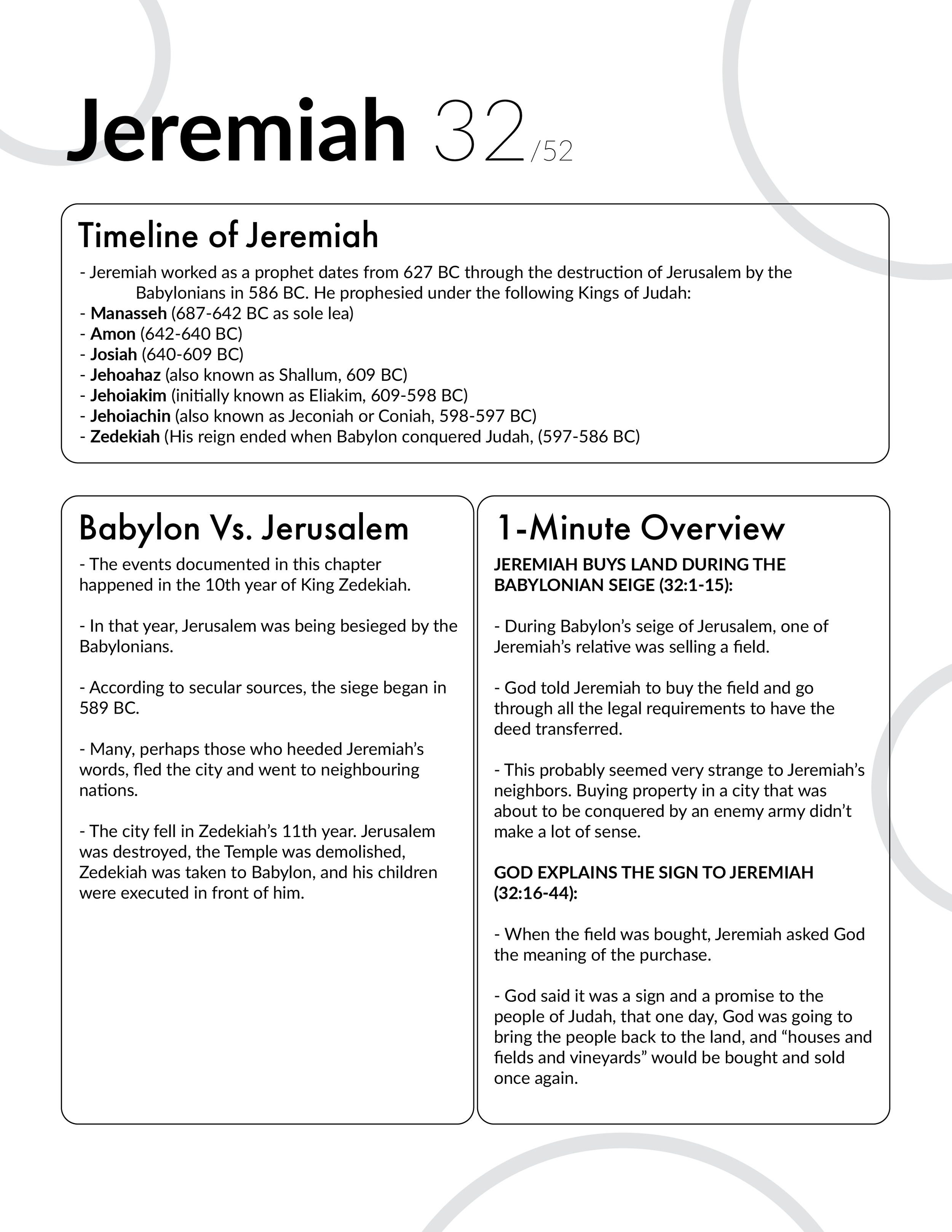
Jeremiah was a priest who lived in Anathoth (3 miles from Jerusalem). His ministry was directed towards the people of Judah, immediately before and during their exile in Babylon. His work as a prophet dates from 627 BC through the destruction of Jerusalem by the Babylonians in 586 BC.
Jeremiah is the longest book in the English Bible by word count. The book has 52 chapters.
Jeremiah prophesied under the following Kings of Judah:
Manasseh (687-642 BC)
Amos (642-640 BC)
Josiah (640-609 BC)
Jehoiakim (initially known as Eliakim, 609-598 BC)
Jehoiachin (also known as Jeconiah or Coniah, 598-597 BC)
Zedekiah (His reign ended when Babylon conquered Judah, (597-586 BC)
BABYLON VS JERUSALEM:
The events documented in this chapter happened in the 10th year of King Zedekiah.
In that year, Jerusalem was being besieged by the Babylonians.
According to secular sources, the siege began in 589 BC.
Many, perhaps those who heeded Jeremiah’s words, fled the city and went to neighbouring nations.
The city fell in Zedekiah’s 11th year. Jerusalem was destroyed, the Temple was demolished, Zedekiah was taken to Babylon, and his children were executed in front of him.
OUTLINE:
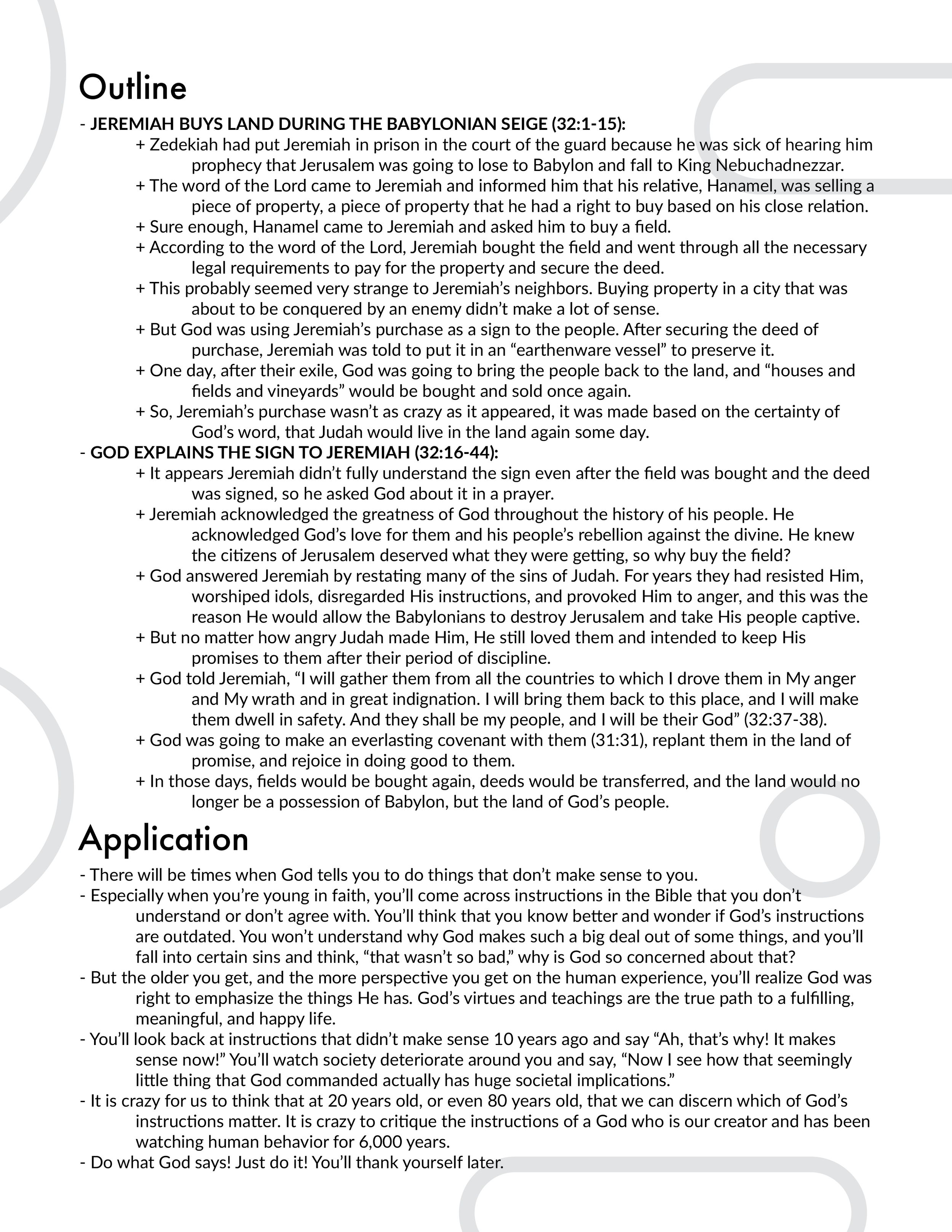
JEREMIAH BUYS LAND DURING THE BABYLONIAN SEIGE (32:1-15):
Zedekiah had put Jeremiah in prison in the court of the guard because he was sick of hearing him prophecy that Jerusalem was going to lose to Babylon and the royal family would be captured by Nebuchadnezzar.
The word of the Lord came to Jeremiah and informed him that his relative, Hanamel, was selling a piece of property, a piece of property that he had a right to buy based on his close relation.
Sure enough, Hanamel came to Jeremiah and asked him to buy a field.
According to the word of the Lord, Jeremiah bought the field and went through all the necessary legal requirements to pay for the property and secure the deed.
This probably seemed very strange to Jeremiah’s neighbors. Buying property in a city that was about to be conquered by an enemy didn’t make a lot of sense.
But God was using Jeremiah’s purchase as a sign to the people. After securing the deed of purchase, Jeremiah was told to put it in an “earthenware vessel” to preserve it.
One day, after their exile, God was going to bring the people back to the land, and “houses and fields and vineyards” would be bought and sold once again.
So, Jeremiah’s purchase wasn’t as crazy as it appeared, it was made based on the certainty of God’s word, that Judah would live in the land again some day.
GOD EXPLAINS THE SIGN TO JEREMIAH (32:16-44):
It appears Jeremiah didn’t fully understand the sign even after the field was bought and the deed was signed, so he asked God about it in a prayer.
Jeremiah acknowledged the greatness of God throughout the history of his people. He acknowledged God’s love for them and his people’s rebellion against the divine. He knew the citizens of Jerusalem deserved what they were getting, Babylon was at their doorstep, so why buy the field?
God answered Jeremiah by restating many of the sins of Judah. For years they had resisted Him, worshiped idols, disregarded His instructions, and provoked Him to anger, and this was the reason He would allow the Babylonians to destroy Jerusalem and take His people captive.
But no matter how angry Judah made Him, He still loved them and intended to keep His promises to them after their period of discipline.
God told Jeremiah, “I will gather them from all the countries to which I drove them in My anger and My wrath and in great indignation. I will bring them back to this place, and I will make them dwell in safety. And they shall be my people, and I will be their God” (32:37-38).
God was going to make an everlasting covenant with them (31:31), replant them in the land of promise, and rejoice in doing good to them.
In those days, fields would be bought again, deeds would be transferred, and the land would no longer be a possession of Babylon, but the land of God’s people.
APPLICATION:
There will be times when God tells you to do things that don’t make sense to you.
Especially when you are young in your faith, you’ll come across instructions in the Bible that you don’t understand and that you’ll question the validity of. You’ll think that you know better and wonder if God’s instructions are outdated. You won’t understand why God makes such a big deal out of some things, and you’ll fall into certain sins and think, “that wasn’t so bad,” why is God so concerned about that?
But the older you get, and the more perspective you get on the human experience, you’ll realize God was right to emphasize the things He has. God’s virtues and teachings are the true path to a fulfilling, meaningful, and happy life.
You’ll look back at instructions that didn’t make sense to you 10 years ago and say to yourself “Ah, that’s why! It makes sense now!”
You’ll watch society deteriorate around you and say, “Now I see how that seemingly little thing that God commanded actually has huge societal implications.”
It is crazy for us to think that at 20 years old, or even 80 years old, that we can discern which of God’s instructions matter. It is crazy to critique the instructions of a God who is our creator and has been watching human behavior for 6,000 years.
Do what God says! Just do it! You’ll thank yourself later.
