Jeremiah 33 - Bible Study, Explanation, and Application
Jeremiah 33 Bible Study
INTRO AND TIMELINE:
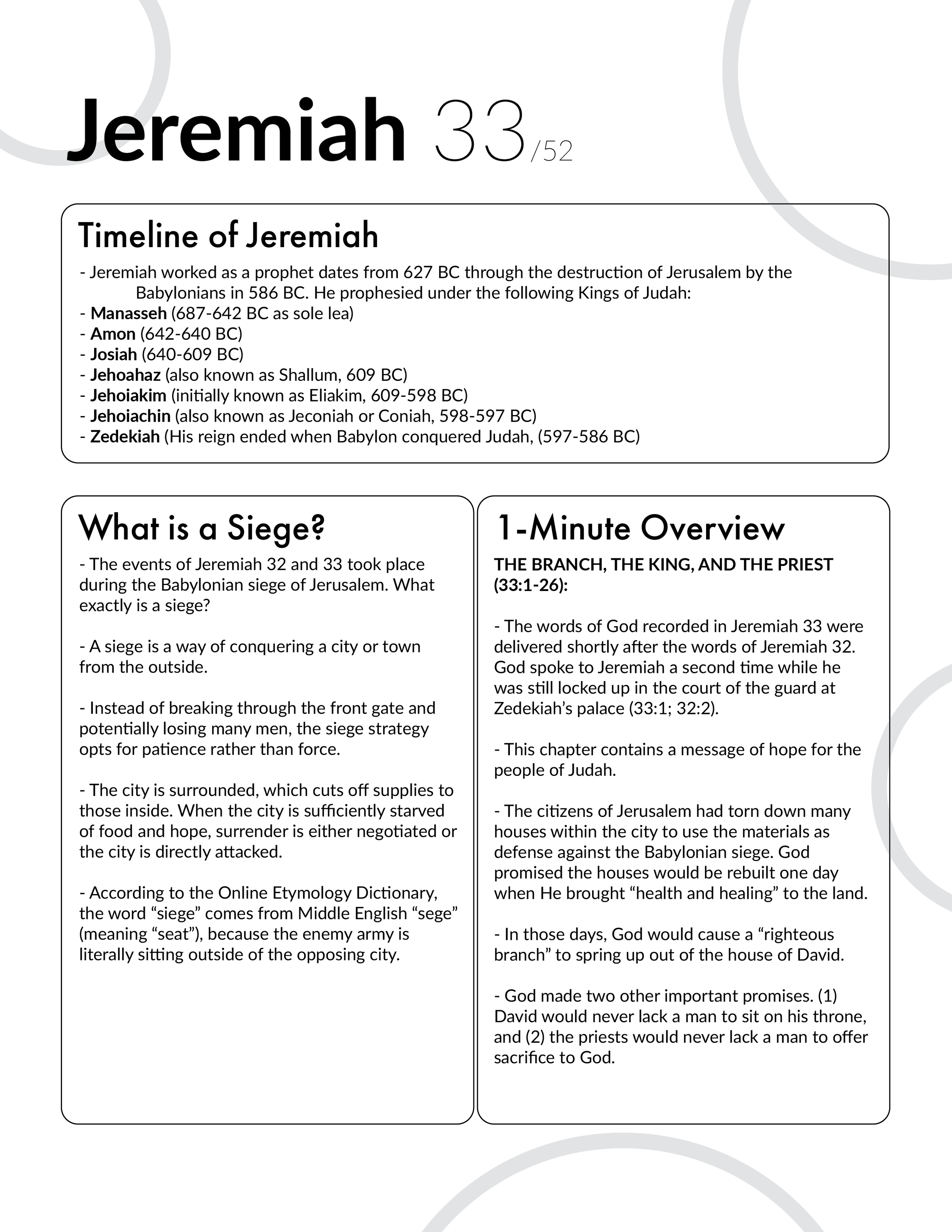
Jeremiah was a priest who lived in Anathoth (3 miles from Jerusalem). His ministry was directed towards the people of Judah, immediately before and during their exile in Babylon. His work as a prophet dates from 627 BC through the destruction of Jerusalem by the Babylonians in 586 BC.
Jeremiah is the longest book in the English Bible by word count. The book has 52 chapters.
Jeremiah prophesied under the following Kings of Judah:
Manasseh (687-642 BC)
Amos (642-640 BC)
Josiah (640-609 BC)
Jehoiakim (initially known as Eliakim, 609-598 BC)
Jehoiachin (also known as Jeconiah or Coniah, 598-597 BC)
Zedekiah (His reign ended when Babylon conquered Judah, (597-586 BC)
WHAT IS A SIEGE?:
The events of Jeremiah 32 and 33 took place during the Babylonian siege of Jerusalem. What exactly is a siege?
A siege is a way of conquering a city or town from the outside.
Instead of breaking through the front gate and potentially losing many men, the siege strategy opts for patience rather than force.
The city is surrounded, which cuts off supplies to those inside. When the city is sufficiently starved of food and hope, surrender is either negotiated or the city is directly attacked.
According to the Online Etymology Dictionary, the word “siege” comes from Middle English “sege” (meaning “seat”), because the enemy army is literally sitting outside of the opposing city.
OUTLINE:
THE BRANCH, THE KING, AND THE PRIEST (33:1-26):
The words of God recorded in Jeremiah 33 were delivered shortly after the words of Jeremiah 32. God spoke to Jeremiah a second time while he was still locked up in the court of the guard at Zedekiah’s palace (33:1; 32:2).
This chapter contains a message of hope for the people of Judah.
The citizens of Jerusalem had torn down many houses within the city to use the materials as defense against the Babylonian siege. God promised the houses would be rebuilt one day when He brought “health and healing” to the land.
After their Babylonian punishment, God was going to rebuilt Judah and Israel and take away the guilt of their sins.
Though they were presently trembling under the threat of the Babylonians, one day they would tremble “because of all the good and all the prosperity” that God would provide (33:9).
In those days, God would cause a “righteous branch” to spring up out of the house of David.
As we’ve observed in other passages (Isa 11:1; Jer 23:5), the “branch” is a reference to the Messiah, the savior and future king of the people of God.
The branch would be a standard of righteousness and justice. He would bring salvation to Judah.
God made two other important promises. (1) David would never lack a man to sit on his throne, and (2) the priests would never lack a man to offer sacrifice to God (more on this in the application section).
God said those promises would come to pass as certainly as the night comes after the day and the sun rises every morning.
Some people were suggesting that God had abandoned Judah and Israel forever, but God made it clear that was a misguided suggestion.
APPLICATION:
You might be thinking, “There is no human king over the nation of Israel currently and there is no priestly line continually offering sacrifices in Jerusalem, so what happened to God’s promises? What happened to David’s throne?”
What if I told you there is a king over Israel and there is a high priest who makes atonement for the sins of the people!?
The Branch, prophesied in Jeremiah 33, was a reference to Jesus, the Messiah. Jesus was a descendant of David by linage, and took authority over David’s throne (Luke 1:32).
How long does a king reign on the throne? Until he dies or is overthrown by another man, right? Neither of those things are ever going to happen to Jesus, which makes Him king forever (Heb 1:8).
Jesus also assumed the role of eternal high priest. This is explained in greater detail in the Book of Hebrews. Human priests died and had to be replaced, but Jesus never dies, so He is priest forever (Heb 2:17; 4:14).
Jesus is also superior to any human priest, in the sense that He offered a better and more powerful sacrifice than the priests in Moses or Jeremiah’s time. Those priests offered animal sacrifices, but Jesus offered Himself, the blood of the Lamb of God, which had the power to forgive sin once and for all.
Jesus doesn’t have to offer sacrifices continually, like the priests in the Temple, His sacrifice was effective once for all time for “eternal redemption” (Heb 7:27; 9:12, 26).
So, Jesus fulfills God’s promise in Jeremiah 33 that a king and a priest will never be lacking.
