Jeremiah 34 - Bible Study, Explanation, and Application
Jeremiah 34 Bible Study
INTRO AND TIMELINE:
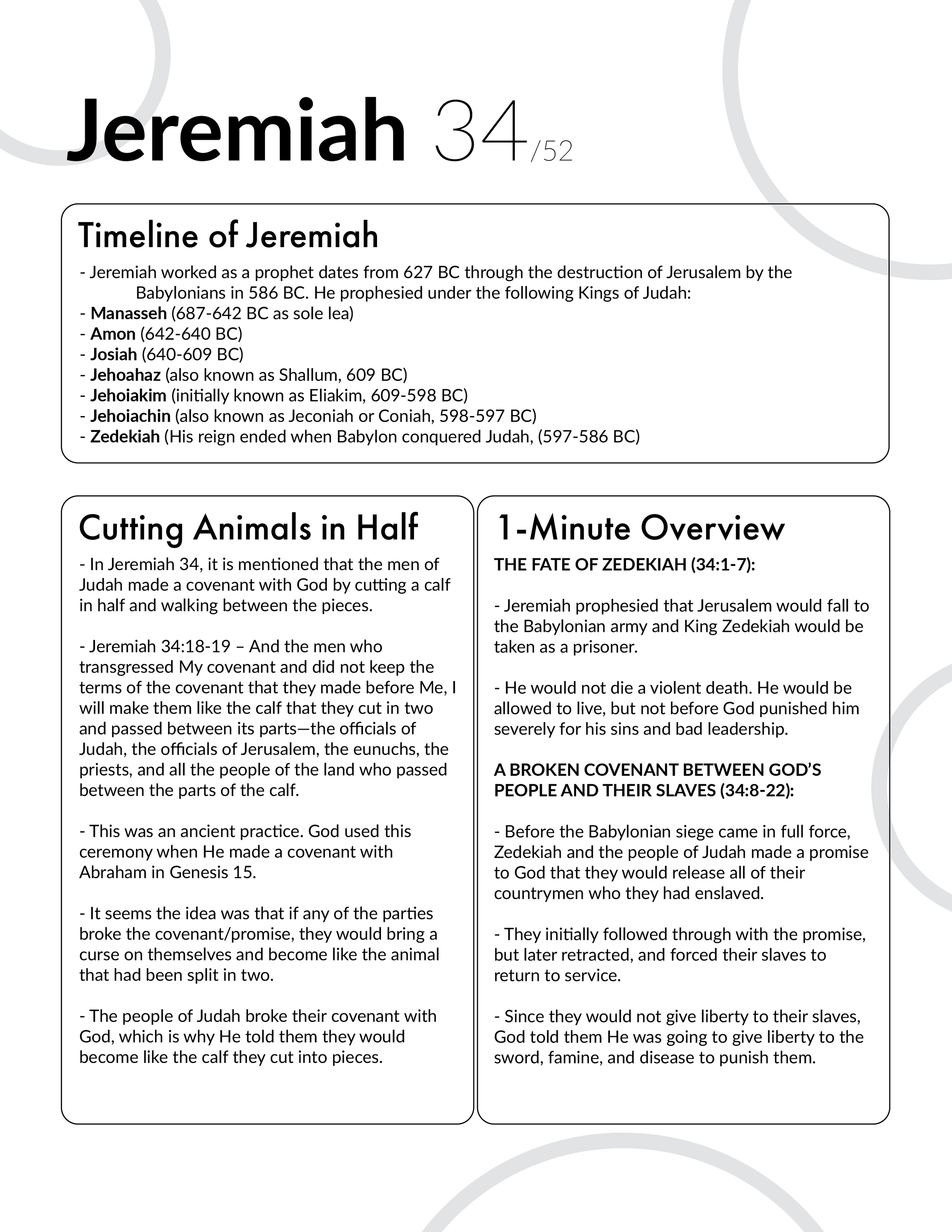
Jeremiah was a priest who lived in Anathoth (3 miles from Jerusalem). His ministry was directed towards the people of Judah, immediately before and during their exile in Babylon. His work as a prophet dates from 627 BC through the destruction of Jerusalem by the Babylonians in 586 BC.
Jeremiah is the longest book in the English Bible by word count. The book has 52 chapters.
Jeremiah prophesied under the following Kings of Judah:
Manasseh (687-642 BC)
Amos (642-640 BC)
Josiah (640-609 BC)
Jehoiakim (initially known as Eliakim, 609-598 BC)
Jehoiachin (also known as Jeconiah or Coniah, 598-597 BC)
Zedekiah (His reign ended when Babylon conquered Judah, (597-586 BC)
CUTTING ANIMALS IN HALF:
In Jeremiah 34, it is mentioned that the men of Judah made a covenant with God by cutting a calf in half and walking between the pieces.
Jeremiah 34:18-19 – And the men who transgressed My covenant and did not keep the terms of the covenant that they made before Me, I will make them like the calf that they cut in two and passed between its parts—the officials of Judah, the officials of Jerusalem, the eunuchs, the priests, and all the people of the land who passed between the parts of the calf.
This was an ancient practice. God used this ceremony when He made a covenant with Abraham in Genesis 15.
It seems the idea was that if any of the parties broke the covenant/promise, they would bring a curse on themselves and become like the animal that had been split in two.
The people of Judah broke their covenant with God, which is why He told them they would become like the calf they cut into pieces.
OUTLINE:
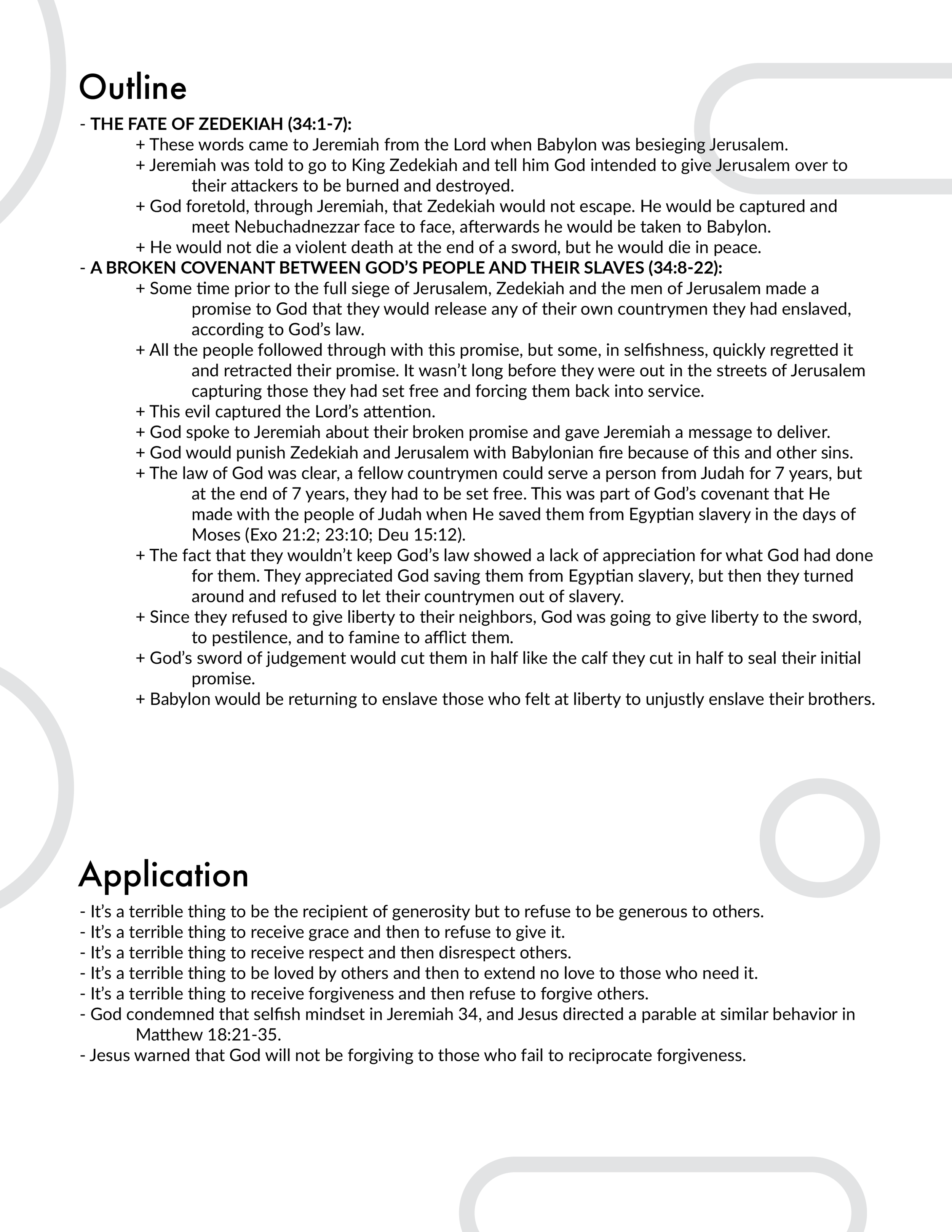
THE FATE OF ZEDEKIAH (34:1-7):
These words came to Jeremiah from the Lord when Babylon was besieging Jerusalem.
Jeremiah was told to go to King Zedekiah and tell him God intended to give Jerusalem over to their attackers to be burned and destroyed.
God foretold, through Jeremiah, that Zedekiah would not escape. He would be captured and meet Nebuchadnezzar face to face, afterwards he would be taken to Babylon.
He would not die a violent death at the end of a sword, but he would die in peace.
A BROKEN COVENANT BETWEEN GOD’S PEOPLE AND THEIR SLAVES (34:8-22):
Some time prior to the full siege of Jerusalem, Zedekiah and the men of Jerusalem made a promise to God that they would release any of their own countrymen they had enslaved, according to God’s law.
All the people followed through with this promise, but some, in selfishness, quickly regretted it and retracted their promise. It wasn’t long before they were out in the streets of Jerusalem capturing those they had set free and forcing them back into service.
This evil captured the Lord’s attention.
God spoke to Jeremiah about their broken promise and gave Jeremiah a message to deliver.
God would punish Zedekiah and Jerusalem with Babylonian fire because of this and other sins.
The law of God was clear, a fellow countrymen could serve a person from Judah for 7 years, but at the end of 7 years, they had to be set free. This was part of God’s covenant that He made with the people of Judah when He saved them from Egyptian slavery in the days of Moses (Exo 21:2; 23:10; Deu 15:12).
The fact that they wouldn’t keep God’s law showed a lack of appreciation for what God had done for them. They appreciated God saving them from Egyptian slavery, but then they turned around and refused to let their countrymen out of slavery.
Since they refused to give liberty to their neighbors, God was going to give liberty to the sword, to pestilence, and to famine to afflict them.
God’s sword of judgement would cut them in half like the calf they cut in half to seal their initial promise.
Babylon would be returning to enslave those who felt at liberty to unjustly enslave their brothers.
APPLICATION:
It’s a terrible thing to be the recipient of generosity but to refuse to be generous to others.
It’s a terrible thing to receive grace and then to refuse to give it.
It’s a terrible thing to receive respect and then disrespect others.
It’s a terrible thing to be loved by others and then to extend no love to those who need it.
It’s a terrible thing to receive forgiveness and then refuse to forgive others.
God condemned that selfish mindset in Jeremiah 34, and Jesus directed a parable at similar behavior in Matthew 18:21-35.
Jesus warned that God will not be forgiving to those who fail to reciprocate forgiveness.
