Jeremiah 35 - Bible Study, Explanation, and Application
Jeremiah 35 Bible Study
INTRO AND TIMELINE:
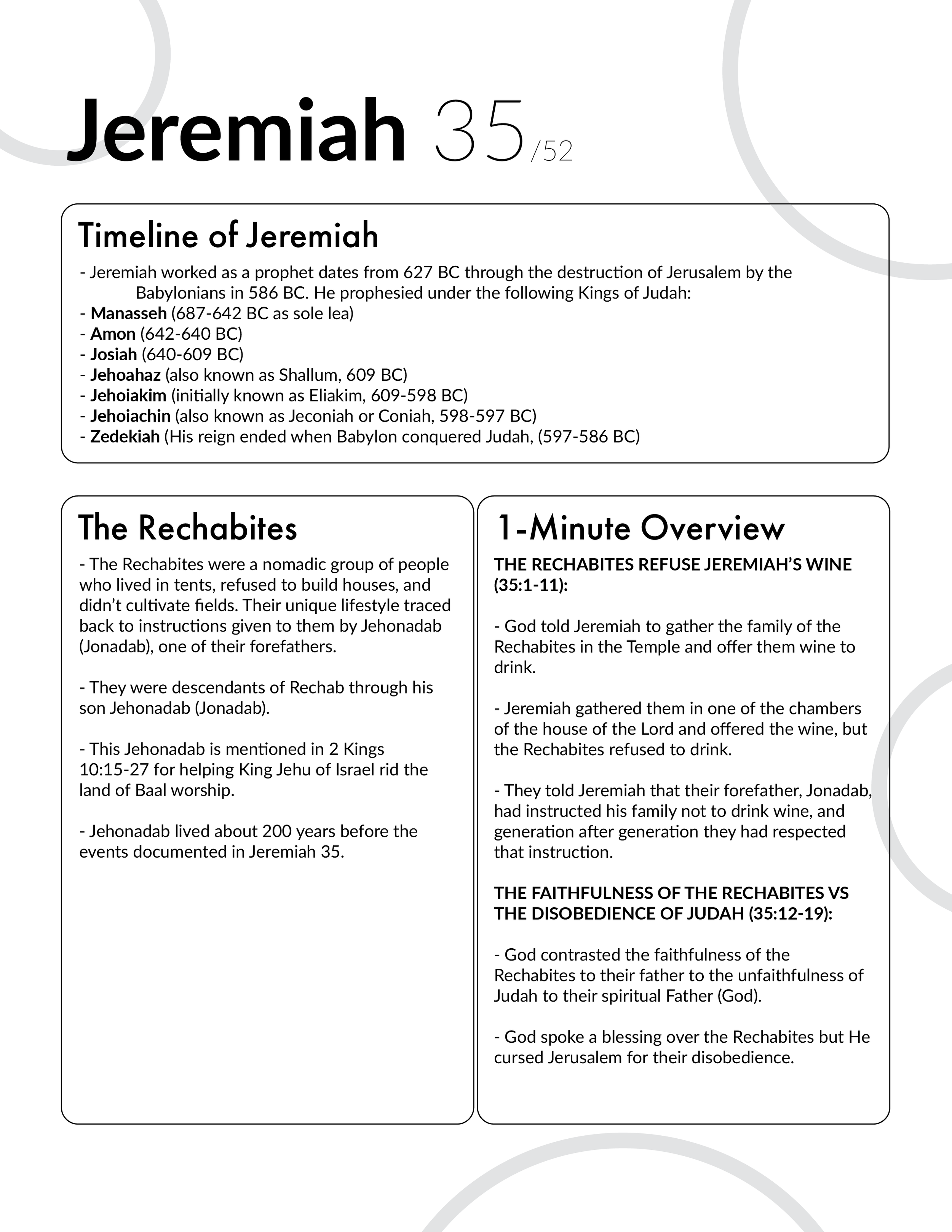
Jeremiah was a priest who lived in Anathoth (3 miles from Jerusalem). His ministry was directed towards the people of Judah, immediately before and during their exile in Babylon. His work as a prophet dates from 627 BC through the destruction of Jerusalem by the Babylonians in 586 BC.
Jeremiah is the longest book in the English Bible by word count. The book has 52 chapters.
Jeremiah prophesied under the following Kings of Judah:
Manasseh (687-642 BC)
Amos (642-640 BC)
Josiah (640-609 BC)
Jehoiakim (initially known as Eliakim, 609-598 BC)
Jehoiachin (also known as Jeconiah or Coniah, 598-597 BC)
Zedekiah (His reign ended when Babylon conquered Judah, (597-586 BC)
WHO WERE THE RECHABITES?:
The Rechabites were a nomadic group of people who lived in tents, refused to build houses, and didn’t cultivate fields. Their unique lifestyle traced back to instructions given to them by Jehonadab (Jonadab), one of their forefathers.
They were descendants of Rechab through his son Jehonadab (Jonadab).
This Jehonadab is mentioned in 2 Kings 10:15-27 for helping King Jehu of Israel rid the land of Baal worship.
Jehonadab lived about 200 years before the events documented in Jeremiah 35.
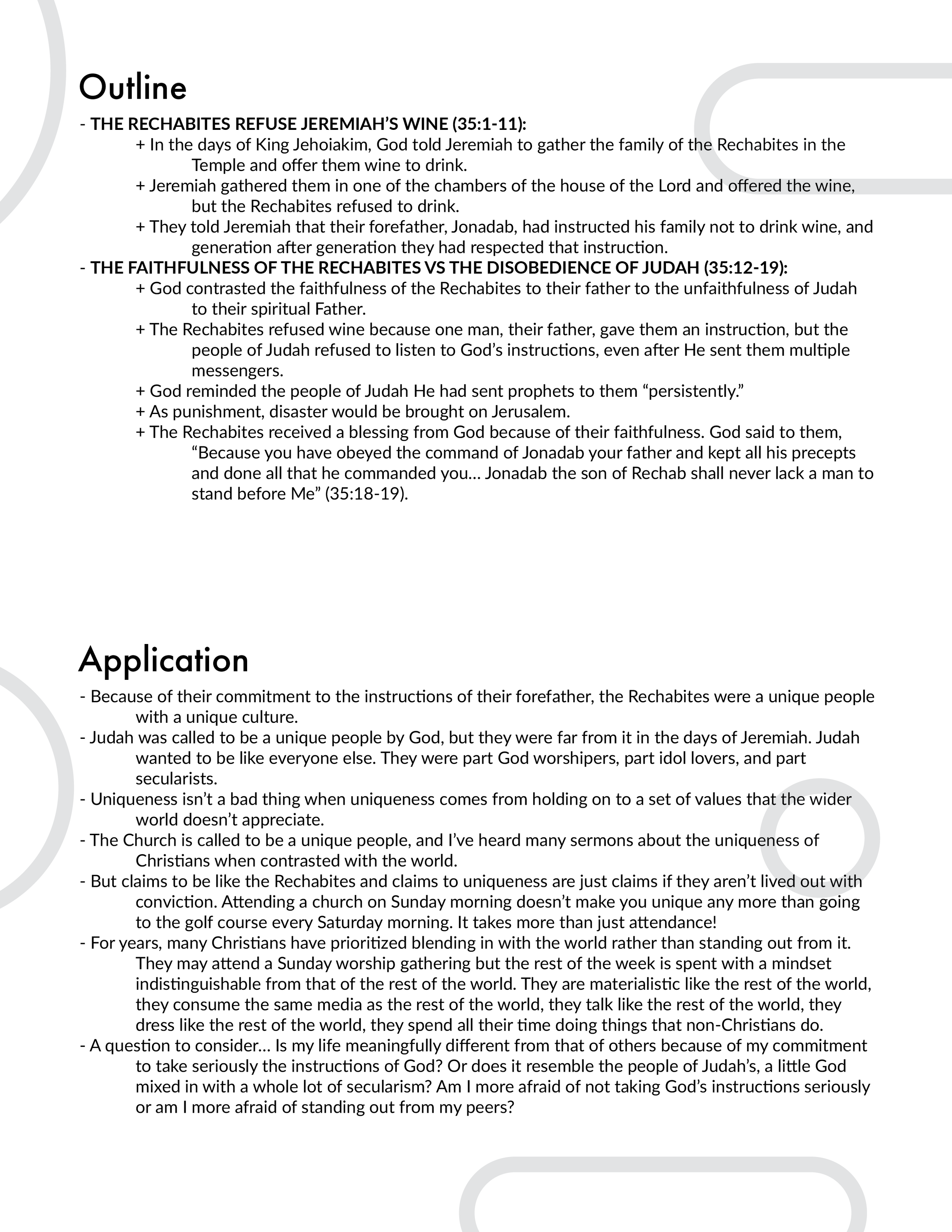
OUTLINE:
THE RECHABITES REFUSE JEREMIAH’S WINE (35:1-11):
In the days of King Jehoiakim, God told Jeremiah to gather the family of the Rechabites in the Temple and offer them wine to drink.
Jeremiah gathered them in one of the chambers of the house of the Lord and offered the wine, but the Rechabites refused to drink.
They told Jeremiah that their forefather, Jonadab, had instructed his family not to drink wine, and generation after generation they had respected that instruction.
THE FAITHFULNESS OF THE RECHABITES VS THE DISOBEDIENCE OF JUDAH (35:12-19):
God contrasted the faithfulness of the Rechabites to their father to the unfaithfulness of Judah to their spiritual Father.
The Rechabites refused wine because one man, their father, gave them an instruction, but the people of Judah refused to listen to God’s instructions, even after He sent them multiple messengers.
God reminded the people of Judah He had sent prophets to them “persistently.”
As punishment, disaster would be brought on Jerusalem.
The Rechabites received a blessing from God because of their faithfulness. God said to them, “Because you have obeyed the command of Jonadab your father and kept all his precepts and done all that he commanded you… Jonadab the son of Rechab shall never lack a man to stand before Me” (35:18-19).
APPLICATION:
Because of their commitment to the instructions of their forefather, the Rechabites were a unique people with a unique culture.
Judah was called to be a unique people by God, but they were far from it in the days of Jeremiah. Judah wanted to be like everyone else. They were part God worshipers, part idol lovers, and part secularists.
Uniqueness isn’t a bad thing when uniqueness comes from holding on to a set of values that the wider world doesn’t appreciate.
The Church is called to be a unique people, and I’ve heard many sermons about the uniqueness of Christians when contrasted with the world.
But claims to be like the Rechabites and claims to uniqueness are just claims if they aren’t lived out with conviction. Attending a church on Sunday morning doesn’t make you unique any more than going to the golf course every Saturday morning. It takes more than just attendance!
For years, many Christians have prioritized blending in with the world rather than standing out from it. They may attend a Sunday worship gathering but the rest of the week is spent with a mindset indistinguishable from that of the rest of the world. They are materialistic like the rest of the world, they consume the same media as the rest of the world, they talk like the rest of the world, they dress like the rest of the world, they spend all their time doing things that non-Christians do.
A question to consider… Is my life meaningfully different from that of others because of my commitment to take seriously the instructions of God? Or does it resemble the people of Judah’s, a little God mixed in with a whole lot of secularism? Am I more afraid of not taking God’s instructions seriously or am I more afraid of standing out from my peers?
