Jeremiah 37 - Bible Study, Explanation, and Application
Jeremiah 37 Bible Study
INTRO AND TIMELINE:
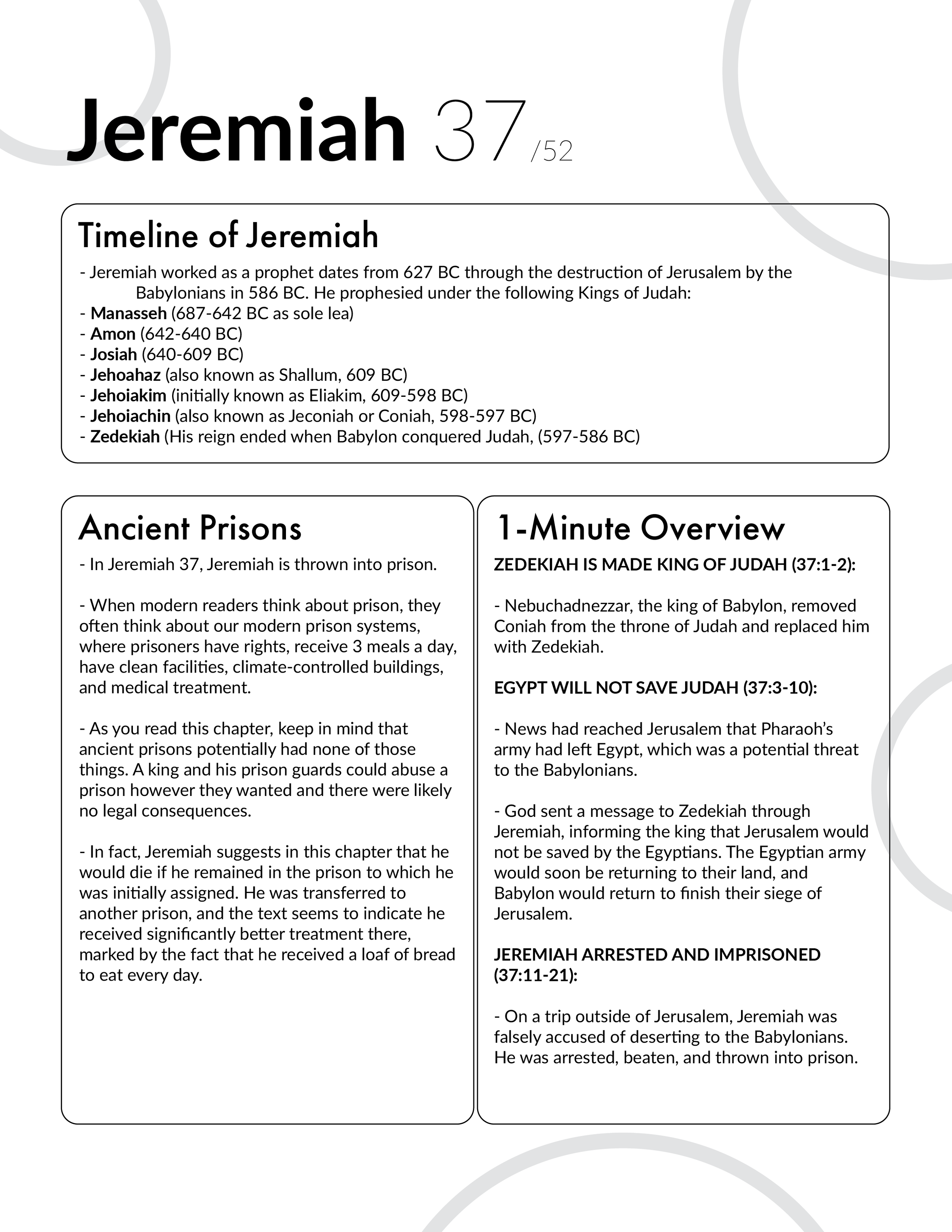
Jeremiah was a priest who lived in Anathoth (3 miles from Jerusalem). His ministry was directed towards the people of Judah, immediately before and during their exile in Babylon. His work as a prophet dates from 627 BC through the destruction of Jerusalem by the Babylonians in 586 BC.
Jeremiah is the longest book in the English Bible by word count. The book has 52 chapters.
Jeremiah prophesied under the following Kings of Judah:
Manasseh (687-642 BC)
Amos (642-640 BC)
Josiah (640-609 BC)
Jehoiakim (initially known as Eliakim, 609-598 BC)
Jehoiachin (also known as Jeconiah or Coniah, 598-597 BC)
Zedekiah (His reign ended when Babylon conquered Judah, (597-586 BC)
ANCIENT PRISONS:
In Jeremiah 37, Jeremiah is thrown into prison.
When modern readers think about prison, they often think about our modern prison systems, where prisoners have rights, receive 3 meals a day, have clean facilities, climate-controlled buildings, and medical treatment.
As you read this chapter, keep in mind that ancient prisons potentially had none of those things. A king and his prison guards could abuse a prison however they wanted and there were likely no legal consequences.
In fact, Jeremiah suggests in this chapter that he would die if he remained in the prison to which he was initially assigned. He was transferred to another prison, and the text seems to indicate he received significantly better treatment there, marked by the fact that he received a loaf of bread to eat every day.
OUTLINE:
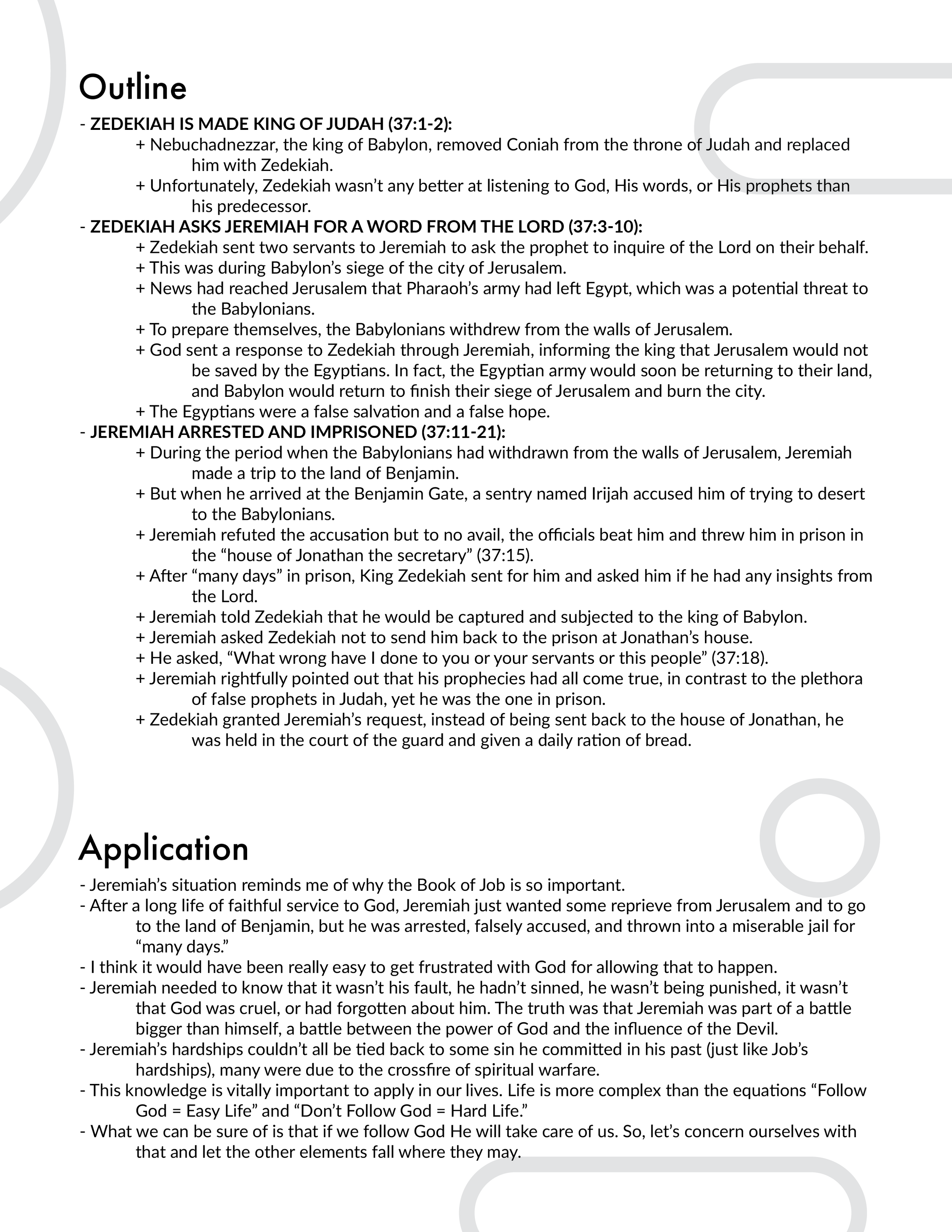
ZEDEKIAH IS MADE KING OF JUDAH (37:1-2):
Nebuchadnezzar, the king of Babylon, removed Coniah from the throne of Judah and replaced him with Zedekiah.
Unfortunately, Zedekiah wasn’t any better at listening to God, His words, or His prophets than his predecessor.
ZEDEKIAH ASKS JEREMIAH FOR A WORD FROM THE LORD (37:3-10):
Zedekiah sent two servants to Jeremiah to ask the prophet to inquire of the Lord on their behalf.
This was during Babylon’s siege of the city of Jerusalem.
News had reached Jerusalem that Pharaoh’s army had left Egypt, which was a potential threat to the Babylonians.
To prepare themselves, the Babylonians withdrew from the walls of Jerusalem.
God sent a response to Zedekiah through Jeremiah, informing the king that Jerusalem would not be saved by the Egyptians. In fact, the Egyptian army would soon be returning to their land, and Babylon would return to finish their siege of Jerusalem and burn the city.
The Egyptians were a false salvation and a false hope.
JEREMIAH ARRESTED AND IMPRISONED (37:11-21):
During the period when the Babylonians had withdrawn from the walls of Jerusalem, Jeremiah made a trip to the land of Benjamin.
But when he arrived at the Benjamin Gate, a sentry named Irijah accused him of trying to desert to the Babylonians.
Jeremiah refuted the accusation but to no avail, the officials beat him and threw him in prison in the “house of Jonathan the secretary” (37:15).
After “many days” in prison, King Zedekiah sent for him and asked him if he had any insights from the Lord.
Jeremiah told Zedekiah that he would be captured and subjected to the king of Babylon.
Jeremiah asked Zedekiah not to send him back to the prison at Jonathan’s house.
He asked, “What wrong have I done to you or your servants or this people” (37:18).
Jeremiah rightfully pointed out that his prophecies had all come true, in contrast to the plethora of false prophets in Judah, yet he was the one in prison.
Zedekiah granted Jeremiah’s request, instead of being sent back to the house of Jonathan, he was held in the court of the guard and given a daily ration of bread.
APPLICATION:
Jeremiah’s situation reminds me of why the Book of Job is so important.
After a long life of faithful service to God, Jeremiah just wanted some reprieve from Jerusalem and to go to the land of Benjamin, but he was arrested, falsely accused, and thrown into a miserable jail for “many days.”
I think it would have been really easy to get frustrated with God for allowing that to happen.
Jeremiah needed to know that it wasn’t his fault, he hadn’t sinned, he wasn’t being punished, it wasn’t that God was cruel, or had forgotten about him. The truth was that Jeremiah was part of a battle bigger than himself, a battle between the power of God and the influence of the Devil.
Jeremiah’s hardships couldn’t all be tied back to some sin he committed in his past (just like Job’s hardships), many were due to the crossfire of spiritual warfare.
This knowledge is vitally important to apply in our lives. Life is more complex than the equations “Follow God = Easy Life” and “Don’t Follow God = Hard Life.”
What we can be sure of is that if we follow God He will take care of us. So, let’s concern ourselves with that and let the other elements fall where they may.
