Jeremiah 48 - Bible Study, Explanation, and Application
Jeremiah 48 Bible Study
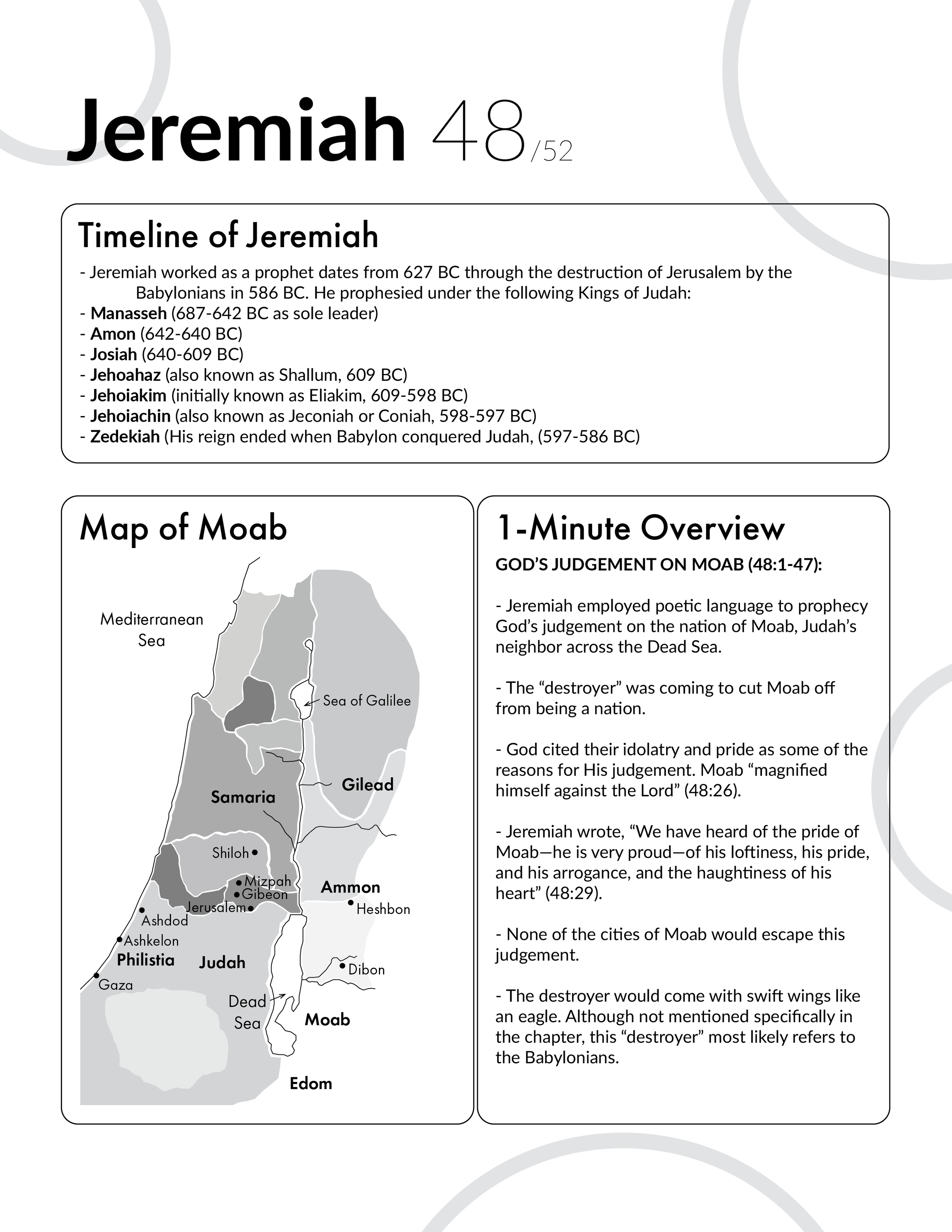
INTRO AND TIMELINE:
Jeremiah was a priest who lived in Anathoth (3 miles from Jerusalem). His ministry was directed towards the people of Judah, immediately before and during their exile in Babylon. His work as a prophet dates from 627 BC through the destruction of Jerusalem by the Babylonians in 586 BC.
Jeremiah is the longest book in the English Bible by word count. The book has 52 chapters.
Jeremiah prophesied under the following Kings of Judah:
Manasseh (687-642 BC)
Amos (642-640 BC)
Josiah (640-609 BC)
Jehoiakim (initially known as Eliakim, 609-598 BC)
Jehoiachin (also known as Jeconiah or Coniah, 598-597 BC)
Zedekiah (His reign ended when Babylon conquered Judah, (597-586 BC)
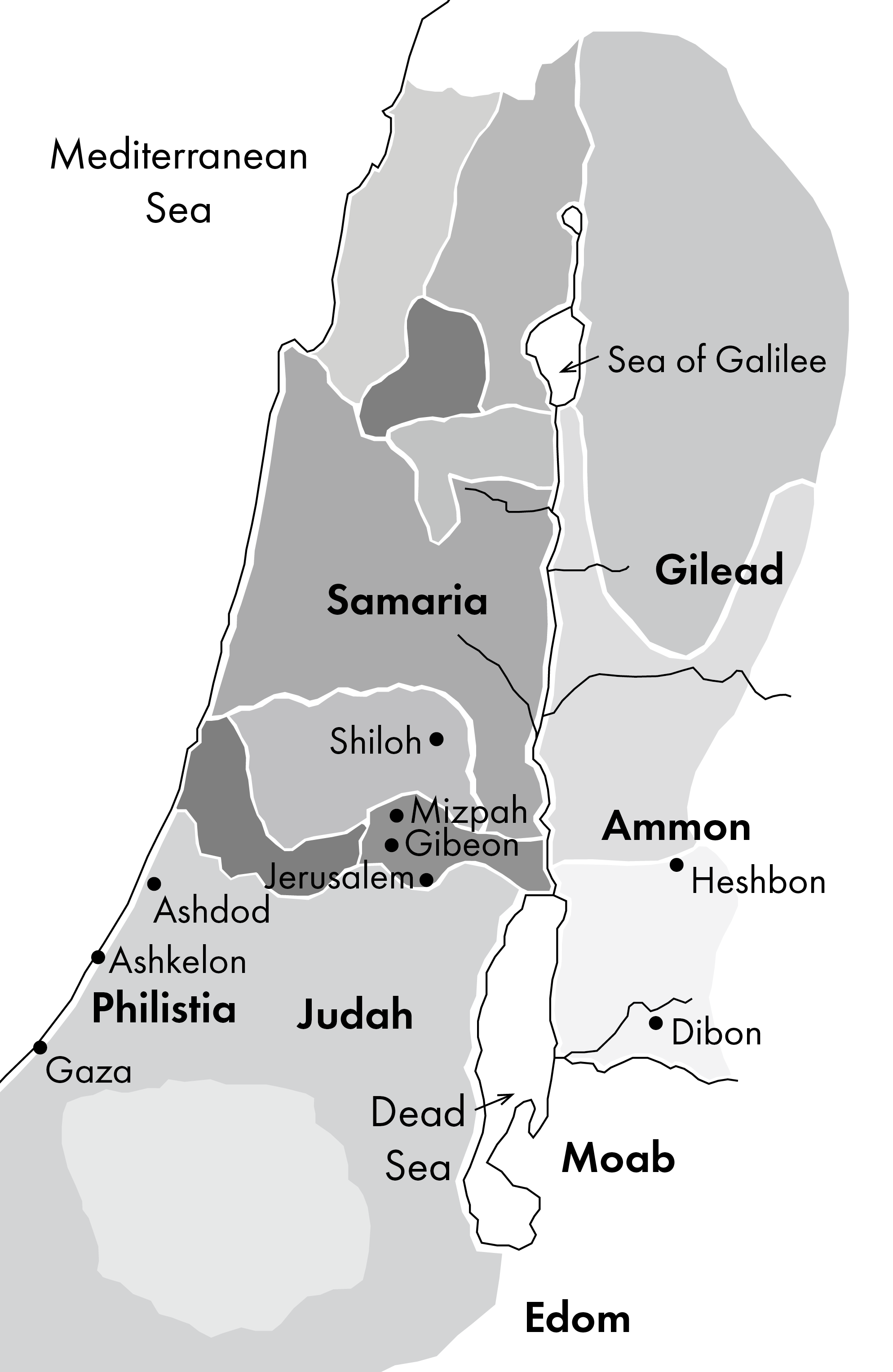
MAP OF MOAB - JEREMIAH 48:
OUTLINE:
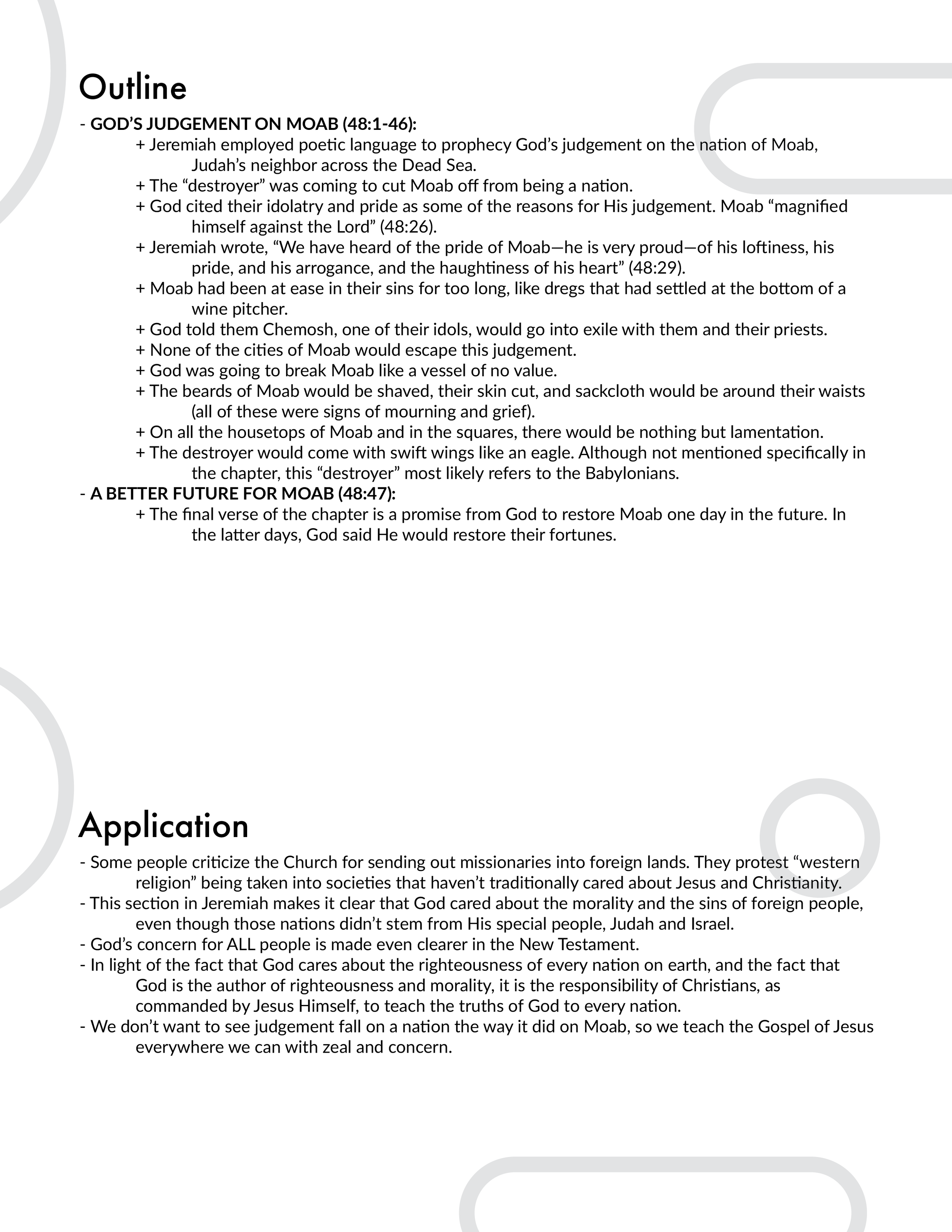
GOD’S JUDGEMENT ON MOAB (48:1-46):
Jeremiah employed poetic language to prophecy God’s judgement on the nation of Moab, Judah’s neighbor across the Dead Sea.
The “destroyer” was coming to cut Moab off from being a nation.
God cited their idolatry and pride as some of the reasons for His judgement. Moab “magnified himself against the Lord” (48:26).
Jeremiah wrote, “We have heard of the pride of Moab—he is very proud—of his loftiness, his pride, and his arrogance, and the haughtiness of his heart” (48:29).
Moab had been at ease in their sins for too long, like dregs that had settled at the bottom of a wine pitcher.
God told them Chemosh, one of their idols, would go into exile with them and their priests.
None of the cities of Moab would escape this judgement.
God was going to break Moab like a vessel of no value.
The beards of Moab would be shaved, their skin cut, and sackcloth would be around their waists (all of these were signs of mourning and grief).
On all the housetops of Moab and in the squares, there would be nothing but lamentation.
The destroyer would come with swift wings like an eagle. Although not mentioned specifically in the chapter, this “destroyer” most likely refers to the Babylonians.
A BETTER FUTURE FOR MOAB (48:47):
The final verse of the chapter is a promise from God to restore Moab one day in the future. In the latter days, God said He would restore their fortunes.
APPLICATION:
Some people criticize the Church for sending out missionaries into foreign lands. They protest “western religion” being taken into societies that haven’t traditionally cared about Jesus and Christianity.
This section in Jeremiah makes it clear that God cared about the morality and the sins of foreign people, even though those nations didn’t stem from His special people, Judah and Israel.
God’s concern for ALL people is made even clearer in the New Testament.
In light of the fact that God cares about the righteousness of every nation on earth, and the fact that God is the author of righteousness and morality, it is the responsibility of Christians, as commanded by Jesus Himself, to teach the truths of God to every nation.
We don’t want to see judgement fall on a nation the way it did on Moab, so we teach the Gospel of Jesus everywhere we can with zeal and concern.
