Jeremiah 8 - Bible Study, Explanation, and Application
Jeremiah 8 Bible Study
INTRO AND TIMELINE:
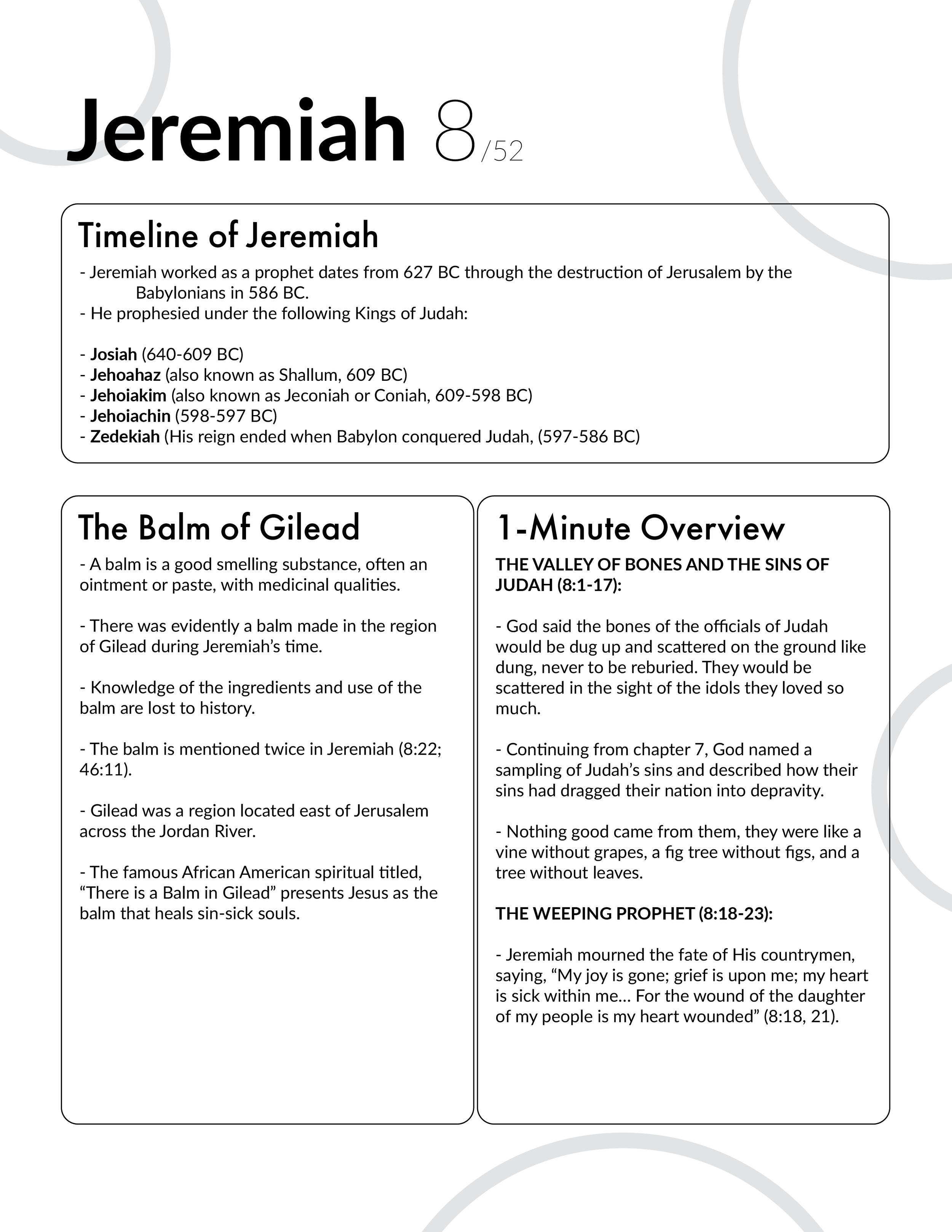
Jeremiah was a priest who lived in Anathoth (3 miles from Jerusalem). His ministry was directed towards the people of Judah, immediately before and during their exile in Babylon. His work as a prophet dates from 627 BC through the destruction of Jerusalem by the Babylonians in 586 BC.
Jeremiah is the longest book in the English Bible by word count. The book has 52 chapters.
Jeremiah prophesied under the following Kings of Judah:
Josiah (640-609 BC)
Jehoahaz (also known as Shallum, 609 BC)
Jehoiakim (also known as Jeconiah or Coniah, 609-598 BC)
Jehoiachin (598-597 BC)
Zedekiah (His reign ended when Babylon conquered Judah, (597-586 BC)
THE BALM OF GILEAD:
A balm is a good smelling substance, often an ointment or paste, with medicinal qualities.
There was evidently a balm made in the region of Gilead during Jeremiah’s time.
Knowledge of the ingredients and use of the balm are lost to history.
The balm is mentioned twice in Jeremiah (8:22; 46:11).
Gilead was a region located east of Jerusalem across the Jordan River.
The famous African American spiritual titled, “There is a Balm in Gilead” presents Jesus as the balm that heals sin-sick souls.
OUTLINE:
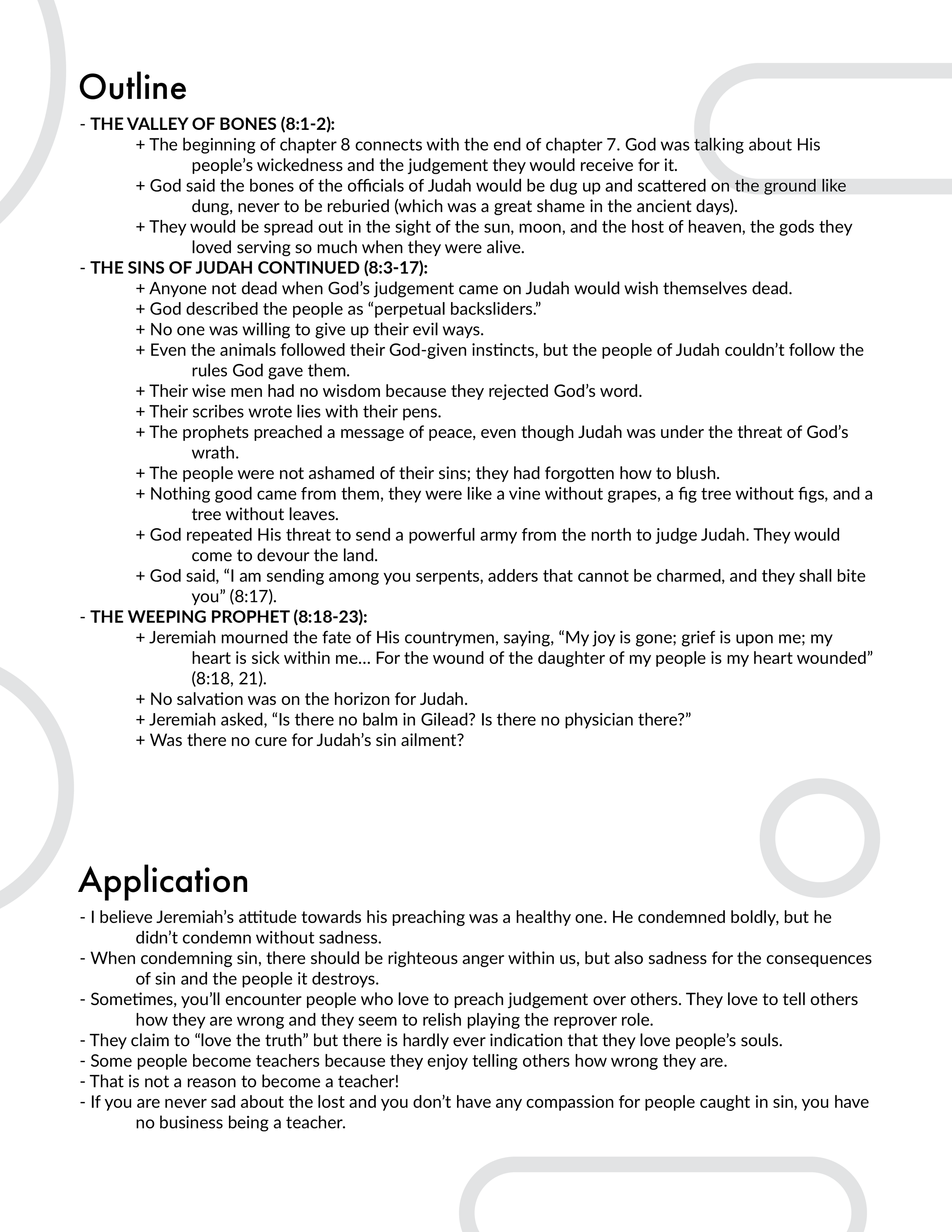
THE VALLEY OF BONES (8:1-2):
The beginning of chapter 8 connects with the end of chapter 7. God was talking about His people’s wickedness and the judgement they would receive for it.
God said the bones of the officials of Judah would be dug up and scattered on the ground like dung, never to be reburied (which was a great shame in the ancient days).
They would be spread out in the sight of the sun, moon, and the host of heaven, the gods they loved serving so much when they were alive.
THE SINS OF JUDAH CONTINUED (8:3-17):
Anyone not dead when God’s judgement came on Judah would wish themselves dead.
God described the people as “perpetual backsliders.”
No one was willing to give up their evil ways.
Even the animals followed their God-given instincts, but the people of Judah couldn’t follow the rules God gave them.
Their wise men had no wisdom because they rejected God’s word.
Their scribes wrote lies with their pens.
The prophets preached a message of peace, even though Judah was under the threat of God’s wrath.
The people were not ashamed of their sins; they had forgotten how to blush.
Nothing good came from them, they were like a vine without grapes, a fig tree without figs, and a tree without leaves.
God repeated His threat to send a powerful army from the north to judge Judah. They would come to devour the land.
God said, “I am sending among you serpents, adders that cannot be charmed, and they shall bite you” (8:17).
THE WEEPING PROPHET (18-23):
Jeremiah mourned the fate of His countrymen, saying, “My joy is gone; grief is upon me; my heart is sick within me… For the wound of the daughter of my people is my heart wounded” (8:18, 21).
No salvation was on the horizon for Judah.
Jeremiah asked, “Is there no balm in Gilead? Is there no physician there?”
Was there no cure for Judah’s sin ailment?
APPLICATION:
I believe Jeremiah’s attitude towards his preaching was a healthy one. He condemned boldly, but he didn’t condemn without sadness.
When condemning sin, there should be righteous anger within us, but also sadness for the consequences of sin and the people it destroys.
Sometimes, you’ll encounter people who love to preach judgement over others. They love to tell others how they are wrong and seem to relish playing the reprover role.
They claim to “love the truth” but there is hardly ever indication that they love people’s souls.
Some people become teachers because they enjoy telling others how wrong they are.
That is not a reason to become a teacher!
If you are never sad about the lost and you don’t have any compassion for people caught in sin, you have no business being a teacher.
