Jeremiah 7 - Bible Study, Explanation, and Application
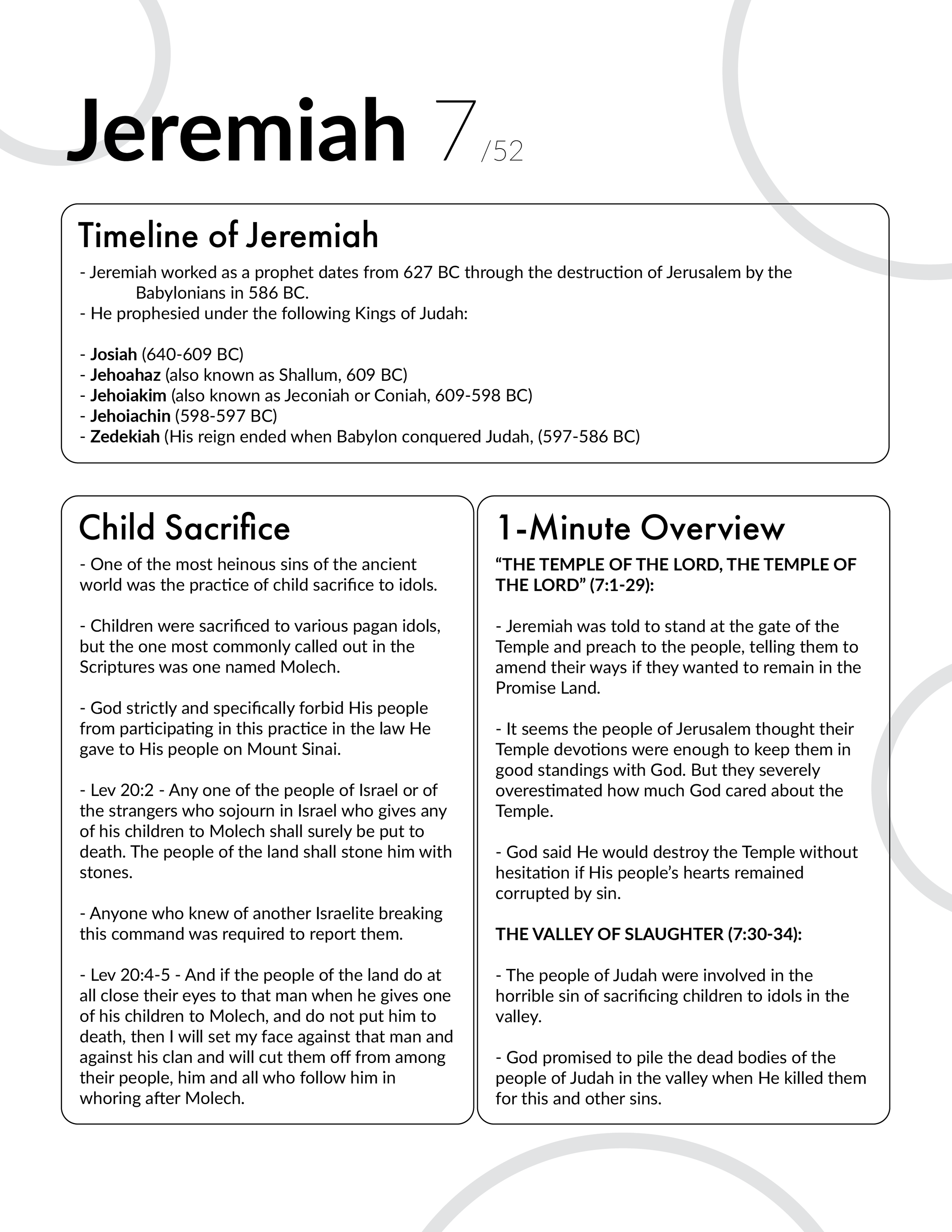
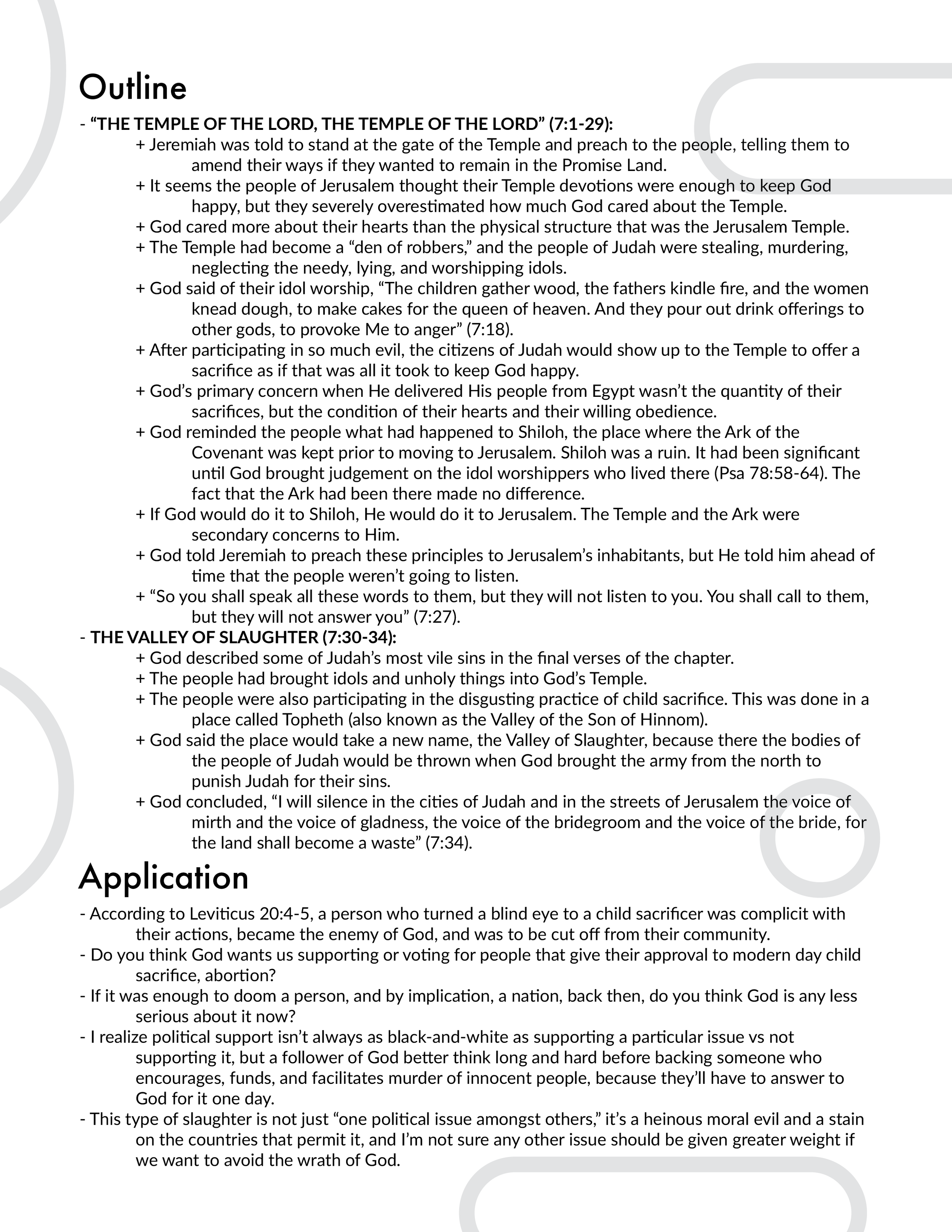
Jeremiah 7 Bible Study
INTRO AND TIMELINE:
Jeremiah was a priest who lived in Anathoth (3 miles from Jerusalem). His ministry was directed towards the people of Judah, immediately before and during their exile in Babylon. His work as a prophet dates from 627 BC through the destruction of Jerusalem by the Babylonians in 586 BC.
Jeremiah is the longest book in the English Bible by word count. The book has 52 chapters.
Jeremiah prophesied under the following Kings of Judah:
Josiah (640-609 BC)
Jehoahaz (also known as Shallum, 609 BC)
Jehoiakim (also known as Jeconiah or Coniah, 609-598 BC)
Jehoiachin (598-597 BC)
Zedekiah (His reign ended when Babylon conquered Judah, (597-586 BC)
CHILD SACRIFICE:
One of the most heinous sins of the ancient world was the practice of child sacrifice to idols.
Children were sacrificed to various pagan idols, but the one most commonly called out in the Scriptures was one named Molech.
God strictly and specifically forbid His people from participating in this practice in the law He gave to His people on Mount Sinai.
Lev 20:2 - Any one of the people of Israel or of the strangers who sojourn in Israel who gives any of his children to Molech shall surely be put to death. The people of the land shall stone him with stones.
Anyone who knew of another Israelite breaking this command was required to report them.
Lev 20:4-5 - And if the people of the land do at all close their eyes to that man when he gives one of his children to Molech, and do not put him to death, then I will set my face against that man and against his clan and will cut them off from among their people, him and all who follow him in whoring after Molech.
OUTLINE:
“THE TEMPLE OF THE LORD, THE TEMPLE OF THE LORD” (7:1-29):
Jeremiah was told to stand at the gate of the Temple and preach to the people, telling them to amend their ways if they wanted to remain in the Promise Land.
It seems the people of Jerusalem thought their Temple was enough to keep them in good standings with God. But they severely overestimated how much God cared about the Temple.
God cared more about the hearts of His people than the physical structure that was the Jerusalem Temple.
The Temple had become a “den of robbers,” and the people of Judah were stealing, murdering, neglecting the needy, lying, and worshipping idols.
God said of their idol worship, “The children gather wood, the fathers kindle fire, and the women knead dough, to make cakes for the queen of heaven. And they pour out drink offerings to other gods, to provoke Me to anger” (7:18).
After participating in so much evil, the citizens of Judah would show up to the Temple to offer a sacrifice as if that was all it took to keep God happy.
God’s primary concern when He delivered His people from Egypt wasn’t the quantity of their sacrifices, but the condition of their hearts and their willing obedience.
God reminded the people what had happened to Shiloh, the place where the Ark of the Covenant was kept prior to moving to Jerusalem. Shiloh was a ruin. It had been significant until God brought judgement on the idol worshippers who lived there (Psa 78:58-64). The fact that the Ark had been there made no difference.
If God would do it to Shiloh, He would do it to Jerusalem. The Temple and the Ark were secondary concerns to Him.
God told Jeremiah to preach these principles to Jerusalem’s inhabitants, but He told him ahead of time that the people weren’t going to listen.
“So you shall speak all these words to them, but they will not listen to you. You shall call to them, but they will not answer you” (7:27).
THE VALLEY OF SLAUGHTER (7:30-34):
God described some of Judah’s most vile sins in the final verses of the chapter.
The people had brought idols and unholy things into God’s Temple.
The people were also participating in the disgusting practice of child sacrifice. This was done in a place called Topheth (also known as the Valley of the Son of Hinnom).
God said the place would take a new name, the Valley of Slaughter, because there the bodies of the people of Judah would be thrown when God brought the army from the north to punish Judah for their sins.
God concluded, “I will silence in the cities of Judah and in the streets of Jerusalem the voice of mirth and the voice of gladness, the voice of the bridegroom and the voice of the bride, for the land shall become a waste” (7:34).
APPLICATION:
According to Leviticus 20:4-5, a person who turned a blind eye to a child sacrificer was complicit with their actions, became the enemy of God, and was to be cut off from their community.
Do you think God wants us supporting or voting for people that give their approval to modern day child sacrifice, abortion?
If it was enough to doom a person, and by implication, a nation, back then, do you think God is any less serious about it now?
I realize political support isn’t always as black-and-white as supporting a particular issue vs not supporting it, but a follower of God better think long and hard before backing someone who encourages, funds, and facilitates murder of innocent people, because they’ll have to answer to God for it one day.
This type of slaughter is not just “one political issue amongst others,” it’s a heinous moral evil and a stain on the countries that permit it, and I’m not sure any other issue should be given greater weight if we want to avoid the wrath of God.
