Jeremiah 6 - Bible Study, Explanation, and Application
Jeremiah 6 Bible Study
INTRO AND TIMELINE:
Jeremiah was a priest who lived in Anathoth (3 miles from Jerusalem). His ministry was directed towards the people of Judah, immediately before and during their exile in Babylon. His work as a prophet dates from 627 BC through the destruction of Jerusalem by the Babylonians in 586 BC.
Jeremiah is the longest book in the English Bible by word count. The book has 52 chapters.
Jeremiah prophesied under the following Kings of Judah:
Josiah (640-609 BC)
Jehoahaz (also known as Shallum, 609 BC)
Jehoiakim (also known as Jeconiah or Coniah, 609-598 BC)
Jehoiachin (598-597 BC)
Zedekiah (His reign ended when Babylon conquered Judah, (597-586 BC)
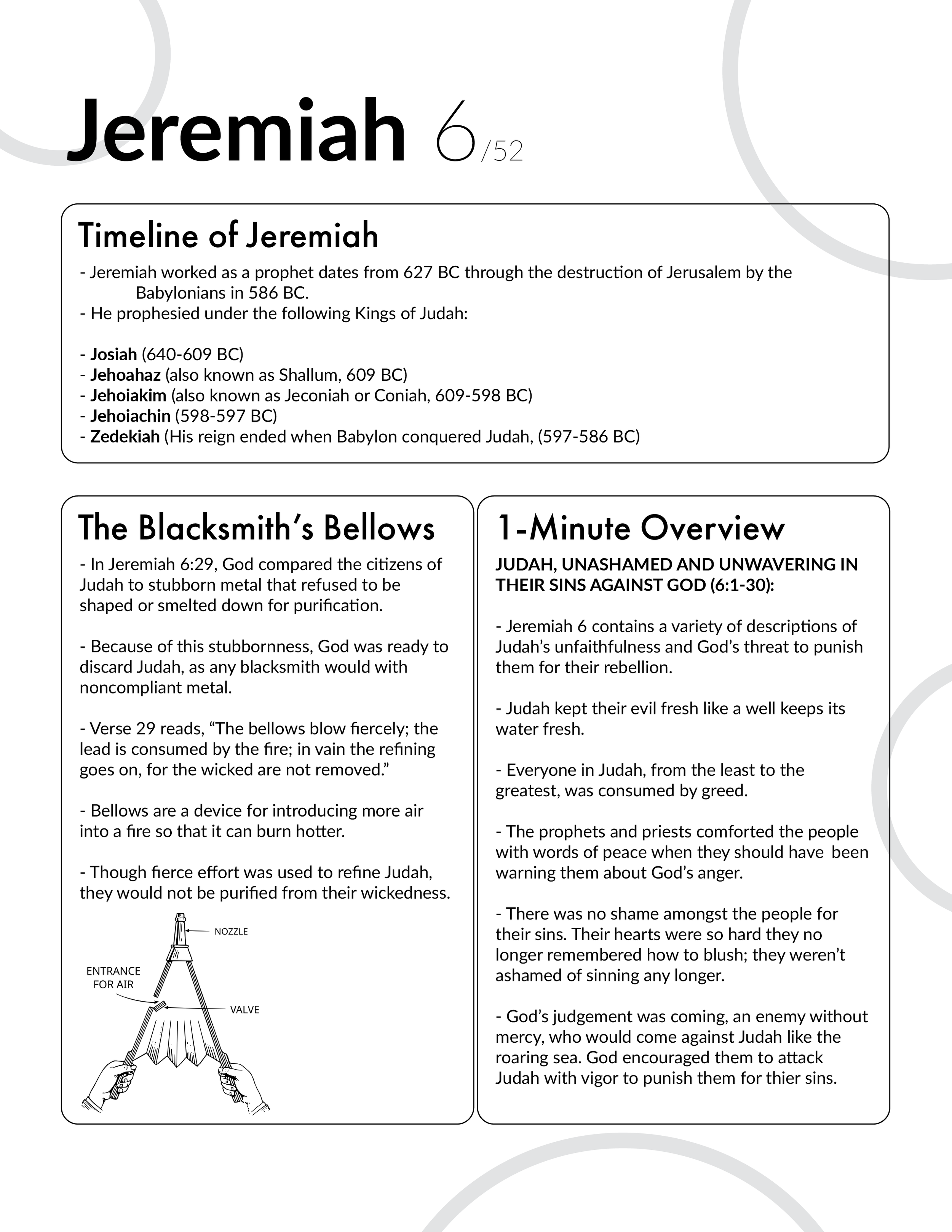
THE BLACKSMITH’S BELLOWS:
In Jeremiah 6:29, God compared the citizens of Judah to stubborn metal that refused to be shaped or smelted down for purification.
Because of this stubbornness, God was ready to discard Judah, as any blacksmith would with noncompliant metal.
Verse 29 reads, “The bellows blow fiercely; the lead is consumed by the fire; in vain the refining goes on, for the wicked are not removed.”
Bellows are a device for introducing more air into a fire so that it can burn hotter.
Though fierce effort was used to refine Judah, they would not be purified from their wickedness.

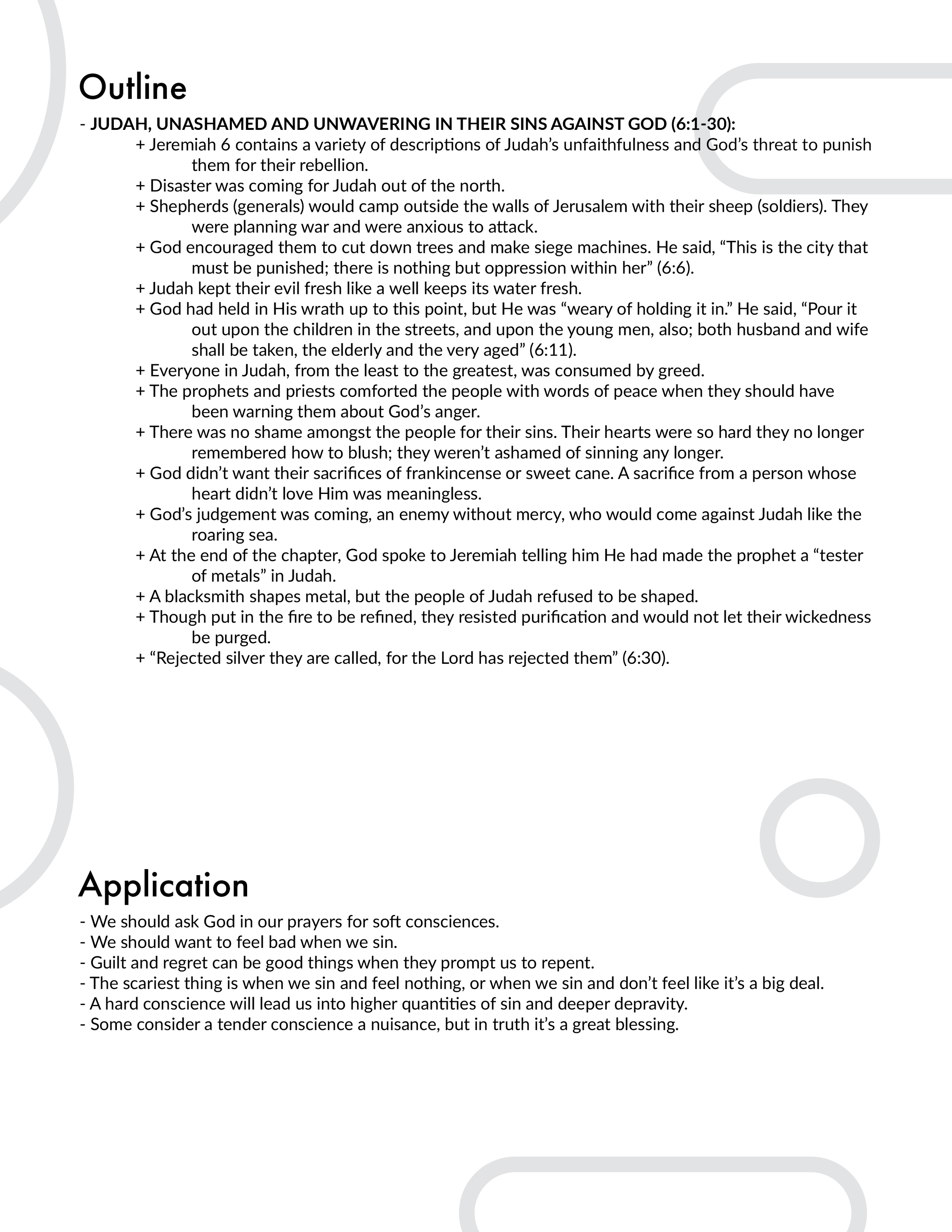
OUTLINE:
JUDAH, UNASHAMED AND UNWAVERING IN THEIR SINS AGAINST GOD (6:1-30):
Jeremiah 6 contains a variety of descriptions of Judah’s unfaithfulness and God’s threat to punish them for their rebellion.
Disaster was coming for Judah out of the north.
Shepherds (generals) would camp outside the walls of Jerusalem with their sheep (soldiers). They were planning war and were anxious to attack.
God encouraged them to cut down trees and make siege machines. He said, “This is the city that must be punished; there is nothing but oppression within her” (6:6).
Judah kept their evil fresh like a well keeps its water fresh.
God had held in His wrath up to this point, but He was “weary of holding it in.” He said, “Pour it out upon the children in the streets, and upon the young men, also; both husband and wife shall be taken, the elderly and the very aged” (6:11).
Everyone in Judah, from the least to the greatest, was consumed by greed.
The prophets and priests comforted the people with words of peace when they should have been warning them about God’s anger.
There was no shame amongst the people for their sins. Their hearts were so hard they no longer remembered how to blush; they weren’t ashamed of sinning any longer.
God didn’t want their sacrifices of frankincense or sweet cane. A sacrifice from a person whose heart didn’t love Him was meaningless.
God’s judgement was coming, an enemy without mercy, who would come against Judah like the roaring sea.
At the end of the chapter, God spoke to Jeremiah telling him He had made the prophet a “tester of metals” in Judah.
A blacksmith shapes metal, but the people of Judah refused to be shaped.
Though put in the fire to be refined, they resisted purification and would not let their wickedness be purged.
“Rejected silver they are called, for the Lord has rejected them” (6:30).
APPLICATION:
We should ask God in our prayers for soft consciences.
We should want to feel bad when we sin.
Guilt and regret can be good things when they prompt us to repent.
The scariest thing is when we sin and feel nothing, or when we sin and don’t feel like it’s a big deal.
A hard conscience will lead us into higher quantities of sin and deeper depravity.
Some consider a tender conscience a nuisance, but in truth it’s a great blessing.
