Joel 2 Bible Study
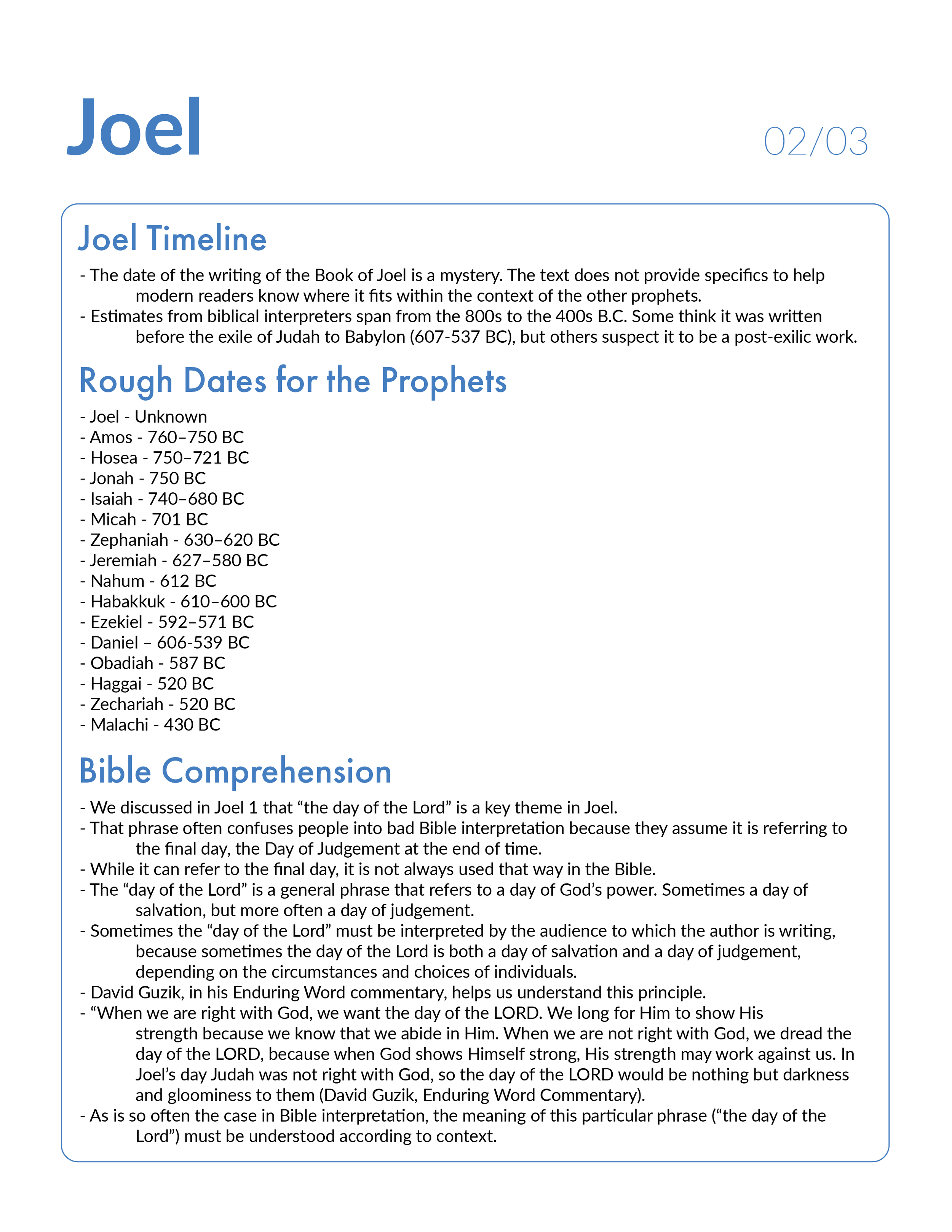
JOEL TIMELINE:
The date of the writing of the Book of Joel is a mystery. The text does not provide specifics to help modern readers know where it fits within the context of the other prophets.
Estimates from biblical interpreters span from the 800s to the 400s B.C. Some think it was written before the exile of Judah to Babylon (607-537 BC), but others suspect it to be a post-exilic work.
ROUGH DATES FOR THE PROPHETS:
Joel - Unknown
Amos - 760–750 BC
Hosea - 750–721 BC
Jonah - 750 BC
Isaiah - 740–680 BC
Micah - 701 BC
Zephaniah - 630–620 BC
Jeremiah - 627–580 BC
Nahum - 612 BC
Habakkuk - 610–600 BC
Ezekiel - 592–571 BC
Daniel – 606-539 BC
Obadiah - 587 BC
Haggai - 520 BC
Zechariah - 520 BC
Malachi - 430 BC
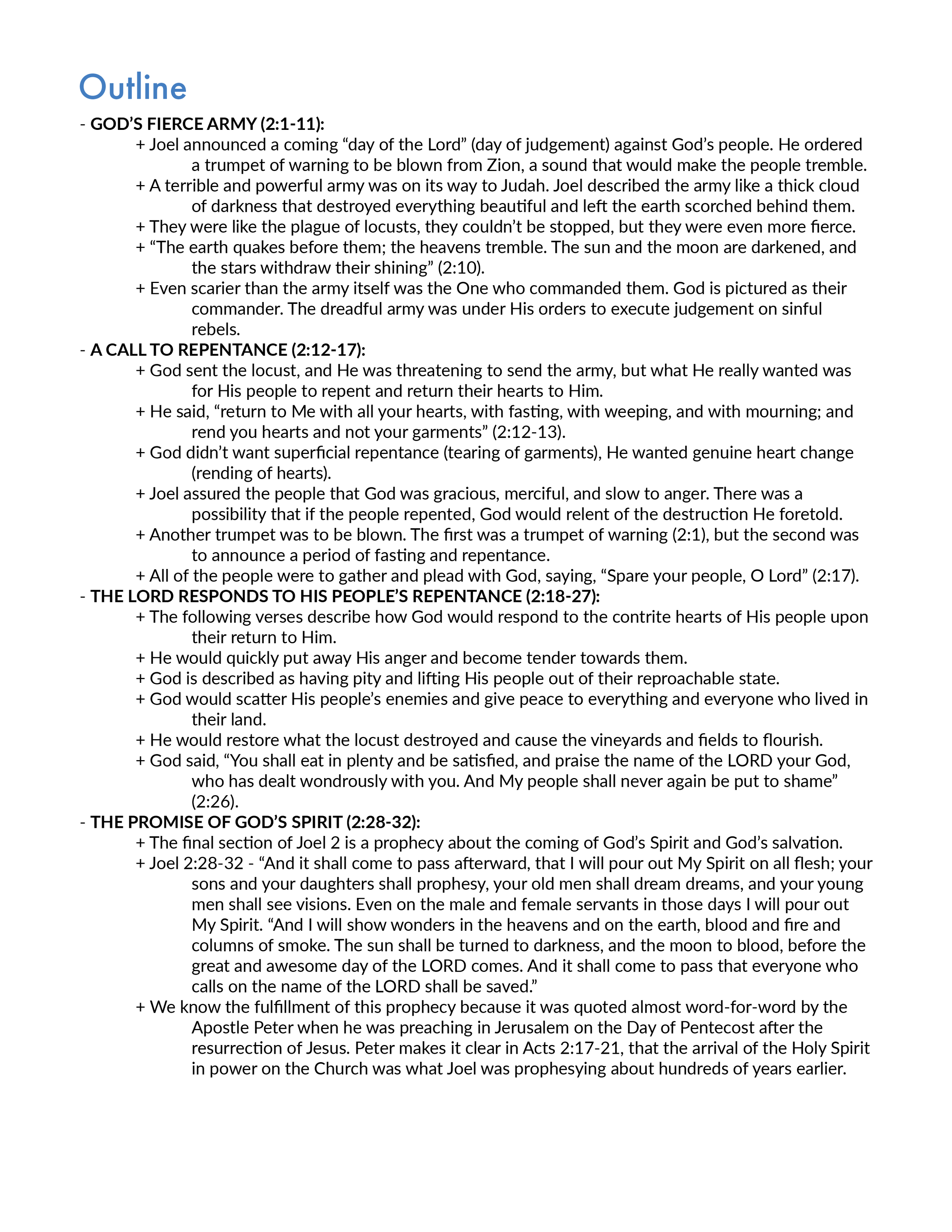
OUTLINE:
GOD’S FIERCE ARMY (2:1-11):
Joel announced a coming “day of the Lord” (day of judgement) against God’s people. He ordered a trumpet of warning to be blown from Zion, a sound that would make the people tremble.
A terrible and powerful army was on its way to Judah. Joel described the army like a thick cloud of darkness that destroyed everything beautiful and left the earth scorched behind them.
They were like the plague of locusts, they couldn’t be stopped, but they were even more fierce.
“The earth quakes before them; the heavens tremble. The sun and the moon are darkened, and the stars withdraw their shining” (2:10).
Even scarier than the army itself was the One who commanded them. God is pictured as their commander. The dreadful army was under His orders to execute judgement on sinful rebels.
A CALL TO REPENTANCE (2:12-17):
God sent the locust, and He was threatening to send the army, but what He really wanted was for His people to repent and return their hearts to Him.
He said, “return to Me with all your hearts, with fasting, with weeping, and with mourning; and rend you hearts and not your garments” (2:12-13).
God didn’t want superficial repentance (tearing of garments), He wanted genuine heart change (rending of hearts).
Joel assured the people that God was gracious, merciful, and slow to anger. There was a possibility that if the people repented, God would relent of the destruction He foretold.
Another trumpet was to be blown. The first was a trumpet of warning (2:1), but the second was to announce a period of fasting and repentance.
All of the people were to gather and plead with God, saying, “Spare your people, O Lord” (2:17).
THE LORD RESPONDS TO HIS PEOPLE’S REPENTANCE (2:18-27):
The following verses describe how God would respond to the contrite hearts of His people upon their return to Him.
He would quickly put away His anger and become tender towards them.
God is described as having pity and lifting His people out of their reproachable state.
God would scatter His people’s enemies and give peace to everything and everyone who lived in their land.
He would restore what the locust destroyed and cause the vineyards and fields to flourish.
God said, “You shall eat in plenty and be satisfied, and praise the name of the LORD your God, who has dealt wondrously with you. And My people shall never again be put to shame” (2:26).
THE PROMISE OF GOD’S SPIRIT (2:28-32):
The final section of Joel 2 is a prophecy about the coming of God’s Spirit and God’s salvation.
Joel 2:28-32 - “And it shall come to pass afterward, that I will pour out My Spirit on all flesh; your sons and your daughters shall prophesy, your old men shall dream dreams, and your young men shall see visions. Even on the male and female servants in those days I will pour out My Spirit. “And I will show wonders in the heavens and on the earth, blood and fire and columns of smoke. The sun shall be turned to darkness, and the moon to blood, before the great and awesome day of the LORD comes. And it shall come to pass that everyone who calls on the name of the LORD shall be saved.”
We know the fulfillment of this prophecy because it was quoted almost word-for-word by the Apostle Peter when he was preaching in Jerusalem on the Day of Pentecost after the resurrection of Jesus. Peter makes it clear in Acts 2:17-21, that the arrival of the Holy Spirit in power on the Church was what Joel was prophesying about hundreds of years earlier.
APPLICATION:
We discussed in Joel 1 that “the day of the Lord” is a key theme in Joel.
That phrase often confuses people into bad Bible interpretation because they assume it is referring to the final day, the Day of Judgement at the end of time.
While it can refer to the final day, it is not always used that way in the Bible.
The “day of the Lord” is a general phrase that refers to a day of God’s power. Sometimes a day of salvation, but more often a day of judgement.
Sometimes the “day of the Lord” must be interpreted by the audience to which the author is writing, because sometimes the day of the Lord is both a day of salvation and a day of judgement, depending on the circumstances and choices of individuals.
David Guzik, in his Enduring Word commentary, helps us understand this principle.
“When we are right with God, we want the day of the LORD. We long for Him to show His strength because we know that we abide in Him. When we are not right with God, we dread the day of the LORD, because when God shows Himself strong, His strength may work against us. In Joel’s day Judah was not right with God, so the day of the LORD would be nothing but darkness and gloominess to them (David Guzik, Enduring Word Commentary).
As is so often the case in Bible interpretation, the meaning of this particular phrase (“the day of the Lord”) must be understood according to context.
